What Is an AI Agent? A Complete Guide to Core Architecture and Enterprise Implementation Challenges

A comprehensive breakdown of AI Agent architecture, core components, and why enterprise deployment remains challenging.
This article explains what AI Agents are, tracing the concept from its academic origins to today's LLM-based implementations. It covers the three-part architecture (perception, brain, action), four core components (LLM, memory, planning, tools), their varying maturity levels, and the essential differences between chatbots, AI assistants, and true agents—revealing why Agent engineering remains a critical challenge.
Why "Agent" Is Translated as "Intelligent Entity" in Chinese
If you look up the dictionary, the direct translation of "Agent" in Chinese would be "proxy" (代理). But in the field of artificial intelligence, this translation is clearly inadequate. "Proxy" only conveys the meaning of "a tool that does things on behalf of others," failing to express the core trait of an Agent—independently and autonomously completing designated tasks in a goal-oriented manner.
That's why in classic works like Artificial Intelligence: A Modern Approach, AI Agent is translated as "智能体" (intelligent entity)—an independent individual capable of perceiving its environment, making decisions autonomously, and ultimately achieving its goals. This translation better aligns with how the AI field defines and envisions Agents. Artificial Intelligence: A Modern Approach, co-authored by Stuart Russell and Peter Norvig, has been used as an AI textbook by over 1,500 universities worldwide since its first edition in 1995 and is widely recognized as one of the most authoritative textbooks in artificial intelligence. The book systematically establishes the Agent as the core abstraction in AI research, defining multiple levels from simple reflex agents to utility-based agents, providing a unified theoretical framework for the entire AI discipline.
It's worth noting that the concept of Agent is nothing new. Related papers were published as early as 1995, giving it over thirty years of history. It has never been just a theoretical concept confined to papers—it has always been supported by substantial real-world applications.
Agents in the Broad Sense: They're Everywhere
Artificial Intelligence: A Modern Approach provides a fairly broad academic definition: anything that can perceive its environment through sensors and act upon that environment through actuators can be called an agent. Simply put, as long as something possesses the two capabilities of "perceiving the environment" and "changing the environment," it qualifies as an agent.
From this perspective, agents are actually all around us:
- Autonomous driving: Perceives road conditions, makes acceleration or braking decisions, thereby changing the traffic environment.
- Robot vacuums: Determines navigation routes and cleaning intensity based on terrain and floor cleanliness.
- Smart home systems: Automatically adjusts device switches based on temperature, humidity, and light.
- Game AI: Like AI opponents in Honor of Kings, which make responsive decisions based on player behavior.
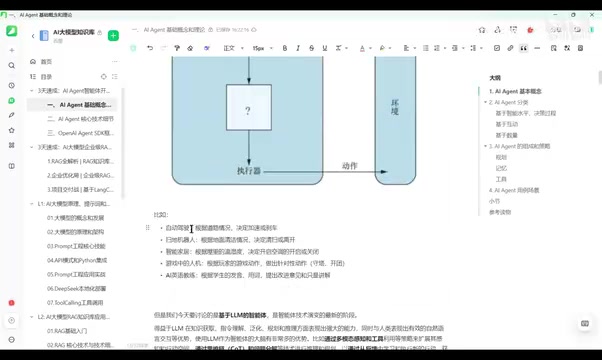
These examples all fit the broad definition of an Agent—they can both perceive and change their environment. However, it's important to clarify that this is a fairly broad and longstanding concept that doesn't entirely align with the AI Agents being hotly discussed today.
Agents in the Era of Large Models
The agents we discuss today are primarily built on Large Language Models (LLMs), such as Agents constructed around models like DeepSeekAd, GPT, and others.
Why are large models so well-suited to serve as the "brain" of an agent? There are two major advantages:
Powerful Cognitive Abilities
Large models' capabilities in knowledge acquisition, content comprehension, and planning/reasoning are well demonstrated. A typical example: someone described their symptoms to DeepSeek, and when they showed the analysis to a doctor, it was highly consistent with the doctor's own assessment. This demonstrates that large models' cognitive reasoning capabilities have indeed reached a remarkably high level. This capability stems from the massive amount of knowledge absorbed from text during pre-training, further enhanced through instruction fine-tuning and Reinforcement Learning from Human Feedback (RLHF) to improve reasoning and instruction-following abilities.
Natural Human-Machine Interaction Advantages
Another key advantage of large models lies in human-machine interaction. Multimodal models can understand text, images, video, and audio, and can also generate various forms of content that humans easily understand. They are inherently designed to facilitate communication between machines and humans, rather than efficient machine-to-machine communication. This gives them a natural advantage in building agents. Multimodal large models (such as GPT-4o, Gemini, etc.) use a unified Transformer architecture to map information from different modalities into a shared semantic space, enabling cross-modal understanding and generation—achieving complex interaction scenarios like "describing images" and "understanding audio."
Furthermore, large models can learn and improve through feedback—tasks they originally weren't good at can be gradually improved through training. This growth potential makes Agents even more promising.
Core Component Architecture of an Agent
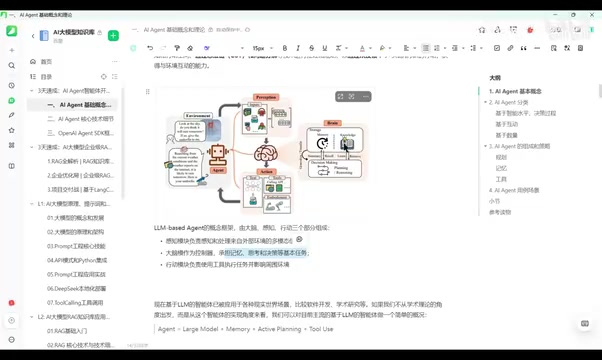
A survey paper on Agents published by a Fudan University team systematically organized LLM-based Agents, abstracting them into three major parts: Perception, Brain, and Action. This paper, A Survey on Large Language Model based Autonomous Agents, was published in 2023 by Fudan University's NLP team, authored by Wang Lei et al. It has become one of the most cited survey papers in the field, providing an important theoretical framework for subsequent Agent research and engineering practice.
- Perception Module: Responsible for gathering information. Since it's based on large models, information like images, video, audio, and text is converted into vectors (a data format that large models can understand). Vectors refer to the process of converting unstructured data into high-dimensional numerical arrays, also known as embeddings. Large models process these vectors through the attention mechanism in the Transformer architecture, where each token is mapped to a vector representation of hundreds to thousands of dimensions. The model understands semantic relationships by computing similarity between vectors. This unified numerical representation allows multimodal information to be processed and compared within the same semantic space.
- Brain Module: Responsible for thinking, decision-making, and reasoning. This includes short-term memory (such as recent conversation context) and long-term memory (such as knowledge bases). With memory support, decisions become more specialized and accurate.
- Action Module: Puts decisions into practice by invoking tools to change the external environment.
The paper includes a classic example: a user asks, "Check if it's going to rain, and if so, get my umbrella ready." The Agent collects information through images, weather forecasts, and satellite cloud maps (perception), makes a comprehensive judgment about whether it will rain (brain decision), and if it will rain, uses a robotic arm to bring the umbrella (action). This is the complete working loop of an Agent.
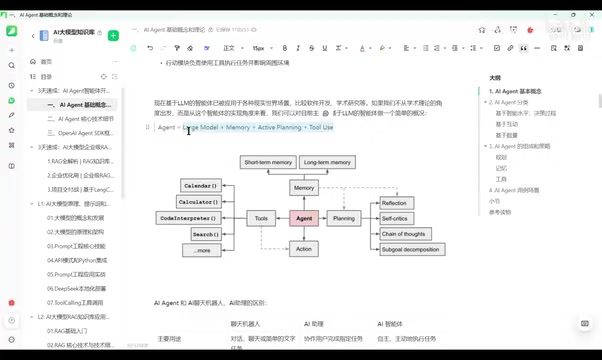
From a practical development perspective, an LLM-based Agent typically consists of four core components:
- Large Model — The core engine responsible for reasoning and decision-making
- Memory — Divided into short-term memory (RAM/files) and long-term memory (databases, especially vector databases). Vector databases (such as Pinecone, Milvus, Weaviate, etc.) are specifically designed for storing and retrieving high-dimensional vector data, supporting Approximate Nearest Neighbor (ANN) search based on semantic similarity. When an Agent needs to recall relevant knowledge, it retrieves the most relevant information by computing cosine similarity between the current query and stored vectors—this is the core principle behind Retrieval-Augmented Generation (RAG). Compared to exact matching in traditional relational databases, vector databases enable "fuzzy" semantic-level retrieval.
- Planning Capability — Task decomposition and solution strategies. Current mainstream planning methods include Chain of Thought, Tree of Thoughts, ReAct (alternating reasoning and action), and other frameworks that enable large models to progressively decompose complex goals into executable sub-task sequences.
- Tools — From function calls to API calls, to more mature protocol approaches like MCP and A2A. MCP (Model Context Protocol) is an open protocol proposed by Anthropic in late 2024, aimed at standardizing the connection between large models and external tools/data sources—similar to providing a unified "USB port" standard for AI applications. The A2A (Agent-to-Agent) protocol, proposed by Google in 2025, focuses on solving communication and collaboration problems between different Agents, defining standardized processes for Agent capability discovery, task delegation, state synchronization, and more. These two protocols represent an important trend of the Agent tool ecosystem moving from fragmentation toward standardization, though they are still in early adoption stages.
Understanding Agent Development Challenges Through Maturity Levels
These four components vary greatly in maturity, which explains why companies are still actively hiring Agent engineers.
Large models and memory are relatively mature. There are numerous open-source or paid large models and multimodal models available for direct use; memory is also supported by mature products like relational databases and vector databases. These two areas are typically provided as infrastructure by large companies, making individual development extremely costly. Take large models as an example: training a frontier large model requires thousands of GPUs, millions of dollars in compute investment, and TB-scale high-quality training data. These barriers make large models more suitable to be called as infrastructure rather than built from scratch.
Planning capability and tools are far from mature. Planning capability currently lacks independent, mature products and remains in an exploratory and iterative phase. Current challenges include: large models being prone to hallucinations and logical jumps during multi-step reasoning, insufficient reliability in long-term planning, and lack of universal standards for task decomposition strategies. While tools can be developed as independent products, they come in too many varieties with non-unified functionality and usage—much like how everyone's toolbox contains different tools.
This means that in actual Agent development and deployment, planning and tools often require customization based on specific business needs, accounting for a large proportion of the work. Theoretical papers and off-the-shelf products cannot be directly applied to specific business scenarios—this is the fundamental reason why demand for Agent engineers remains strong.
The Essential Differences Between Chatbots, AI Assistants, and AI Agents
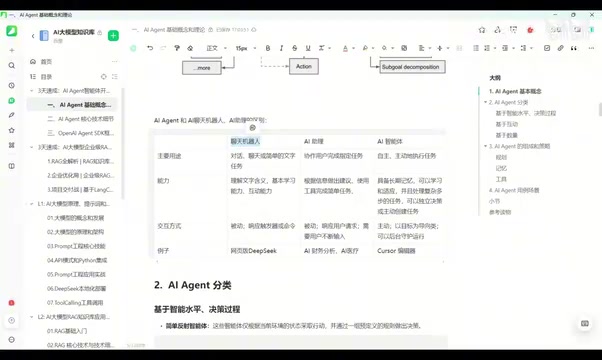
Many people ask: I'm already using large models like DeepSeek and GPT—why emphasize Agents? Here's a clear comparison across three levels:
Chatbots: Passive Text Interaction
The most basic form, like the web versions of DeepSeek and GPT, primarily used for text communication, conversation, and article generation. Their capability is limited to text output and is passive—if you don't engage them, they stop working. From a technical perspective, chatbots are essentially stateless (or short-state) request-response systems that don't proactively trigger any subsequent behavior after a conversation ends.
AI Assistants: Passive Response with Tool Augmentation
By integrating a series of tools via APIs, AI can complete tasks beyond text, such as turning on lights, querying databases, or analyzing reports. Financial data analysis and AI-assisted medical diagnosis belong to this level. But the essence hasn't changed—they remain passive responders in an assistive role. The final decisions in data analysis and the responsibility in medical diagnosis still rest with humans. Typical examples include OpenAI's GPT Actions and various enterprise Copilot products, which use Function Calling mechanisms to let the model invoke external APIs, but the trigger timing and final decision-making authority remain in the user's hands.
AI Agents: From Passive to Proactive
The defining characteristic of a true agent is autonomous proactivity. It is goal-oriented, capable of independently discovering needs, decomposing tasks, executing tasks, evaluating completion status, and following up or improving subsequent tasks—all with minimal ongoing human involvement. The key technologies behind this autonomy include: Autonomous Loop—the Agent continuously perceives, thinks, and acts in a persistent running loop; Self-Reflection—the Agent can evaluate the effectiveness of its own actions and make adjustments; and Goal Decomposition—recursively breaking down high-level goals into executable atomic operations.
To support this proactivity, agents also possess long-term memory, trial-and-error learning capability, complex task decomposition ability, and the capacity for independent decision-making and proactive task creation.
Why Tech Giants Are Betting Big on Agents
To summarize agents in one sentence: an independent, autonomous individual capable of perceiving its environment and taking action based on goals. It has three core characteristics—independence and autonomy, goal-orientation, and environmental perception and response.
The current situation is: chatbots and AI assistants are already very mature in the engineering world; while AI agents have abundant excellent theoretical guidance from academic papers, the engineering world has not yet achieved the vision of "everyone can use them simply." Current mainstream Agent development frameworks like LangChain, AutoGen, CrewAI, etc., while lowering the development threshold, still face numerous challenges in production environments regarding stability, controllability, and observability—this remains a direction of continuous iteration in the field.
What's missing is precisely—the step of translating academic theory into practical applications. This is exactly the strategic position that numerous companies are racing to capture. For developers looking to enter the field, understanding the concept of Agents, mastering their core component architecture, and recognizing the maturity differences among components is the first step into this domain.
Key Takeaways
Related articles

AI-Powered SRC Vulnerability Hunting: A Hands-On Guide to Building the Hermes Agent Workbench
Based on a hands-on Bilibili video: how to build an AI-powered SRC vulnerability hunting workbench—three-step method, four report elements, Agent mode vs web chat, and tool selection.

CLI-Anything Complete Beginner's Guide: How AI Operates Software — Principles and Practice
A complete beginner's guide to CLI-Anything: how AI Agents operate professional software via the command line, covering the three-layer architecture, CLI Hub installation, DrawIO practice, generator principles, and limits.

Carbon-X: A 14.8B Open-Source Model That Handles DNA and Text Simultaneously
Carbon-X is a 14.8B open-source multimodal model on Hugging Face where DNA and text share a token stream. 6-mer tokenization, 302B token mid-training, deployable on a single 80GB GPU, 66.7% average on five DNA benchmarks, Apache 2.0 license.