What Is DeepSeek Harness? Dissecting the 7 Core Modules of Agent Architecture

DeepSeek Harness is an Agent architecture paradigm where the model sets the floor but Harness sets the ceiling.
DeepSeek Harness is not just a product but a complete Agent architecture paradigm — the engineering system wrapped around large models. This article dissects its 7 core modules (tool calling, file system, sandbox, context management, memory, orchestration, and feedback loops), explaining why agents using the same model perform differently and why Harness engineering determines an agent's upper bound.
Starting with DeepSeek Harness: A Misunderstood Concept
DeepSeekAd's recent release of "Harness" has sparked widespread discussion in the developer community. Many people's first reaction is to treat it as a specific product, but if you understand it that way in an interview or technical discussion, you'll likely miss the point.
The word "Harness" itself refers to the complete set of equipment for a horse — reins, saddle, and all. Behind this naming lies a remarkably apt metaphor: Today's large models are already extremely powerful, like a wild horse, but no matter how strong a wild horse is, you can't ride it directly to get work done — you need to put reins and a saddle on it. And Harness is that complete engineering system wrapped around the model.
To understand why the "wild horse" metaphor is so fitting, you need to first appreciate DeepSeek's model capabilities. DeepSeek-V3 uses a Mixture-of-Experts (MoE) architecture with a total parameter count of 671B, but only activates approximately 37B parameters per inference, dramatically reducing computational costs while maintaining extremely high performance. DeepSeek-R1 achieves breakthroughs in reasoning ability, using reinforcement learning (RL) training to give the model Chain-of-Thought reasoning capabilities, approaching or even surpassing GPT-4-level performance on complex reasoning tasks like math and code. This raw "intellectual" power is precisely the premise for the Harness architecture's existence — the more capable the model, the more it needs a sophisticated engineering system to constrain and guide it.
It's worth noting that "harness" as a naming choice has deep roots in software engineering. The "test harness" in testing frameworks refers to the complete set of auxiliary infrastructure built around the code being tested — including input simulation, output capture, environment preparation, and more. DeepSeek's migration of this concept to the large model domain is essentially saying: the large model is like the core logic being tested, and the external engineering system is the "harness" that enables it to run controllably in real-world scenarios. This naming strategy both respects software engineering tradition and precisely conveys the architecture's core philosophy.
So the more accurate positioning of DeepSeek Harness is: an officially produced intelligent agent (Agent) product from DeepSeek that highly conforms to the Harness architecture paradigm. It is both a product and a practical demonstration of an architectural philosophy.
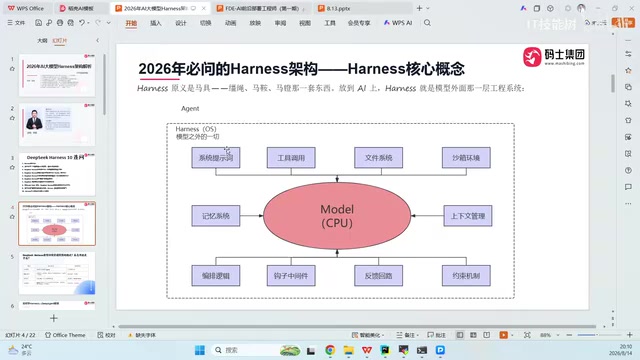
What Harness Really Is: The Engineering System Beyond the Model
To truly understand Harness, you need to look at it on two levels.
Broad Understanding: A Universal Agent Architecture Paradigm
In a broad sense, Harness is an intelligent agent architecture. It's not something DeepSeek invented — Claude Code, Codex, and various AI development frameworks you've used are all fundamentally applying this architecture. DeepSeek simply gave their implementation a name, explicitly telling the market: this is an agent that conforms to the Harness architecture.
The proposal of the Harness architecture didn't emerge from nothing — it's a natural result of AI Agent technology evolution. In early 2023, the AutoGPT project ignited the autonomous agent craze but quickly exposed the problem of lacking effective constraints and feedback mechanisms — Agents often fell into infinite loops or drifted off-task. Subsequently, BabyAGI, MetaGPT, and other projects gradually introduced task decomposition and role division mechanisms. In mid-2023, Anthropic's Claude conversation system and OpenAI's GPT-4 API Function Calling feature provided more reliable tool-calling infrastructure for Agents. By 2024, the maturation of the LangChain ecosystem, Microsoft's AutoGen multi-Agent collaboration framework, and CrewAI's role orchestration system collectively pushed Agent architecture toward engineering-oriented, modular approaches. The proposal of the Harness concept is essentially a summary and formalization of this evolutionary journey.
So what does this layer of "horse gear" specifically contain? At its core, it's a complete engineering system built around the model:
-
Tool Calling: Enabling the model to connect to external tools like file systems, terminals, Web Coding environments, and browsers. The technical foundation of tool calling stems from the Function Calling mechanism proposed by OpenAI in 2023: when generating responses, the model can output structured function call requests (including function names and parameters), which are executed by external systems that return results to the model. This mechanism evolved models from "can only generate text" to "can operate the external world." Current mainstream implementations include the ReAct (Reasoning + Acting) paradigm, Tool Use protocols, and more. The core idea of the ReAct paradigm is to have the model alternate between reasoning (Thought) and action (Action) during task execution, observing results (Observation) after each action before deciding the next step — highly similar to how humans solve problems. In concrete implementations, tool descriptions are typically provided to the model in JSON Schema format, including tool name, function description, parameter types, and constraints. Tool call requests generated by the model are parsed and routed by the Harness execution layer to the corresponding tool implementations. It's worth noting that tool calling reliability largely depends on the quality of tool descriptions — ambiguous descriptions lead to incorrect tool selection or wrong parameters, making this a critical engineering concern in Harness design. Both DeepSeek V3 and R1 series models natively support tool calling capabilities, providing the foundational support for Harness architecture implementation.
-
Memory System: Large models inherently have no memory — they forget what was asked in the previous sentence. Harness is responsible for recording the context of agent-model interactions. From a technical implementation perspective, memory systems are typically divided into three layers: short-term memory (the current conversation's context window, limited by tokens), working memory (maintaining key information within a single session through summarization and compression techniques), and long-term memory (persistent cross-session storage, usually implemented via vector databases for semantic retrieval). The core technology of long-term memory systems relies on Vector Databases and semantic retrieval: text is converted to high-dimensional vectors through embedding models (such as OpenAI's text-embedding-3-large or open-source BGE series) and stored in dedicated vector databases; during retrieval, the query is similarly converted to a vector, and the most semantically similar document fragments are found through Approximate Nearest Neighbor (ANN) search algorithms. Mainstream vector databases include Pinecone (cloud-native), Milvus (open-source distributed), Weaviate (supports hybrid search), and Chroma (lightweight embedded). RAG (Retrieval-Augmented Generation) technology can also be viewed as an external memory mechanism — it injects relevant document fragments into context through retrieval, compensating for the model's knowledge timeliness and specialization gaps. In RAG scenarios, retrieval quality directly affects generation quality, so document chunking strategy, embedding model selection, and whether to adopt hybrid retrieval (weighted fusion of vector retrieval + keyword retrieval) are all critical engineering decisions affecting system performance.
-
Context Management: Determining the model's capability boundaries and information organization methods
-
Feedback Loop: How to retry and fall back on errors, and under what circumstances to hand off to human processing
-
Constraint Mechanisms & Sandbox Environments: Ensuring execution safety and controllability. A Sandbox is a classic concept in operating systems and security, referring to running untrusted code in an isolated environment to prevent it from affecting the host system. In Agent architecture, sandboxing is particularly critical — because agents may execute arbitrary code, modify files, or initiate network requests. Common sandbox implementations include: containerization technology (Docker), virtual machines (such as gVisor, Firecracker micro-VMs), WebAssembly sandboxes, and more. Sandbox design needs to balance security with functionality: too strict limits agent capabilities, too loose poses security risks.
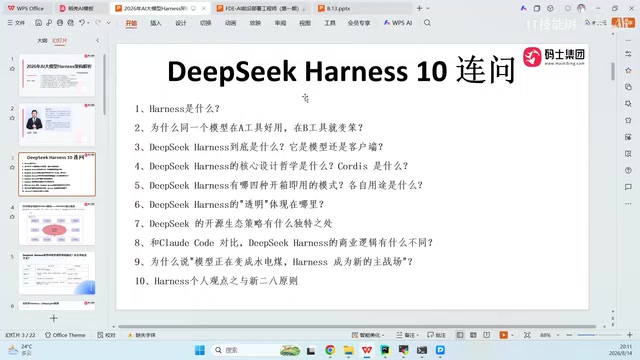
One-Sentence Summary: The Model Handles Judgment, Harness Handles Everything Else
Using a computer analogy: The model is like the CPU, responsible for judgment and computation; Harness handles everything except computation. This division is crucial — it directly explains why developers diverge onto two completely different technical paths. If you focus on the model itself, that's the algorithms direction; if you build upper-layer applications, you're inevitably on the Harness path.
Why Does the Same Model Seem "Dumber" When You Switch Tools?
This is the most worth exploring point, and a genuine confusion for many developers: We're both using DeepSeek, so why does someone else's agent seem smart while mine seems dumb?
The answer lies not in the model, but in the Harness.
Imagine two agents: Agent A has a quality memory system, precise tool calling, good context management, and constraint mechanisms plus sandbox fallbacks when errors occur; Agent B lacks these capabilities and has no feedback or fallback handling when errors occur. Even if they're calling the same underlying model, A will appear extremely intelligent while B will seem clumsy.
The core difference here lies in the granularity of context management. While mainstream large models' context windows have expanded from the original 4K tokens to 128K or even million-level, "being able to fit it in" and "being able to effectively use it" are two different things. In 2023, researchers from Stanford and UC Berkeley published the landmark paper Lost in the Middle: How Language Models Use Long Contexts, systematically revealing the performance degradation patterns of large models when processing long contexts. The research found that when key information is located at the beginning or end of the context, the model performs best; when key information is in the middle, performance drops significantly — accuracy decreased by over 20 percentage points on certain tasks. This finding had a profound impact on Harness context management module design: engineers need to place the most important information at the beginning and end of the context, intelligently compressing or summarizing middle content, rather than simply stacking all historical information together. Anthropic's later introduction of Context Caching technology in Claude also partially alleviates this issue. Therefore, excellent Harness needs to solve engineering problems like information priority ranking, dynamic compression, and sliding window strategies — these directly determine whether an agent appears "smart" or "clumsy" in complex multi-turn tasks.
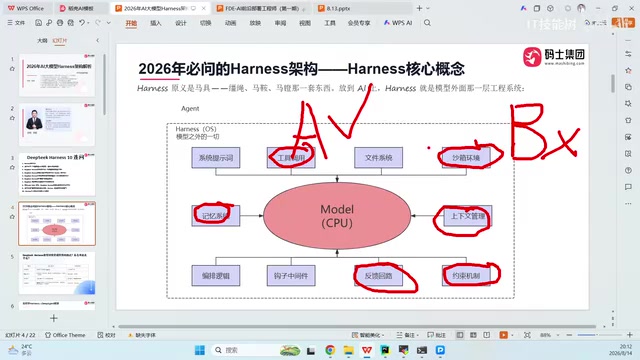
Here's a statement worth every AI developer remembering:
The model only determines the agent's floor; Harness determines the agent's ceiling.
Model capability is the baseline at the very bottom, while how well an agent ultimately performs depends on how solid the outer Harness engineering is. This also explains why more and more interviewers no longer just ask "do you understand models" but have shifted to "do you understand the engineering system beyond models."
The Seven Core Modules of Harness Architecture Explained
From an engineering implementation perspective, a complete Harness architecture can be roughly decomposed into seven layers/modules. Together, these modules constitute the engineering system beyond the model:
-
Tool Calling: Defining which external tools the model can use and how to call them. This includes not only tool registration and description (typically provided to the model in JSON Schema format) but also parsing of tool execution results, timeout handling, and dependency management between tools. In practical engineering, tool calling design also needs to consider idempotency (the same call produces consistent results across multiple executions) and rollback capability (the ability to undo completed steps when an operation fails) — these are the engineering foundations for building reliable Agent systems.
-
File System: Managing read/write operations for code, documents, and other files. In actual implementations, the file system module typically needs to support incremental reading (avoiding loading entire large files into context), file change tracking (diff), and integration with version control systems (like Git).
-
Sandbox Environment: Providing secure, isolated execution environments to prevent misoperations from affecting the main system. Claude Code uses a restricted Shell environment, while Codex executes code in cloud containers. Well-designed sandboxes also need to support resource limits (CPU, memory, network bandwidth) and execution time limits.
-
Context Management: Organizing and compressing conversation history to ensure the model always receives the most relevant information. This is the most technically deep module in Harness, involving strategies for conversation summary generation, key information extraction, and token budget allocation.
-
Memory System: Saving key information across sessions to enable long-term memory capabilities. Unlike context management, which focuses on information organization within a single session, the memory system concerns cross-session knowledge accumulation — such as user preferences, project background, and historical decisions.
-
Logic Orchestration / Central Middleware (Orchestration): Coordinating workflows and execution order across modules. Current mainstream orchestration patterns include: sequential execution (Pipeline), conditional branching (Router), parallel execution (Fan-out/Fan-in), and Human-in-the-loop. Frameworks like Microsoft's AutoGen, CrewAI, and LangGraph all provide different levels of orchestration capabilities. In multi-Agent collaboration scenarios, the orchestration layer also needs to handle inter-Agent communication protocols, task decomposition, and result aggregation. Currently, mainstream multi-Agent collaboration patterns in the industry include: centralized (one main Agent decomposes tasks and assigns them to sub-Agents), decentralized (multiple Agents collaborate autonomously through message passing), and hierarchical (different Agents handle tasks at different abstraction levels). At the communication protocol level, Anthropic's proposed Model Context Protocol (MCP) is becoming the de facto standard for Agent-external tool interaction, defining unified interface specifications that enable tools and data sources from different origins to be seamlessly called by Agents.
-
Feedback Loop & Constraint Mechanisms: Handling errors, retries, fallbacks, and safety boundaries. Technical implementations include: execution result validation (e.g., checking for errors after code execution), self-reflection (Reflexion, having the model evaluate its own output quality and retry), and external validators (such as unit tests, type checkers, and lint tools). Reflexion is a self-improvement framework for Agents proposed by Shinn et al. in 2023, considered one of the most important technical breakthroughs in feedback loop design. Traditional Agents typically just retry after failure, but Reflexion introduces a "reflection" step: after failure, the Agent generates a natural language reflection summary (e.g., "I failed last time because I didn't correctly handle edge cases") and stores this reflection in memory, providing it as context to the model in the next attempt. Experiments show this mechanism significantly improves Agent success rates on programming, reasoning, and other tasks. Good feedback loop design also needs to include a "circuit breaker" mechanism — stopping execution when retry count exceeds a threshold to avoid infinite loops consuming resources.
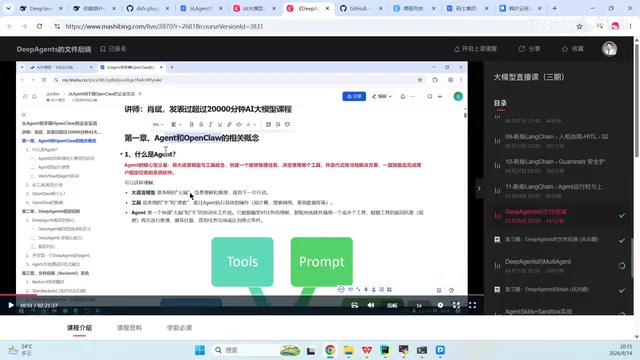
It's worth mentioning that this system is not something new. The Deep Agents framework in the industry had previously proposed a similar seven-layer implementation structure — it just didn't have the unified canonical name "Harness" at the time. One could say the Deep Agents framework itself is a complete prototype of Harness architecture — it revolves around core elements like tool calling, file handling, and path planning, highly consistent with today's Harness philosophy.
Implications for Developers: From Understanding to Practice
From Deep Agents to DeepSeek Harness, what we're seeing is the same engineering philosophy being continuously named, standardized, and productized. This brings two practical insights for AI developers:
First, understanding Harness is key to understanding modern Agent development. In the future, the gap between intelligent agent products will largely no longer be about model competition, but about Harness engineering capability competition. Whoever has a stronger memory system, more refined context management, and more robust feedback mechanisms will have the smarter and more reliable agent. This mirrors the logic in traditional software engineering where "the framework determines the product's ceiling" — just as the choice and depth of use of frameworks like React/Vue in web development determine frontend application quality, the design and implementation quality of Harness determines the ultimate experience of AI applications.
Second, technology evolves extremely fast, and rapid learning itself is a competitive advantage. Companies and interviewers tend to favor the new, and developers who can master new technologies and concepts first have a clear advantage whether job hunting or leading projects. After DeepSeek Harness's release, developers should download and experience it hands-on to feel how the Harness architecture operates in a real product. The recommended path is: first understand the design principles of the seven core modules, then deepen understanding by reading source code of open-source Agent frameworks (like LangChain, AutoGen), and finally try building your own lightweight Harness implementation based on the DeepSeek API. In this process, particular attention should be paid to learning the MCP (Model Context Protocol) — as an Agent tool interaction standard proposed by Anthropic and widely adopted by the industry, mastering MCP will become an essential skill for Agent developers.
Conclusion
The value of DeepSeek Harness lies not only in being a usable agent product, but more importantly in pushing the concept of "Harness architecture" to the forefront. Remember that core judgment: The model determines the floor; Harness determines the ceiling. For engineers who want to pursue the AI application development path, deeply understanding and practicing this engineering system beyond the model will be one of the most important capability investments for the future.
From a more macro perspective, the rise of Harness architecture marks AI engineering entering a new phase: the industry's competitive focus is shifting from "whose model is stronger" to "who can better harness the model." This means the classic wisdom of software engineering — modular design, separation of concerns, testability, fault tolerance mechanisms — has not only not become obsolete in the AI era but has become more important than ever. Developers who master these engineering capabilities will become the scarcest talent in the wave of AI application deployment.
Related articles

Why Does the Tesla Roadster Need to Fly? A Deep Dive into Musk's Wild Demo
Tesla's Roadster launch showed wall-climbing, upside-down driving, and flying stunts—but The Vergecast notes the demo car may lack a battery, the Rocket version is invite-only and not street-legal, and the website terms don't guarantee delivery. After nine years of delays, why does this car still need to exist?

AI Is Not a Replacement: Human-AI Collaboration Through the Lens of Factory Root Cause Analysis
Starting from factory root cause analysis, this article explains how AI accelerates evidence chain construction rather than replacing human experts, exploring the pragmatic implementation logic and business value of 'AI supporting people rather than replacing them.'

AI Agent Decision Auditing: Building an Evidence Chain in Regulated Workflows
Starting from a Reddit discussion, this article analyzes three core issues in AI agent decision auditing within regulated workflows: what fields audit records should contain, how to handle feedback latency for erroneous decisions, and how to continuously calibrate LLM judge consistency with human judgment.