Why General-Purpose Agents Don't Work: How a Job Interview Reshaped One Developer's Thinking

Why general-purpose Agents fail startups — and why vertical Agents are the real opportunity.
Agent developer Joy shares how a three-round job interview dismantled her assumptions about AI Agents. Big tech has locked up the general-purpose Agent space, leaving startups no room to compete. The real opportunity lies in vertical Agents — products built on irreplaceable domain context, sustained by faster iteration than the underlying models, and distributed through mainstream Agent ecosystems.
It Started with a Three-Round Interview
Recently, an Agent developer named Joy shared a story on Bilibili that sparked widespread discussion. She had just completed a three-round interview process and received an offer — a technical screen, a product round (with the CTO), and a co-founder round (with the CEO). The company originally built document creation tools (similar to Feishu Docs), and after securing overseas funding, decided to pivot toward becoming the "Canva of the AI era," targeting international markets with both B2C and B2B ambitions.
What was striking was that the technical interview contained almost no traditional rote knowledge questions. Instead, it was dominated by scenario design and product thinking challenges. The experience completely dismantled Joy's existing assumptions about Agents — and made her realize: in the Agent era, product thinking is beginning to matter more than pure technical skill.
Her core conclusion was blunt: the general-purpose Agent path is a dead end for startups and individual developers.
Interview Questions With No Right Answers
How Do You Give AI "Taste" and Aesthetic Sensibility?
The interviewer posed a classic question: how would you use Codex or Claude Code to design a frontend website or landing page with genuine aesthetic quality? There was no standard answer. Joy walked through several mainstream approaches:
- The Skill approach: This doesn't actually teach the AI taste — it wraps what the author considers "good" design standards (a
design.mdfile) into pre-packaged prompts. It's more about encoding experience than building capability. - The RL approach: Reinforcement learning can theoretically improve AI aesthetics, but the data requirements and cost are enormous. This corresponds to RLHF (Reinforcement Learning from Human Feedback) and RLAIF (Reinforcement Learning from AI Feedback) paradigms. OpenAI's InstructGPT paper (2022) was the first to systematically demonstrate RLHF's effectiveness in aligning with human preferences. Transferring this to visual aesthetics requires building an "aesthetic scoring model" as a reward function — and collecting large-scale, high-quality visual preference annotations is prohibitively expensive. Companies like Adobe and Canva have a natural edge here due to their vast user behavior datasets. This is why genuinely improving aesthetic capability still falls to model providers like OpenAI at the training stage.
- The data accumulation approach: For B2B products, as long as you have customers, you can collect usage data and feedback to build a picture of user preferences — and that itself becomes a moat.
How Do You Design an Agent's File System?
Another scenario question asked: how would you design a file system for a design-focused Agent? If a user uploads a PDF, PPT, and CSV, how should the Agent handle each?
Joy's approach started with intent recognition. Not everything a user uploads is a "creative asset" — it might be a reference website they want to emulate, a must-use asset for the design (screenshot/sticker), or a batch generation instruction (like a 555-row CSV where each row represents a separate design to produce). Identify intent first, then decide how to process — that's the product-minded Agent logic that good design requires.
The Software Interaction Paradigm Is Being Rewritten
Joy outlined three stages of AI Agent evolution, mapping how interaction paradigms have shifted:
Stage 1: Text-Based Q&A Machine
Early AI had no Agent capabilities and was essentially "blind" — users had to visit a website to ask questions, and interaction was limited to text.

Stage 2: Local and IDE Agents
This stage saw a classic transitional form: AI + browser. From the early Arc browser to Perplexity's Comet and ChatGPT's Atlas. Then came the rise of local IDE Agents — Cursor, Codex, Windsurf — where Agents began to develop genuine execution capabilities.
Stage 3: Agents Embedded in Organizations
Epitomized by Claude for Slack, Agents began to live inside your organization, becoming long-term team collaborators.
Slack was founded in 2013, acquired by Salesforce for $27.7 billion in 2021, and now dominates the overseas B2B collaboration market with over 32 million monthly active users. There's an interesting detail here: Slack's lock-in effect operates at three levels — accumulated historical messages and files (companies build up years of communication records), deep integrations with third-party tools (over 2,600 app integrations), and embedded team habits and organizational culture. Once a company has used it for a year, migrating historical data out is extremely difficult. The strategic significance of Claude for Slack is that Anthropic, through Slack's organization-level penetration, gives Claude access to "workflow context" that traditional SaaS cannot reach — including team decision-making patterns, project backgrounds, and communication styles. When an Agent becomes deeply embedded in a team's workflow and accumulates rich context, the cost of switching multiplies several times over. For enterprises, this creates both dependency and lock-in.
Where Is the Agent Moat, Really?
Redefining Agent: More Than LLM + Tools
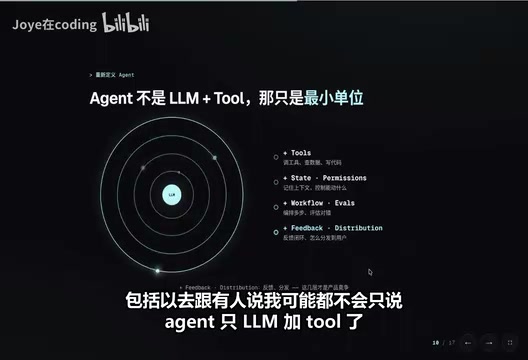
A famous line from the Hugging Face course says: "An Agent is just an LLM plus tools." But Joy thinks this definition is outdated. The technical definition of AI Agents has evolved significantly — early academic definitions described an Agent as "an autonomous system that perceives its environment and takes actions to achieve goals," a concept rooted in multi-agent systems research from the 1990s. Hugging Face's simplified definition, while accessible, obscures the core complexity of modern Agent systems: state persistence, multi-step planning, tool orchestration, error recovery, and more. If an Agent were just an LLM calling tools, ChatGPT's web interface would have already done it — does Doubao generating an image count as an Agent?
She argues that an Agent with genuine boundaries, ceiling, and moat depends on the following dimensions:
- State (State Management): Persistent Agents, managed context state, no loss of user information
- Permission (Access Control): Granular operation authorization mechanisms
- Workflow (Orchestration): Coordinating multi-step, long-chain task execution
- Evals (Evaluation Framework): Continuously quantifying product quality to drive iterative improvement
- Feedback & Distribution: Building user feedback loops to progressively enhance product capability
Production-grade Agents must handle engineering challenges like long context window management, idempotency in tool calls, and task interruption and resumption — all far beyond simple API call wrappers. Joy acknowledged honestly: if the Agent you're building is just an "LLM + Tool" wrapper, you might only be an "Agent wrapper" rather than a true Agent engineer — much like the old jab, "you're just a developer who knows how to call APIs."
Why General-Purpose Agents Are a Dead End
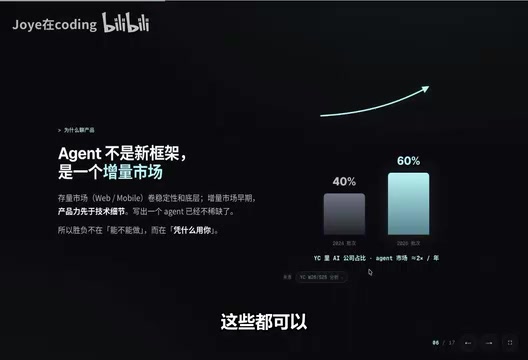
Manus is a general-purpose AI Agent product developed by the Chinese team behind Monica. After launching by invitation in early 2025, it attracted global attention for its multi-step autonomous task execution capabilities (such as automatically completing market research, writing code, and handling complex file workflows) — widely regarded as the benchmark for general-purpose Agents. Manus was acquired by Meta for $210 million, bringing Agents into mainstream public awareness; Codex and Claude Code then truly carried Agents beyond the developer community. Meta's acquisition of Manus reflects the urgency with which big tech is racing to acquire Agent talent and technology — large companies acquire general-purpose Agent products with dual motives: internalizing general capabilities as platform infrastructure while using talent acquisition to prevent competitors from building equivalent capabilities. But these very products from big tech have also closed off the general-purpose Agent path entirely.
Big tech dominates the general-purpose lane, and market share has already solidified — startups and individual developers simply cannot break in. The Coding Agent space is a perfect example: you can't out-compete Codex or Claude Code.
The way forward is vertical Agents. Because you possess deep domain context — something general-purpose large models fundamentally lack. The core competitive advantage of a vertical Agent lies in the irreplaceability of domain context. After RAG (Retrieval-Augmented Generation) architectures became widespread, general-purpose models gained broad training data coverage but limited vertical depth. Vertical Agents, by contrast, can build proprietary industry knowledge bases, user behavior data, and business rules that create reasoning advantages general models cannot replicate. Common verticals include: AI + Recruiting, AI + Design, AI + Business Research, and more.
Take AI + Recruiting as an example: in service industries (like blue-collar hiring), even the business owner often doesn't know how to write a job description — many roles are filled through the soft judgment of "meeting face-to-face and feeling like it's a fit," not through hard requirements like "proficiency in the frontend trinity." This kind of "tacit knowledge" can only be crystallized through large amounts of real business data. The combination of RAG + fine-tuning is currently the mainstream technical path for building moats in vertical Agent products, where the data flywheel effect (more users → richer data → more accurate product → more users) is a key indicator of long-term vertical Agent value. Turning that industry expertise into domain context is the core logic behind why products get customers — and why investors write checks.
The Dynamic Nature of the Moat
But verticals carry their own risks. Joy emphasizes that the iteration velocity of your product features and tool orchestration must consistently outpace the evolution of the underlying general-purpose models — otherwise you will eventually be absorbed by the expanding capability frontier of large models. Acceleration of iteration, not just iteration itself, is the true source of your moat and pricing power.

Verticals Must Also Connect to the General Ecosystem
No matter how deep you go in a vertical, you can't afford to focus solely on your niche. HeyGen was founded in 2020 and is a leading product in AI-generated avatar video, known for AI face-swapping, lip-sync, and multilingual video translation — at one point valued at over $500 million. HeyGen is a telling case study: the product recently launched a Hyperframes plugin (essentially using an Agent to write HTML for video production) and integrated it with Claude Code, Codex, and other mainstream Agents for distribution. This represents an emerging "Agent-as-distribution" strategy: by packaging vertical capabilities as plugins and plugging into mainstream Agent platforms, HeyGen achieves expanded user touchpoints without changing existing workflows. In the Agent era, distribution channels have shifted from the App Store to the tool-calling layer (Function Calling / MCP protocol) of mainstream LLMs — leveraging mass-market entry points for rapid social media breakout. Vertical products ultimately need broader Agent distribution channels to grow, and becoming the "go-to tool" for a mainstream Agent means passively benefiting from its traffic.
Practical Advice for Agent Practitioners
Always Ask About the Product in Interviews
Joy repeatedly stressed: don't just focus on the technical side — product is the key variable. Especially for startups, product capability and growth ability matter far more than pure technical execution. Her recommendations:
- Ask your interviewer directly what product they're building, and what differentiates them from the best competitors on the market
- During a CEO/CTO round, gauge whether leadership has genuine conviction in their own product — if the founder can't articulate it clearly, the company probably isn't worth joining
- Make the most of the Q&A portion of any interview — even if you don't get the offer, you'll walk away with first-hand knowledge of the Agent market
She once interviewed at an AI video editing company and asked the CEO point-blank: "Compared to the top products in the market, what's your core advantage? Or are you just building a replacement that isn't necessarily better?" Direct questions like this are an effective way to stress-test a product's substance.
Terms Will Change; Judgment Is What Lasts
Finally, Joy offered a clear-eyed prediction: people building Agents may soon be dismissed as "having no moat, just being Agent wrappers" — just like the old joke about developers who "only know how to call APIs."
But she's not pessimistic. The word "Agent" may be replaced next year — by Proactive Agent or something else entirely — and that's fine. What matters is what it represents: a fundamental shift in how software interaction works in the AI Native era. The way we fulfill needs has changed: when you hit a bug, you used to dig through CSDN page by page; now you just hand the problem to AI to search, locate, and write the test.
As the conclusion goes: terms will change, product forms will change — what endures is the taste and judgment you develop. In the AI era, the ability to perceive signal and understand underlying logic is the hardest moat to copy.
Key Takeaways
Related articles

A Developer's Hands-On Test of Doubao Phone Assistant: AI Phones Are Evolving from Chatbot to Agent
A developer's hands-on test of Doubao Phone Assistant — from screen Q&A and calendar actions to server port checks and FFmpeg vulnerability patching — exploring how AI phones evolve from Chatbot to Agent.
Moving On from ownCloud: Building a 5-Copy, 3-Location Home NAS Backup System
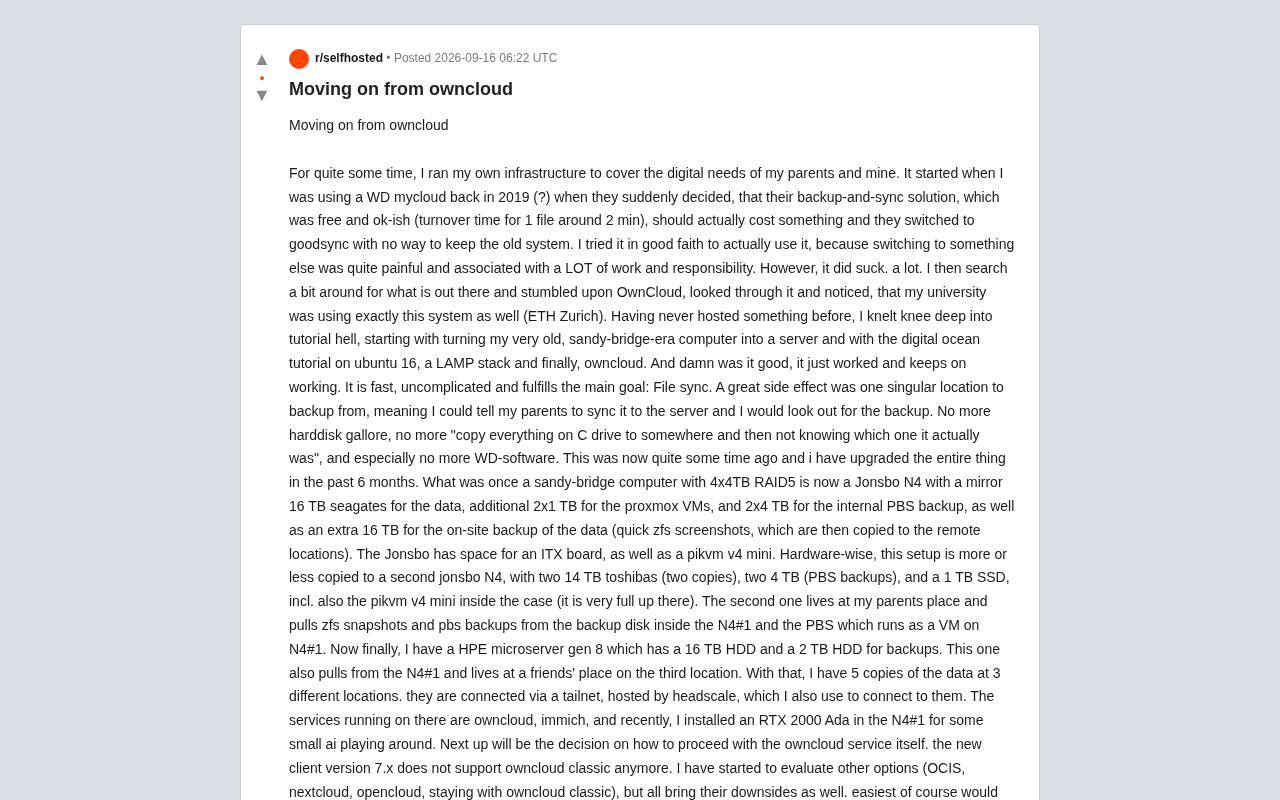
A Reddit user's journey from WD MyCloud to a 5-copy, 3-location ZFS+Proxmox home NAS, and the hard choices facing ownCloud Classic users as the official client drops support.
What Are Agent Skills? A Beginner's Guide from Understanding to Customization
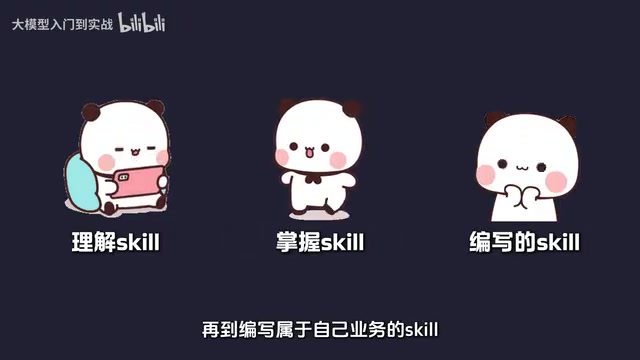
What are Agent Skills? This guide breaks down the Skill concept, its role in ecosystems like Claude Code, and a three-step learning path from understanding to customization.