WorkBuddy Beginner's Guide: How AI Agents Take Large Models from "Talking" to "Doing"

AI Agents like WorkBuddy take large models from "giving solutions" to "taking action," completing batch file conversion in three minutes.
Based on a Bilibili creator's hands-on demo, this article contrasts chat-style large models with AI Agents. Tools like Doubao can understand needs and generate solutions but can't directly operate local files—users still have to run the code themselves. WorkBuddy, after authorization, autonomously reads folders, batch-converts docx to PDF, and archives them, consuming only about 1.55 credits in three minutes. The article also covers the credit system, permission boundaries, the capability gap with Codex, and beginner tips: start with clearly scoped small tasks, treat multi-turn conversation as part of the workflow, and trade time for cost.
Ordinary large models can understand your needs, but they can't directly operate your computer. The emergence of AI Agent tools like WorkBuddy is turning "conversation" into "execution." Based on a hands-on demo by a Bilibili creator, this article breaks down the complete workflow from describing a need to landing a task, compares it with the limitations of chat-style AI like Doubao, and helps you understand the core value of Agents.
Why Do You Need an AI Agent?
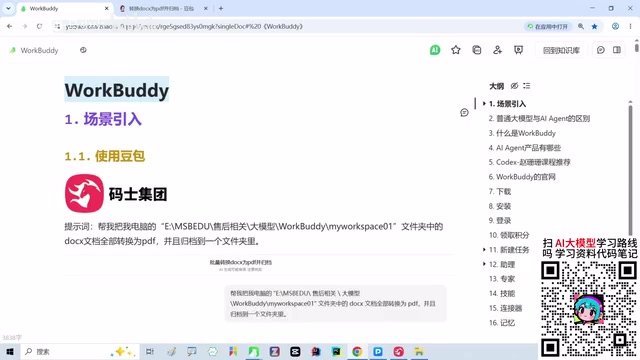
Many people use Doubao, DeepSeekAd, and Tongyi Qianwen for everyday problems and feel they're good enough. But the creator burst this illusion with a single scenario: batch-converting a folder of Word documents to PDF and automatically archiving them to a specified directory.
When he raised this request to Doubao, Doubao understood the intent and provided a solution—installing dependencies and running some Python code. The problem is that non-technical users can't understand that code at all, let alone execute it manually. According to the creator's demo, Doubao "can give me the solution, but can't do this thing for me."
This is the boundary of chat-style large models: they have a brain—able to analyze and generate solutions—but no hands or feet, unable to read local files, invoke software, or execute commands.
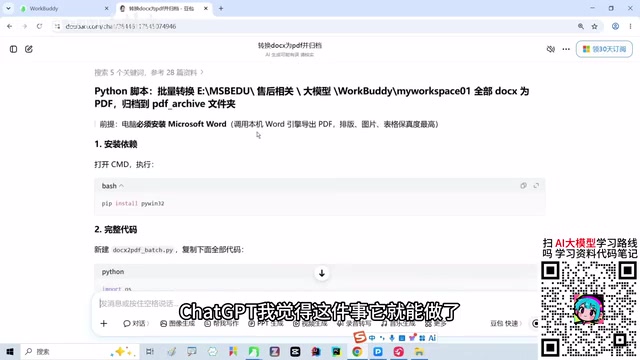
The creator's conclusion is direct: you need a tool that not only understands your needs but, after authorization, can access local files, execute operations, and deliver results. Such tools are AI Agents.
Technical definition of AI Agent: An Agent is a system that can perceive its environment, make autonomous decisions, and take actions to achieve goals. Compared with chat-style large models, Agents have three additional key components: tool calling (executing code, reading/writing files, calling APIs), memory (preserving task context and multi-turn interaction history), and planning (decomposing complex goals into executable steps and executing them in a loop). Most mainstream Agents today are built on the Function Calling capabilities of large models—the model outputs structured instructions, the runtime environment executes them and returns results, forming a "think—act—observe" loop.
WorkBuddy Hands-On: Complete Batch PDF Conversion in Three Minutes
The creator chose WorkBuddyAd as an entry-level Agent tool because it's installation-friendly, has a low barrier to use, and is directly accessible in China without extra network configuration.
Credit System and Getting-Started Cost
New users receive 2,000 credits upon registration and can claim 100 credits daily. The creator's account had 3,900 credits during the demo, and he admitted "it's definitely enough for a short learning period." For users who don't want to pay about 200 yuan per month for tools like Codex (membership fee plus network costs), WorkBuddy's free credit model is a low-barrier starting point.
Task Execution Process
After sending the same request—converting all docx files in a specified directory to PDF and archiving them—to WorkBuddy, the tool began working autonomously. During the livestream, the creator showed real-time consumption: starting at 0.38 credits, with the entire task taking about three minutes and consuming 1.55 credits.
During execution, WorkBuddy identified the first file as successfully converted, then batch-processed the remaining files and automatically archived the results to a newly created folder. The creator opened the archive directory to confirm: "Converted very well."
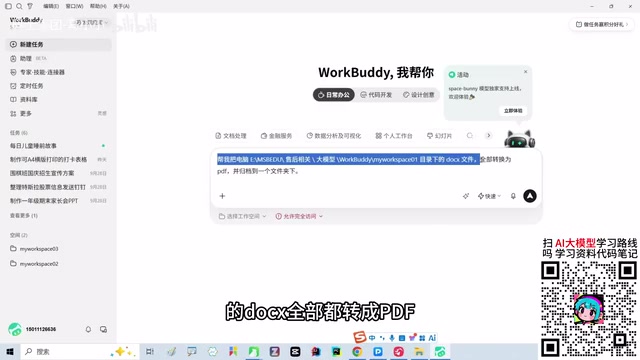
The key here is authorization: the creator granted "allow full access" permission so the Agent could read the local folder, view documents, and execute batch conversion. Permission boundaries are the first lesson you must understand when using Agent tools.

About "allow full access" permission: For an Agent to operate on local files, it must obtain file read/write authorization from the operating system. "Full access" means the Agent can read, modify, and delete the contents of your specified folder, and even execute scripts. This is similar to a mobile app requesting "storage permission," but with higher risk—once authorized, every operation the Agent performs directly affects real files. Practical advice: only authorize the specific folder needed for the task, avoid opening up the entire disk; back up important files in advance; and revoke permissions after the task is complete. Understanding permission boundaries is a prerequisite for safe Agent use.
The Essential Difference Between Ordinary Large Models and Agents
The creator repeatedly emphasized a comparison framework throughout the demo:
Ordinary large model: Understand the problem → analyze the need → generate a solution → hand the solution to you. It stays at the level of "answering questions" and "giving suggestions."
AI Agent: Understand the problem → obtain authorization → access resources → execute operations → deliver results. It accomplishes "executing tasks" and "delivering outcomes."
Using the creator's metaphor, an Agent is like "various little employees"—you assign a task, and it truly goes and does it. From "talking" to "doing"—this is the dividing line between the two types of tools.
There's a Capability Gap, but Trends Are Converging
The creator didn't avoid WorkBuddy's shortcomings. He shared a comparison test: having WorkBuddy and Codex each design a table based on the same Excel format image from Xiaohongshu. WorkBuddy took 23 minutes with unsatisfactory results; Codex took only two and a half to three and a half minutes to meet the requirement.
His judgment: domestic tools still lag behind overseas products in capability, but once competitors align their features, "they will converge sooner or later"—it just takes time. For budget-sensitive users, WorkBuddy's cost-effectiveness lies in free credits plus multi-turn conversation tuning—if the first result isn't good, keep chatting to have it revise, trading time for cost.
What is Codex: The Codex compared in this article usually refers to OpenAI's code generation and execution tool (such as Codex CLI or the programming agent integrated into ChatGPT), which excels at understanding code, operating development environments, and automatically completing programming tasks. It requires a paid subscription (about $20 per month) and may involve network configuration costs when used in China—which is exactly why the creator chose WorkBuddy as an entry-level alternative. The two have similar positioning—both are Agents that can "do things"—but Codex is more mature in complex reasoning and coding tasks, while WorkBuddy wins with its low barrier and free credits.
Three Practical Tips for Getting Started with Agents
First, start with specific, verifiable small tasks. Tasks like batch file conversion and organizing tables by template have clear boundaries and easily checkable results—perfect for building intuition about how Agents work.
Second, understand the relationship between credit consumption and task complexity. In the creator's demo, three minutes of file conversion consumed about 1.55 credits; daily small tasks fit within the 100 daily credits. Complex tasks require reserving more credit headroom.
Third, treat multi-turn conversation as part of the workflow. Don't expect an Agent to deliver perfectly in one shot. The creator explicitly said: "It's very likely some step won't succeed, and you'll have back-and-forth multi-turn conversations with it." The interaction process itself consumes credits—this is the normal cost of using Agents.
Who Should Get Started Now?
The creator's positioning is broad: employed or not, computer science background or not—it applies to all. The core criterion is—do you have a batch of repetitive local file operations, data organization, or format conversion needs, and don't want to learn programming or pay for a membership to handle them?
If the answer is yes, low-barrier Agent tools like WorkBuddy are worth an hour of your time to get started. It won't replace your judgment, but it can bridge the gap between "knowing how to do it" and "actually getting it done."
Related articles

GPT-Next Leak, Gemini 4 Argon Imminent: AI News Roundup
GPT-Next leak suggests extreme efficiency; OpenAI's 28-day shipping pledge boosts speed 50%; Gemini 4 Argon nears release; Anthropic subscription value report sparks debate.

GPT-Next Leaked, Gemini 4 Argon Speeds Up, Fable 5.5 May Launch Today
OpenAI's GPT-Next model leaks, expected to be extremely low-cost and possibly part of the 28-day release plan; Gemini 4 Argon internal testing accelerates, NanoBanana 2.1 is live; Semi Analysis tests show Claude Max's equivalent API value is about 5 times that of ChatGPT Pro; Fable 5.5 may launch today.

Gemini 4 Argon Launches Globally: Key Highlights from the AI Daily Brief
Google opens Gemini 4 Argon globally across Pro and Ultra subscriptions and the API, and demonstrates robot control. This article rounds up open-source models, Agent infrastructure, cost transparency, and safety governance updates.