Zero API, Zero Leaks: A Practical Look at DevWhisper, the Local AI Developer Assistant

DevWhisper uses a fully local pipeline to solve the NDA, precision, and cost flaws of cloud meeting assistants.
DevWhisper is a native Windows desktop app offering a fully local alternative for freelancers facing NDA compliance, poor technical context recognition, and per-seat/per-minute billing in client meetings. It captures speaker and microphone audio via WASAPI loopback without a meeting bot to record Google Meet and Zoom conversations, transcribes locally with whisper.cpp, then uses qwen2.5-coder:7b on Ollama with JSON schema constraints to extract structured technical tasks, priorities, and assignees. Transcripts go into local SQLite with FTS5 search, and temporary audio is deleted after processing. The author argues open-source models are the only solution for air-gapped isolation, zero marginal cost, and vendor independence, and real user feedback shows code-specialized models outperform general assistants at capturing technical action items.
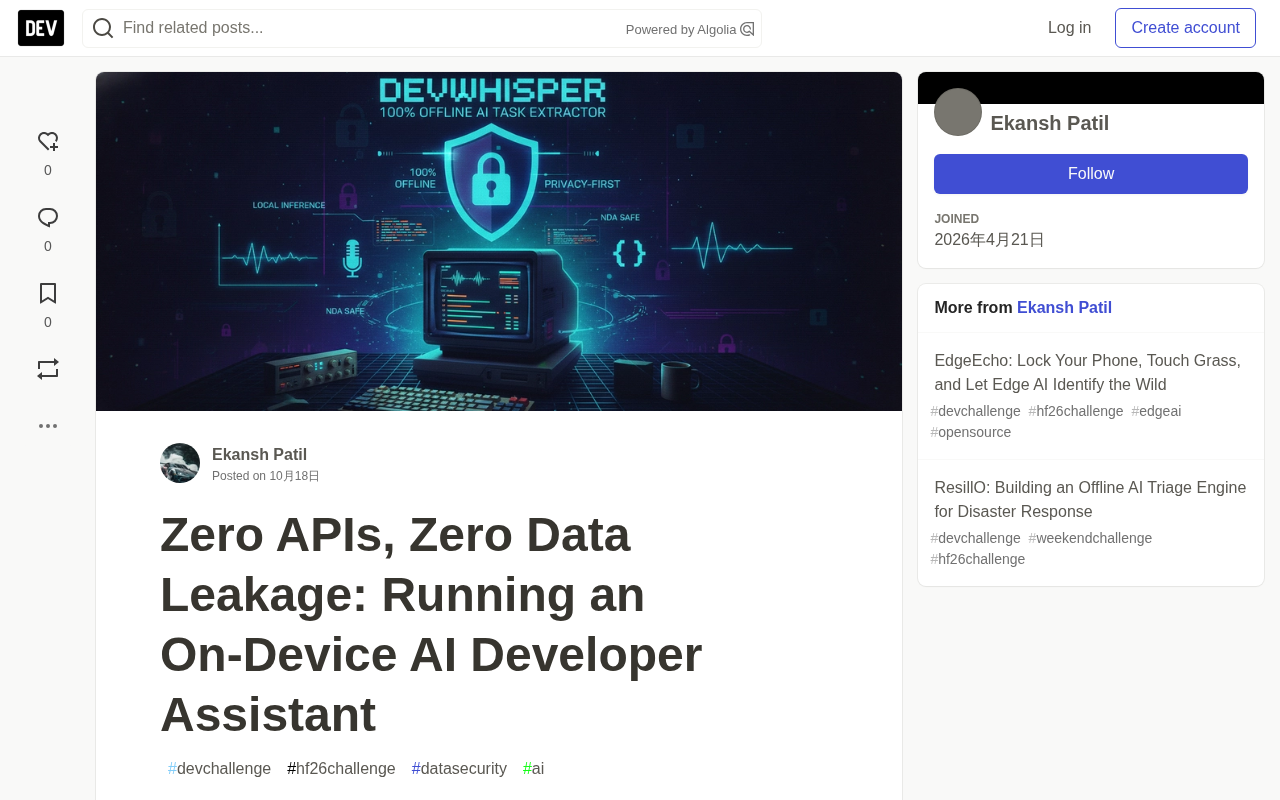
Cloud-based AI meeting assistants are becoming a privacy liability for freelance developers. Tools like Otter and Fireflies upload sensitive client audio to third-party servers, directly crossing NDA red lines. DevWhisper offers another path: using whisper.cpp and local open-source code models to keep the entire pipeline locked down on the developer's own machine.
The Problem: Three Major Flaws of Cloud Meeting Tools
The author of DevWhisper clearly outlined the pain points of existing tools in the Hacktoberfest Open Source AI Challenge. Freelance developers, independent engineering consultants, and small development teams frequently need to process client meeting recordings, and mainstream cloud tools stumble at nearly every turn in these scenarios.
The first is NDA compliance. Cloud note-taking tools upload client audio and proprietary code specifications to third-party servers, creating a substantial risk of breach when taking on sensitive projects. The second is output quality. General-purpose models fail to grasp technical context, and information like API routes, bug descriptions, and variable names is often missed. The third is cost. Seat-based subscriptions of $15 to $30 per month aren't cheap for freelancers with frequent long meetings, and per-minute billing penalizes lengthy technical syncs.
NDA (Non-Disclosure Agreement) is a common legal document between clients and freelance developers that explicitly prohibits disclosing project-related sensitive information to unauthorized third parties. In the context of meeting recordings, uploading audio containing a client's proprietary code specifications and architecture discussions to a cloud note-taking tool may be deemed "disclosure to a third party," thereby constituting a breach. Even if cloud service providers promise encryption and compliance, data leaving the premises and third-party access are themselves enough to trigger compliance reviews at many enterprise clients—which is one of the core selling points of localized solutions.
The Solution: How the Fully Local Pipeline Works
DevWhisper is a native Windows desktop application that captures both system speaker audio and microphone input simultaneously via WASAPI loopback, recording two-way conversations in Google Meet and Zoom without needing a meeting bot or invitation permissions.
The processing pipeline runs entirely locally. Audio is first sent to whisper.cpp (via pywhispercpp bindings) for transcription, then qwen2.5-coder:7b on Ollama extracts structured technical tasks, priority tags, and assignees, and drafts client follow-up emails. Pydantic combined with Ollama's JSON schema constraints ensures reliable output structure. Once processing is complete, temporary audio files are immediately deleted from disk.
Transcripts are stored in a local SQLite database with FTS5 full-text search support, forming a searchable meeting archive. All data flows only through localhost and system memory.
WASAPI loopback is a loopback capture mechanism provided by the Windows Audio Session API that can directly record sound currently being played by the system (such as the other party's voice in Zoom) without installing a virtual sound card driver. Combined with microphone input, it captures two-way conversations. Compared to relying on meeting bots to join meetings, loopback capture is transparent to the meeting platform, requires no invitation permissions, and won't show a third-party bot in the participant list—making it better suited for privacy-sensitive scenarios.
Ollama's JSON schema constraints refer to requiring the local large model to strictly generate fields according to a given JSON Schema—such as task title, priority, and assignee—through structured output when calling it. Combined with Pydantic for result validation, this can significantly reduce the probability of output format drift in small-parameter models, making subsequent database storage and automated processing more reliable. This is also a key engineering technique that enables local 7B-class models to serve reliably in engineering pipelines.
Why Open-Source Models Are the Only Answer
The author emphasizes that choosing open-source AI is not a matter of preference but the only way to resolve the core contradictions. Closed-source APIs have structural flaws when freelance developers handle sensitive client work.
Closed-source models require sending raw audio and project transcripts to external servers, which directly violates client NDAs and exposes proprietary code architecture. Open-weight models allow the author to build a fully air-gapped pipeline. On the cost side, closed-source APIs bill by token and audio minute, while local inference reduces the transcription cost of a two-hour meeting to zero. On model selection, general-purpose conversational models can't recognize framework syntax and Git task structures, and switching to code-specialized models yields noticeable improvements. Finally, there's vendor independence—a local pipeline won't break due to API terms changes or price hikes.
Air-gapped refers to a system being physically or logically completely disconnected from external networks, with data able to flow only on the local machine. DevWhisper's design goal is to ensure that audio, transcripts, and structured results never pass through any external API, remaining only on localhost and in memory, with temporary audio deleted after processing. For developers taking on NDA projects, this architecture is not just a technical choice but an auditable basis for proving compliance to clients.
Validated by a Real User
The author had a senior developer and tech community leader use DevWhisper to process recordings of recent technical project syncs. The user employed it to parse hardware and software specifications from long group discussions, without ever uploading member data to external servers. Feedback centered on two points: accuracy in capturing technical action items (such as pin configurations and API endpoints) was noticeably higher than general note-taking tools, and the user was willing to pay monthly for community operations and freelance work.
This case's value lies in validating a niche scenario: general meeting assistants pursue broad coverage, while code-specialized local models' precision advantage in technical contexts is exactly the differentiator freelance developers are willing to pay for. For independent developers taking on NDA projects, the property of data never leaving the machine is itself already a purchasing rationale.
One-line Summary
DevWhisper uses a fully local pipeline to address the NDA, precision, and cost shortcomings of cloud meeting assistants.
Paragraph Summary
DevWhisper is a native Windows desktop application that offers a fully local alternative for freelance developers facing three major pain points in client meeting scenarios: NDA compliance, poor technical context recognition, and per-seat/per-minute billing. It captures both system speaker and microphone audio simultaneously via WASAPI loopback, recording two-way conversations in Google Meet and Zoom without a meeting bot; then transcribes locally with whisper.cpp, after which qwen2.5-coder:7b on Ollama extracts structured technical tasks, priorities, and assignees, with JSON schema constraints ensuring reliable output. Transcripts are stored in local SQLite with FTS5 full-text search, and temporary audio is deleted after processing. The author emphasizes that open-source models are the only solution for air-gapped isolation, zero marginal cost, and vendor independence, and real user feedback shows that code-specialized models outperform general meeting assistants at capturing technical action items.
Related articles

Multi-task Model Accuracy Stuck at 0.40? Community Help and Diagnostic Approaches
A developer seeks help because their multi-task model's accuracy is only 0.40, suspecting model size or lack of pre-training. This article analyzes common bottlenecks in multi-task learning, including model capacity, pre-training, loss weights, and data balance, and provides systematic troubleshooting ideas and community suggestions.

Two RL Agents Team Up to 'Chopstick-Catch a Rocket': Mechazilla Captures Super Heavy Booster in Practice
A developer trains two PPO agents in JAX to control a Super Heavy booster and Mechazilla tower arms for cooperative capture, detailing staged training, rollout length, and learning rate tuning.
ConnectWise Breached by Chinese Hackers, Thousands of Enterprises Targeted by AI Agents
Microsoft discloses that ConnectWise was breached by a China-backed hacking group that used AI agents to rapidly infiltrate thousands of customer enterprises. This article analyzes the AI-driven trend in supply chain attacks, security risks of the MSP model, and defense strategies.