Zero to AI Agent Developer: A 4-Week Learning Roadmap and Guide to 7 Architecture Patterns

A practical 4-week roadmap for learning AI Agent development from scratch, with a guide to 7 architecture patterns.
This article addresses whether beginners can realistically pivot into AI Agent development in a month, offering a structured 4-week roadmap: core components (LLM, Planning, Memory, Tools) in week one; ReAct and other paradigms in week two; multi-agent collaboration and prompt tuning in week three; and hands-on projects in week four. It also compares 7 mainstream Agent architectures and advises choosing the simplest solution that works. Readers are cautioned that "fast-track" content often promotes courses, and real competency comes from sustained project experience.
How Long Does It Really Take to Break Into AI Agent Development?
As competition intensifies for tech roles and layoffs hit traditional software development, AI Agent (intelligent agent) development is becoming a genuine differentiator in the job market. Based on learning experiences shared by creators on Bilibili, even complete beginners can build a practical foundational skill set in about a month — as long as they focus on the right direction with the right approach.
A word of caution upfront: "learning in one month" means grasping core principles and running through basic projects, not becoming an expert. Agent development is a continuously evolving field that sits at the intersection of large language models, system design, and engineering practice. Real competency comes from sustained hands-on work. That said, a clear learning roadmap genuinely reduces the cost of trial and error when self-studying.
The 4-Week Learning Roadmap, Broken Down
Week 1: Master the Core Components
The most important thing at the entry stage is understanding the four core components of an Agent: Large Language Models (LLM) as the decision-making brain, Planning for task decomposition, Memory for storing context and history, and Tools that give the Agent access to external capabilities.
Many beginners rush straight into writing code and end up wasting enormous time untangling conceptual confusion. Spending the first week clarifying the roles and relationships of these components will make everything that follows much smoother. Think of an Agent as an orchestration system of "LLM + Planning + Memory + Tools" — the model handles the thinking, while the other three turn that thinking into executable, sustainable actions.
Week 2: Understand How Agents Work and the Classic Paradigms
Week two dives into how Agents actually operate. The key focus is understanding mainstream Agent paradigms, and ReAct (Reasoning + Acting) is unavoidable. ReAct interleaves reasoning and acting — the Agent thinks one step, takes one action, observes the result, and then continues. This pattern dramatically improves controllability on complex tasks.
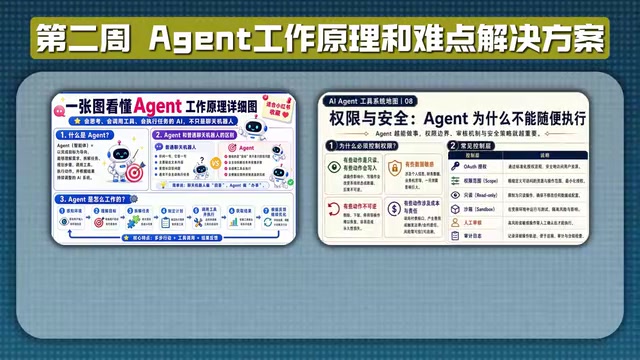
Beyond ReAct, this stage should also cover common pitfalls and how to handle them: retrying failed tool calls, managing context in long-running tasks, and preventing Agents from getting stuck in infinite loops. These engineering details often determine whether an Agent can actually ship to production.
The ReAct paradigm was introduced by Google researchers in 2022 in the paper "ReAct: Synergizing Reasoning and Acting in Language Models." Its core idea is to have the model alternate between generating "Thought," "Action," and "Observation" tokens, forming a closed-loop iterative process. For example, when asked "What's the weather in Beijing today?" — a question requiring real-time data — the Agent first reasons "I need to call a weather API," then executes that tool call, then reasons further based on the returned result, until it produces a final answer. Compared to pure Chain-of-Thought, ReAct's advantage is that reasoning and external information retrieval happen in tandem, preventing the model from relying entirely on its internal knowledge and hallucinating. Understanding the structure of a ReAct trajectory is essential groundwork for learning more advanced paradigms like Reflexion and Plan-and-Execute.
Week 3: Multi-Agent Collaboration and Prompt Tuning
A single Agent has limited capability. Multi-Agent collaboration divides work across specialized roles — planners, executors, reviewers — to tackle more complex tasks. Understanding how different Agents communicate, how responsibilities are allocated, and how results are aggregated is the dividing line between toy projects and production systems.
On the other side, Prompt tuning is a soft skill that runs throughout everything. With the same model and architecture, the quality of your prompts directly affects how accurately the Agent understands its task. This week is about learning how to use structured instructions, few-shot examples, and constraints to get consistently reliable outputs.
In multi-agent systems, inter-Agent communication typically follows two main patterns: shared state, where all Agents read and write to the same context or database (simple to coordinate but prone to conflicts), and message passing, where Agents communicate via structured messages (lower coupling but requires designing a communication protocol). Major frameworks like AutoGen, LangGraph, and CrewAI each implement different collaboration abstractions. For beginners, LangGraph is a good starting point — its directed-graph state machine model makes Agent flow logic intuitive to express, debug, and visualize. Multi-agent architectures raise the capability ceiling but also significantly increase debugging complexity. Errors from a single Agent can be amplified across multiple hops, so output format standardization and error handling for each sub-Agent should be factored into the design from day one.
Week 4: Build Real Projects

No amount of theory matters if it never gets applied. The final week is about connecting everything from the previous three weeks by independently completing a few small projects — for example, a Q&A assistant that can call search and calculator tools, or a document Agent that automatically organizes research materials. Actually integrating AI technology into a real-world use case is what bridges the gap from "understanding it" to "being able to use it."

How to Choose Among 7 Major Agent Architectures
With so many Agent architectures out there, making a choice can feel overwhelming. You can roughly categorize them by task complexity and collaboration requirements:
- Single-step tool call: Best for simple, one-shot tasks. The Agent calls one tool and returns a result directly — easy to implement, low latency.
- ReAct: Best for moderately complex tasks requiring multi-step reasoning and multiple tool calls. Currently the most widely adopted paradigm.
- Plan-and-Execute: A planning module generates a full plan upfront, which is then executed step by step. Best for tasks with clearly defined steps that benefit from global planning.
- Reflexion: Introduces self-evaluation and correction after execution. Best for tasks where output quality is critical.
- Multi-Agent collaboration: Multiple specialized Agents work in parallel. Best for very large, cross-domain complex tasks.
- Router/Dispatcher: A master Agent routes tasks to appropriate sub-Agents based on task type.
- Memory-augmented: Emphasizes long-term memory capabilities. Best for conversational or personalized service scenarios requiring persistent context.
The core principle for choosing an architecture is just enough: don't over-architect. Use simple solutions for simple tasks; if a single Agent can handle it, don't reach for multi-Agent. Avoid the maintenance costs and unpredictable risks that come with over-engineering.
In engineering practice, architecture selection also needs to account for latency and cost. ReAct-style architectures require at least one additional LLM inference per tool call, which can significantly accumulate API costs and response times on tasks with many steps. Plan-and-Execute has higher upfront planning costs, but the execution phase can be parallelized — making it more efficient for tasks with independent steps. Reflexion is the most token-intensive pattern: self-evaluation loops can improve quality but may multiply costs several times over. It's best reserved for scenarios with strict accuracy requirements (such as code generation or fact-checking), and always set a maximum number of reflection rounds to prevent runaway costs. Tying architecture decisions to expected QPS and per-task budget is an engineering consideration that must be planned before any Agent system goes to production.
Realistic Advice for Career Switchers
Regardless of where you are in your career, the learning curve for Agent development isn't actually that steep — the key is whether you can commit to sustained, focused effort. This four-week roadmap provides a starting framework; the real competitive edge comes from continuous project work and keeping up with new developments.
One important caveat: content promising "quick career transitions" often serves as a funnel for courses or paid materials. Treat the "zero to hired in one month" claim with healthy skepticism. Use this kind of content as a reference for pacing your learning schedule, not as a guaranteed shortcut — that's where you'll get the most out of it.
Related articles
Prompt → MCP → Agent → Skill: The AI Terminology Evolution Chain Explained in 5 Minutes
A clear guide to five core AI concepts — Prompt, MCP, Agent, Skill, and Cowork — and how they connect in a layered evolution chain from simple instructions to multi-agent teamwork.
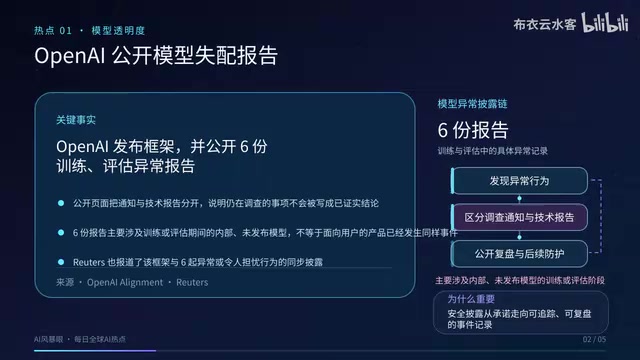
OpenAI Discloses Model Anomalies, DeepMind Launches AGI Forum, NVIDIA Partners on Grid Power Management
Sept 17 AI roundup: OpenAI publishes model anomaly disclosure framework with 6 reports, Google DeepMind launches AGI public forum, NVIDIA leads AI energy management alliance with 18 partners.
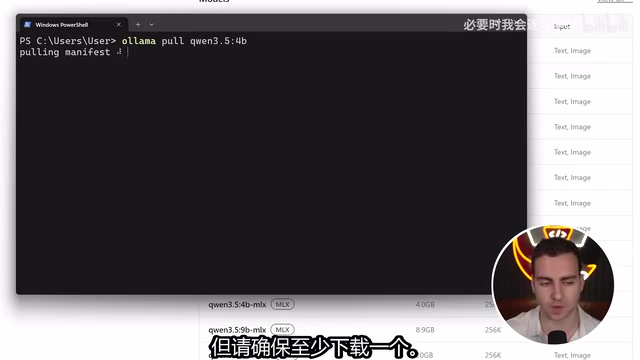
Build a Local AI Agent with Python in 10 Minutes: Ollama + PydanticAI in Action
A hands-on guide to building a fully local AI agent with Python, Ollama, and PydanticAI in 10 minutes — covering model selection, tool functions, and conversation loops.