Zhipu GLM-5.2 Fully Released, AI Regulatory Storm Hits Simultaneously

GLM-5.2 launches for Coding Plan users as AI regulatory pressure mounts on Anthropic and OpenAI.
Zhipu has fully rolled out GLM-5.2 to Coding Plan users, featuring EM-level long-context support and HIGH/MAX reasoning tiers, with an MIT-licensed open-source version coming next week. At the same time, Anthropic was forced to pull two models due to U.S. export controls, and OpenAI faces a multi-state attorney general investigation — signaling that stricter AI regulation is becoming the new normal.
Zhipu GLM-5.2: Full Rollout for Coding Plan Users
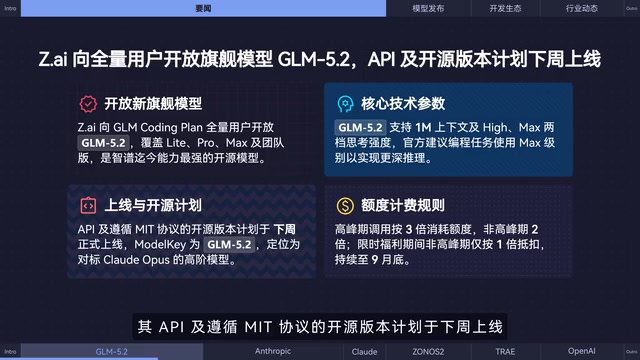
Domestic large language models are once again in the spotlight. Zhipu officially announced that its latest flagship model, GLM-5.2, is now fully available to all GLM Coding Plan users. Notably, the existing GLM-5.1 will be automatically routed to GLM-5.2 — users don't need to switch manually and can seamlessly benefit from the new model's enhanced capabilities.
From a technical standpoint, the upgrades in GLM-5.2 are substantial. The model supports an extremely long context window (EM-level) and offers two tiers of reasoning depth: HIGH and MAX.
Background: Context Windows and Long-Context Technology A context window is the maximum amount of text a large language model can process in a single pass — it directly determines how much conversation history and document content the model can "remember." Early GPT-3 supported only around 4K tokens; GPT-4 expanded that to 32K. In recent years, advances in positional encoding techniques (e.g., RoPE, ALiBi) and attention mechanism optimizations (e.g., Flash Attention, sliding window attention) have made million-token context windows a standard feature in flagship models. "EM-level" typically stands for Extremely Mega — referring to an exceptionally large-scale context capable of handling hundreds of thousands to millions of characters. This is particularly valuable for use cases like code repository analysis and long-horizon task planning.
Zhipu officially recommends using the MAX tier for coding tasks to unlock deeper reasoning capabilities. The two-tier design is quite thoughtful — use the HIGH tier for fast-response scenarios to conserve resources, then switch to MAX for complex code generation and multi-step reasoning tasks to ensure quality. It strikes a balance between cost and performance.
What the developer community is perhaps most excited about is that an open-source version under the MIT license is confirmed to launch next week.
Background: The MIT License and the Open-Source Licensing Ecosystem Open-source licenses are essentially legal frameworks that define the rights and obligations of anyone who uses, modifies, or distributes software. Major licenses generally fall into three categories: permissive licenses like MIT and Apache 2.0, which allow commercial use without requiring derivative works to be open-sourced; copyleft licenses like the GPL family, which require derivative works to also be open-sourced; and weak copyleft licenses (LGPL) that fall somewhere in between. For AI models, the MIT license means companies can integrate a model directly into commercial products, fine-tune it, and release their modifications as closed source — with no obligation to share code back to the original authors. This is why models released under MIT or Apache 2.0 tend to build commercial ecosystems more rapidly, attracting more enterprise users and downstream developers.
The MIT license is one of the most permissive open-source licenses available, placing almost no restrictions on commercial use or derivative works. For teams looking to deploy locally or build custom solutions on top of the model, this is a significant advantage.
Continued Benefits — A Genuine Gesture
On the commercial side, Zhipu has also shown considerable goodwill. Existing perks — including doubled credits during off-peak hours and cash offset benefits — will continue through the end of September. This extended incentive period reflects Zhipu's aggressive push to capture the developer ecosystem: by lowering the barrier to entry and offering generous credits, the company aims to rapidly grow its user base and stake its claim in the high-demand coding assistant space.
Anthropic Hit by Export Controls, Forced to Pull Models
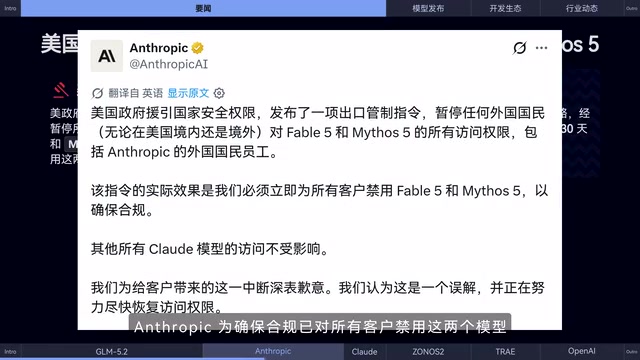
In sharp contrast to Zhipu's high-profile launch, Anthropic is navigating a regulatory storm. According to reports, the U.S. government issued an export control directive to Anthropic on national security grounds, requiring the suspension of all foreign user access to two models: Fable 5 and Methos 5.
Background: The Legal and Political Context of AI Export Controls The legal basis for U.S. export controls on AI models primarily derives from the Export Administration Regulations (EAR) and rules issued by the Bureau of Industry and Security (BIS) under the Department of Commerce. Starting in 2022, the U.S. placed advanced GPU chips (such as the A100 and H100) on export control lists, marking a clear signal that AI compute infrastructure had been designated as strategic assets. Controls on frontier AI models themselves — as a form of "soft compute power" — are a natural extension of this trend. When a model's capabilities reach a level where it could be applied to military simulations, cyberattack planning, or sensitive research areas like bioweapons, its cross-border availability may trigger national security review. The "cross-domain methodology" referenced in Anthropic's statement refers to a specific technical approach or capability boundary, not the model's general intelligence — and this distinction is at the heart of Anthropic's dispute with the government's rationale.
To ensure compliance, Anthropic immediately disabled both models for all customers. Other models remain unaffected. This response reflects the cautious stance companies must take under regulatory pressure — better to fully suspend a sensitive model than risk non-compliance.
Dispute and Response
One notable detail: Anthropic has pushed back on the government's reasoning. The company stated that the government's justification is based on a "narrow, non-general cross-domain methodology" and believes it represents a misunderstanding of the technology. Anthropic says it is actively working to restore access to the affected models.
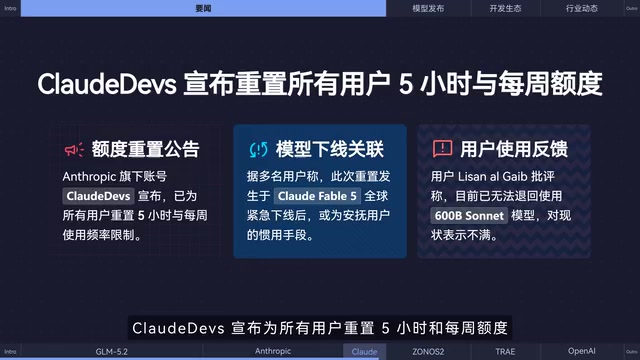
Following Fable 5's emergency takedown, Anthropic moved quickly to compensate users, announcing a reset of 5 hours of usage credits and weekly quota for all users to mitigate the disruption. The episode once again underscores the increasingly sensitive geopolitical nature of frontier AI models — AI capabilities have been explicitly folded into the framework of national security and export control.
Open-Source TTS Newcomer: Zonos 2 Arrives
The text-to-speech space also has fresh news. Zephyra has open-sourced a TTS model called Zonos 2 under the Apache 2.0 license. The model's architecture is noteworthy: it uses a Mixture of Experts (MoE) design with 8B total parameters, but only 900M active parameters during inference.
Background: The MoE Architecture Explained The Mixture of Experts (MoE) architecture was introduced by Google Brain in 2017. The core idea is to split a large neural network into multiple "expert" sub-networks and use a lightweight "router" (Gating Network) to dynamically select which experts to activate for each input. In Zonos 2's case, the 8B parameters are distributed across multiple expert modules, but during each inference pass, the router activates only about 900M worth of expert parameters — the rest remain dormant. This means an MoE model's actual compute during inference is far lower than a dense model of equivalent parameter count, while still retaining a large parameter capacity during training to learn diverse knowledge and skills. Well-known models like GPT-4 and Mixtral 8x7B both use MoE architecture, which has become one of the mainstream approaches for achieving high efficiency with large parameter counts.
The core advantage of MoE is that only a subset of expert networks are activated per inference pass, dramatically reducing actual compute cost while maintaining strong performance. The combination of 8B total parameters and 900M active parameters means Zonos 2 can run stably on relatively modest hardware.
Feature-wise, Zonos 2 focuses on high-fidelity speech synthesis and zero-shot voice cloning, with weights now available for download.
Background: Zero-Shot Voice Cloning Zero-shot voice cloning refers to a model's ability to synthesize any text in a target speaker's voice using only a few seconds to tens of seconds of reference audio — without any additional training on that speaker. This capability relies on a speaker encoder that extracts voice characteristics into a fixed-dimensional embedding vector, which is then injected into the speech generation module to modulate the output timbre. Commercial and research systems such as ElevenLabs and Microsoft's VALL-E have already brought this technology to practical use. However, it has also raised serious ethical concerns around voice forgery and voiceprint fraud. The open-sourcing of a high-fidelity zero-shot cloning model further lowers the barrier to accessing such capabilities. How to build abuse-prevention mechanisms in an open ecosystem will be an important challenge for the industry going forward.
The Apache 2.0 license is similarly friendly to commercial use, making it well-positioned for rapid adoption in voice assistant applications and audio content production. The steady stream of open-source TTS models continues to lower the technical barrier to high-quality speech synthesis.
More Industry Updates
Beyond the major headlines, a few other items are worth noting from the day.
Usage Quota Reset
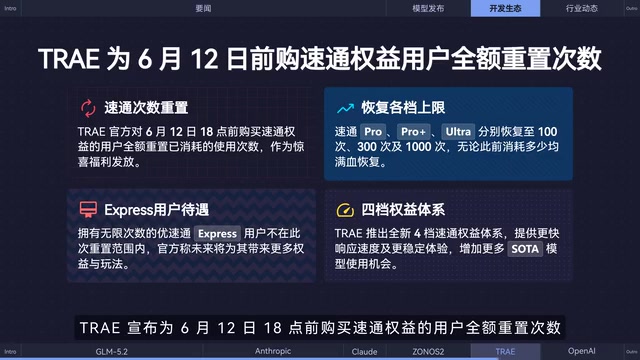
DRA announced a full reset of usage counts for users who purchased fast-pass access before 6:00 PM on June 12. Quotas will be restored to their full values — 100, 300, or 1,000 uses depending on the tier. These quota resets have recently become a common practice among AI service providers looking to stabilize user expectations and reward early supporters.
OpenAI Under Multi-State Investigation
According to media reports, a coalition of U.S. state attorneys general has launched an investigation into OpenAI and issued subpoenas demanding documents covering a broad range of business activities, including user data handling and model performance. OpenAI stated that it is actively cooperating with the investigation.
Background: The Multi-State Attorney General Coalition Investigation Mechanism Multi-state attorney general coalition investigations are a common federal-state coordinated enforcement mechanism in the U.S. They have historically been used in major cases such as the Microsoft antitrust case (1998) and large-scale tech company privacy litigation. Each state's attorney general independently holds enforcement authority under their state's consumer protection and privacy laws. Joint action not only pools evidence and resources across states but also creates stronger negotiating leverage, pressuring investigated companies to make behavior changes or reach settlements at the national level. A subpoena is a legal tool used during the investigation phase requiring a company to produce specific documents and data — it is not equivalent to an indictment, but does signal the possibility of further enforcement action. The fact that OpenAI is being asked to provide documents related to user data handling and model performance suggests the investigation may focus on areas such as data compliance, misrepresentation, or consumer rights.
This parallels Anthropic's export control situation — leading AI companies are increasingly becoming focal points of regulatory scrutiny. From data compliance to export controls, from user privacy to model safety, the era of unchecked expansion in the AI industry is drawing to a close. A much stricter compliance environment has arrived.
Closing Thoughts
Looking across today's developments, a clear dual narrative emerges: on one hand, model capabilities continue to advance — as seen with Zhipu's GLM-5.2 and Zonos 2 — and the open-source ecosystem keeps flourishing. On the other hand, regulatory signals are growing louder and clearer. Whether it's Anthropic's export control situation or OpenAI's multi-state investigation, AI companies are facing an increasingly complex compliance landscape. The parallel tracks of accelerating technology and tightening regulation are the defining reality of the AI industry today.
Key Takeaways
Related articles
Understanding GitHub's Availability Report: Platform Stability and Developer Response Strategies
Deep dive into GitHub's monthly availability report: analyzing service degradation impacts, CI/CD fault tolerance, and platform dependency risk strategies for resilient development.
OpenAI's Claim of Solving a Millennium Prize Problem Sparks Academic Controversy
OpenAI claims its AI solved a Millennium Prize Problem, sparking debates over attribution, verification, and AI's role in reshaping mathematical research.
Ledoit-Wolf Covariance Shrinkage in Practice: 57% Lower Turnover + 10x GPU Acceleration
Learn how Ledoit-Wolf covariance shrinkage reduces portfolio turnover by up to 57% and how cuML GPU acceleration cuts backtest time from 1.5 hours to 9 minutes.