Zod Explained: Define Once to Get TypeScript Type Inference and Runtime Validation
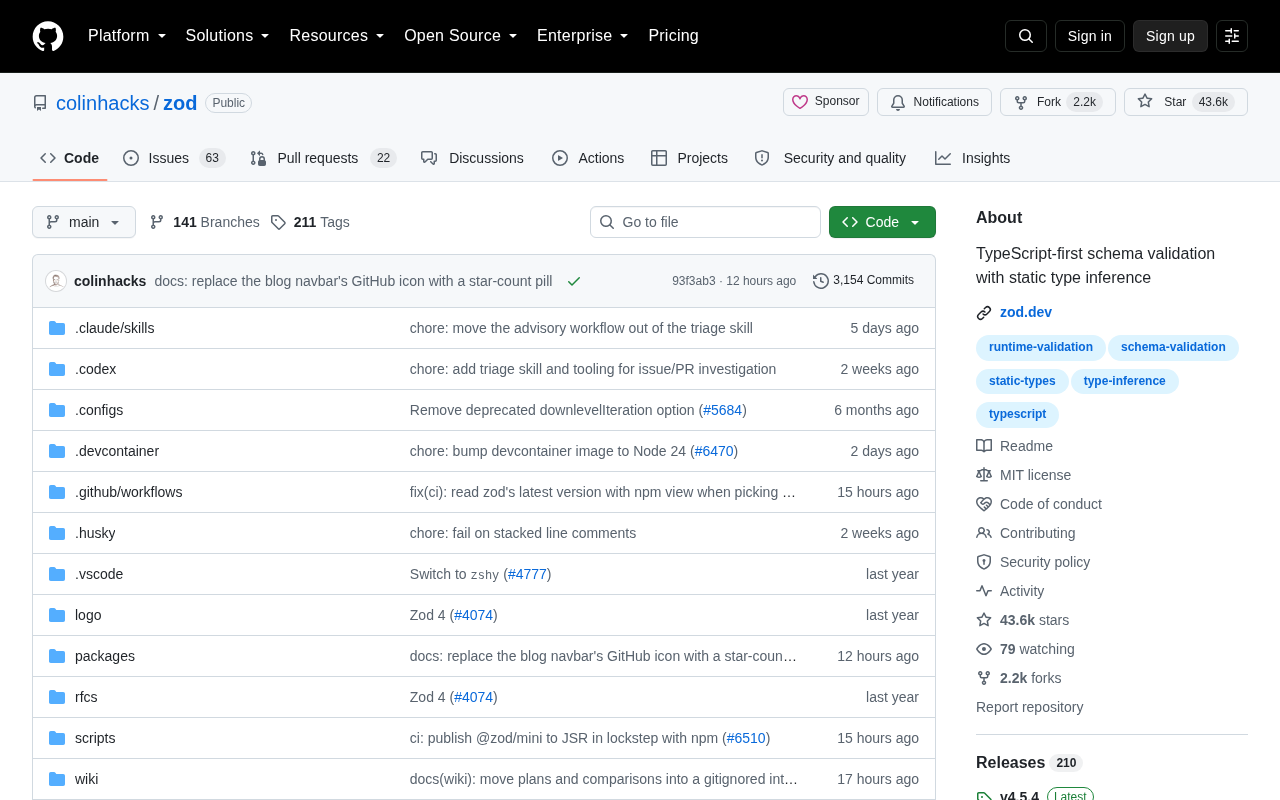
Zod lets you define a schema once to get both TypeScript types and runtime validation.
Zod is a TypeScript-first schema validation library that bridges the gap between static types and runtime validation. By defining a schema once, developers get automatic type inference and runtime data checking — eliminating duplicated code. Widely adopted with 43K+ GitHub Stars, Zod integrates with tRPC, React Hook Form, and AI SDKs for use cases ranging from API validation to LLM structured output.
In modern TypeScript development, how to ensure data correctness at runtime without duplicating type definitions has long been a pain point for developers.
The Gap Between TypeScript's Type System and Runtime Validation
TypeScript is a superset of JavaScript that provides static type checking at compile time, helping developers catch type errors during the coding phase. However, TypeScript's type information is completely erased after compilation to JavaScript, meaning these types can't be used for data validation at runtime.
This creates a fundamental problem: when an application receives data from external sources (such as API responses, user input, or configuration files), TypeScript can't guarantee that the actual data structure matches the type definitions. Developers must write additional runtime validation code to ensure data safety, leading to duplicated maintenance of type definitions and validation logic.
Traditional solutions include manually writing if-checks, using JSON Schema with validation libraries, or adopting decorator-based approaches like class-validator. But all of these suffer from code redundancy, type synchronization difficulties, or steep learning curves. Zod, an open-source library created by Colin McDonnell, offers an elegant answer. By using schema definitions as the single source of truth to simultaneously generate types and validation logic, it fundamentally eliminates this duality. The project has earned over 43,576 Stars on GitHub and continues to grow by hundreds of new Stars daily, making it one of the most popular schema validation solutions in the TypeScript ecosystem.
What Is Zod
Zod is a schema declaration and validation library designed with a TypeScript-first philosophy. Its core advantage is that you only need to define a data structure (schema) once to get both runtime validation and static type inference — no need to maintain separate interface definitions and validation logic.
Schema-Driven Development
A schema is a formal description of a data structure that defines what fields data should have, the type of each field, and related constraints. In traditional development, schemas typically exist as JSON Schema, XML Schema, or OpenAPI specifications, primarily used for documentation generation and runtime validation.
Zod elevates the schema to a central role, forming a "schema-first" development paradigm. In this model, developers first define the data schema in code, then derive everything they need from it: TypeScript type definitions, runtime validation functions, error messages, and even API documentation.
The advantage of this approach is ensuring a Single Source of Truth. When a data structure needs to change, you only modify the schema definition, and the types and validation logic update automatically — greatly reducing maintenance costs and the risk of errors. In traditional approaches, developers often need to first define types in TypeScript, then separately write runtime validation code (e.g., manual if checks or JSON Schema). This is not only redundant but also prone to inconsistencies between type definitions and actual validation logic. Zod solves this problem entirely with its "define once, use everywhere" model.
Getting Started: Core Code Example
Here's a simple user object example:
import { z } from "zod";

const User = z.object({
  username: z.string(),
  age: z.number().min(0),
  email: z.string().email(),
});

// Runtime validation
User.parse({ username: "alice", age: 25, email: "a@b.com" });

// Automatic static type inference
type User = z.infer<typeof User>;
// { username: string; age: number; email: string }
Type Inference Mechanism Explained
TypeScript's type inference refers to the compiler's ability to automatically deduce the types of variables and expressions based on code context, without requiring explicit type annotations from developers. Zod fully leverages TypeScript's advanced type features, including Conditional Types, Mapped Types, and Template Literal Types.
When you define an object schema using z.object(), Zod internally constructs a complex type expression. The z.infer utility type traverses this schema structure, converting each Zod validator (like z.string(), z.number()) into the corresponding TypeScript primitive type. For complex structures like nested objects, arrays, and union types, Zod performs type inference recursively.
With z.infer, you can automatically extract TypeScript types from a schema without manually writing interfaces. The power of this mechanism lies in its complete type safety. Even when you apply modifiers like .optional(), .nullable(), or .transform() to a schema, the inferred type will precisely reflect those changes. For example, z.string().optional() will be inferred as string | undefined. This "definition is the type" development experience is the key reason Zod has been so widely adopted.
Why Developers Love Zod
Zero Dependencies and Cross-Platform Compatibility
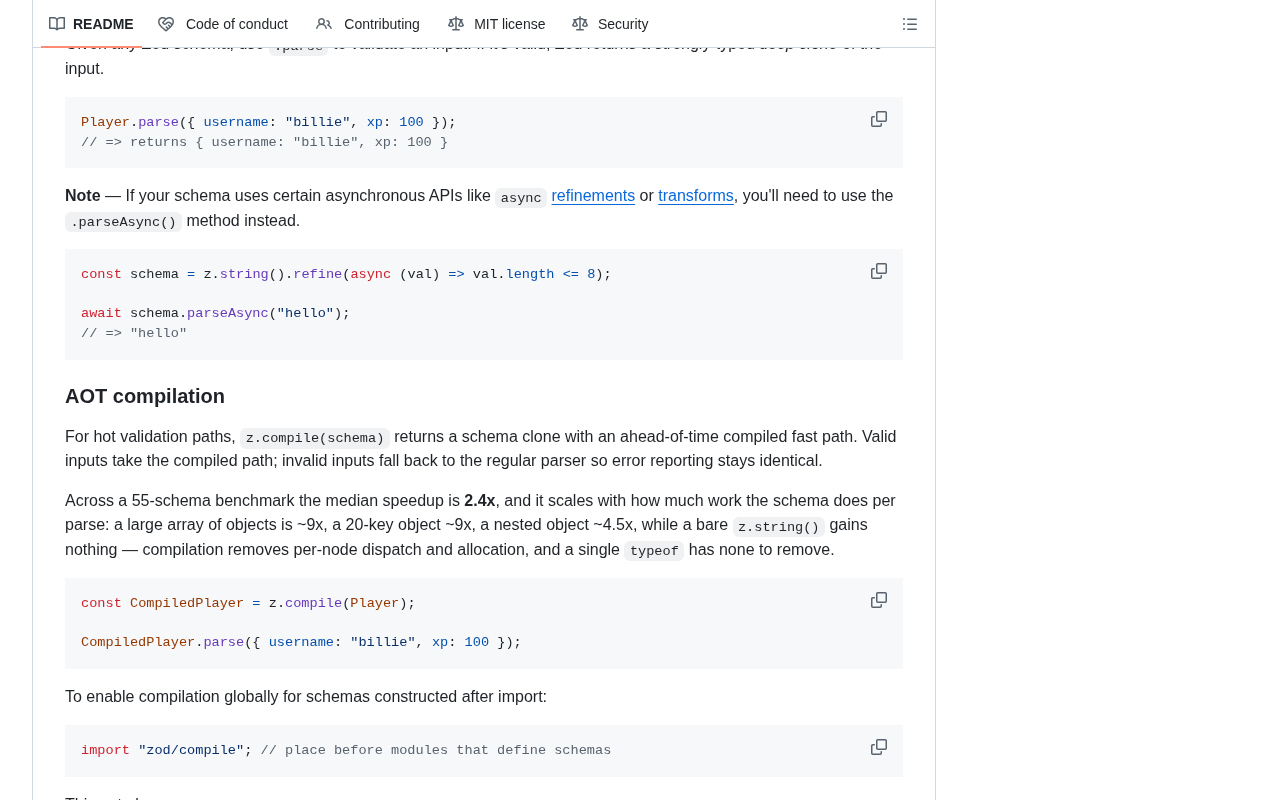
Zod has no third-party dependencies. Its core codebase is compact and runs seamlessly across browsers, Node.js, Deno, Bun, and other runtime environments. This lightweight design makes it ideal for integration into various libraries and frameworks without introducing additional dependency overhead.
Precise TypeScript Type Inference
Zod fully leverages TypeScript's type system. Whether dealing with nested objects, union types, optional fields, or complex data transformation logic, Zod can accurately infer the corresponding static types. Developers enjoy full IntelliSense and type checking right in their editor, significantly reducing the chance of runtime errors.
Rich Validation and Data Transformation API
A Fluent API is an object-oriented design pattern characterized by chainable method calls, where each method returns the object itself or a new object, forming a smooth call chain. This design is very common in the Builder Pattern and query constructors.
All of Zod's validators implement a chainable interface, providing an extremely rich API that covers the following common capabilities:
- String validation: email, URL, UUID, regex matching
- Number validation: minimum, maximum, integer, positive number constraints
- Composite types: arrays, enums, union types, recursive structures
- Data transformation: format conversion on parsed data via
.transform() - Custom rules: arbitrary custom validation logic via
.refine()
For example, z.string().min(5).max(20).email() applies minimum length, maximum length, and email format constraints in sequence. This design delivers excellent readability and composability, allowing developers to describe complex validation rules in an almost natural-language style. These APIs cover virtually all data validation needs in real-world business scenarios.
Typical Use Cases
Zod has become foundational infrastructure for many mainstream toolchains. Here are the most common use cases:
API Request and Response Validation
Validating data formats during front-end and back-end communication is Zod's most classic use case. Particularly in type-safe RPC frameworks like tRPC, Zod serves as the irreplaceable core tool for defining parameter and return value schemas.
tRPC and End-to-End Type Safety
tRPC (TypeScript Remote Procedure Call) is a modern framework for building type-safe APIs. Its core philosophy is sharing type definitions between front-end and back-end to achieve end-to-end type safety. Unlike traditional REST APIs or GraphQL, tRPC requires no code generation or separate type definition files.
In tRPC, API procedures defined on the back-end automatically infer input and output types, and the front-end receives full type hints and checking when making calls. Zod plays a critical role in this system: it both handles runtime validation of request parameter legality and provides static type information to tRPC through type inference.
This integration allows developers to build full-stack applications at minimal cost. When the back-end modifies API parameters, the front-end calling code immediately shows type errors, forcing developers to update accordingly and catching interface mismatches at compile time. The tRPC + Zod combination has become a standard part of the tech stack for modern full-stack frameworks like Next.js and Remix.
Form Validation
Combining Zod with form libraries like React Hook Form enables type-safe form validation. Define a schema once, and it can both drive front-end form error messages and validate data on submission.
Environment Variable Validation
Using Zod to validate environment configuration at application startup lets you catch missing or malformed configurations immediately, preventing runtime crashes caused by environment variable issues.
Structured Output Constraints for AI Applications
With the rise of large language models, Zod is increasingly used to constrain and validate LLM JSON output, ensuring that data returned by models conforms to expected structures.
Function Calling and Structured Output
Function Calling is a feature introduced by OpenAI in 2023 that allows large language models (LLMs) to proactively call external functions or APIs during a conversation. Instead of returning a natural language response directly, the model generates a structured JSON object describing which function to call and what parameters to pass.
The challenge with this technology is ensuring the model's JSON output conforms to the expected data structure. The traditional approach is to describe parameter formats in detail within the prompt, but this method is unreliable and hard to maintain. AI platforms like OpenAI have begun supporting JSON Schema to define function parameter structures, constraining the model to output data that matches the schema.
Zod plays an important role in this scenario. AI ecosystem tools like OpenAI, LangChain, and others directly or indirectly support defining function calling parameter structures via Zod schemas. Many AI SDKs (such as Vercel AI SDK and LangChain) support using Zod schemas directly to define function parameters, with the SDK automatically converting the Zod schema to JSON Schema for the model. This way, developers can define data structures using familiar TypeScript code that serves both runtime validation and AI output format constraints. This has been a major driver behind Zod's continued rise in popularity.
Ecosystem and Competitive Landscape
In the TypeScript validation space, Zod is not the only option. Major competitors include:
| Library | Features | Comparison with Zod |
|---|---|---|
| Yup | Established form validation library | Type inference experience less refined than Zod |
| Joi | Classic solution in the Node.js ecosystem | Not designed with TypeScript as a core focus |
| Valibot | Focused on minimal bundle size | Ecosystem and community scale still lag behind Zod |
| ArkType | Performance-oriented emerging solution | Maturity and ecosystem still developing |
With its mature ecosystem, large community, and deep integration with popular projects like tRPC and React Hook Form, Zod maintains a solid lead in this space. Behind its 40,000+ Stars is the continuous endorsement from countless developers who value its reliability and developer experience.
Conclusion
Zod's success lies in precisely addressing the core pain point of "separation between types and runtime validation" in TypeScript development. Through its "define once, benefit twice" design philosophy, it enables developers to ensure type safety while completing runtime data validation with minimal code.
Whether you're building Web APIs, handling form input, or constraining structured output from models in AI applications, Zod deserves a place as a standard tool in your toolkit. For any TypeScript project that values type safety, Zod is a choice that requires virtually no hesitation.
Related articles
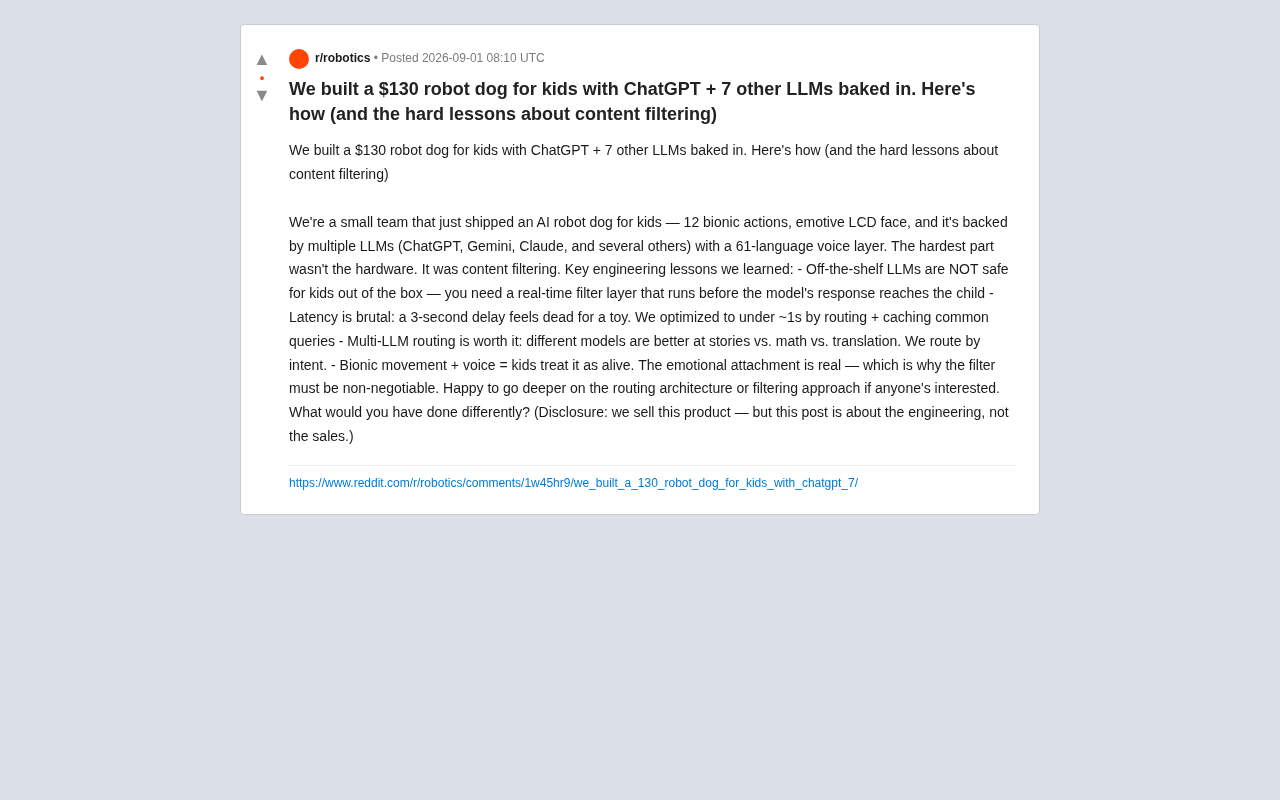
Building an AI Robot Dog for Kids: Multi-Model Routing, Content Filtering, and Latency Optimization
A $130 AI robot dog for kids integrates 8 LLMs with 61-language voice interaction. The team shares key engineering lessons on content safety filtering, multi-LLM intent routing, and sub-1-second latency optimization.

Can Omarchy Dominate the Sub-$1000 Laptop Market? An In-Depth Analysis
Omarchy, based on Arch Linux, shows unique advantages in the sub-$1000 laptop market. This analysis compares Windows and MacBook performance bottlenecks on low-spec hardware and examines why Omarchy enables cheap laptops to run smoothly, plus the ecosystem challenges and market prospects it faces.

AI Agent Beginner's Guide: Building a Creative Strategy Intelligent Assistant from Scratch
A complete guide to building a creative strategy AI Agent from scratch. No coding required — use tools like Dify and Coze to quickly build an intelligent assistant.