#schema validation
283 related articles

·2 min
Qwen3 Max Tops the Agentic Index Leaderboard: A Deep Dive into Agent Capability Evaluation
Qwen3 Max tops the Agentic Index leaderboard, excelling in tool use, multi-step reasoning, and code execution. A deep analysis of evaluation results and model selection in the agent era.
Read more →

·4 min
Why CodeAct Code-First Agents Haven't Won Yet: A Deep Dive into the Paradigm's Dilemma
Deep analysis of why CodeAct code-first agents haven't replaced ReAct chat-first frameworks. Examining model training bias, protocol limitations, MCP design flaws, and sandbox challenges.
Read more →

·3 min
A Complete Guide to AI Agent Observability and Evaluation Tech Stacks
Deep dive into three technical approaches for AI Agent observability and evaluation: LangSmith native integration, open-source self-hosted solutions like LangFuse, and unified platforms like Lyzr.
Read more →

·3 min
OpenAI Prepaid Credits Vanish Without Records: An Analysis of API Billing Transparency Issues
A developer found OpenAI prepaid credits marked consumed with no usage records available. We analyze API billing transparency issues and offer practical self-protection tips.
Read more →

·4 min
Should You Build or Outsource Your Agent Evaluation Framework? An Open-Source Author's Deep Inquiry
Should AI Agent reliability verification be built in-house or outsourced? An open-source author's candid question sparks industry reflection on eval frameworks.
Read more →

·3 min
Space OCR: A Deep Dive into the Self-Verifying Intelligent OCR Tool
Space OCR is an intelligent OCR tool that self-verifies its answers, supporting structured data extraction from receipts, invoices, and forms with data provenance and auto-validation capabilities.
Read more →

·2 min
LangGraph Studio Hidden Features: Practical Tips for Visually Debugging Agent Workflows
Explore LangGraph Studio's hidden features including time travel debugging, interactive state editing, and human-in-the-loop testing to efficiently debug AI Agent workflows.
Read more →

·3 min
Devin's Stacked PRs Feature Explained: Automatically Splitting Large Tasks into Reviewable PR Stacks
Devin launches Stacked PRs to automatically split large tasks into small reviewable PRs with auto rebase, conflict resolution, and CI validation.
Read more →

·2 min
PraiseEngine: An AI Interview-Style Tool for Collecting Customer Testimonials for SEO Marketing
PraiseEngine is an AI-native testimonial platform that uses 3-question adaptive AI interviews to replace blank text boxes, helping businesses efficiently collect high-quality customer reviews with JSON-LD structured data and SEO-friendly pages.
Read more →

·3 min
Reflections After 10 Years as a Data Engineer at Airbnb: A Deep Retrospective on Semantic Layer Development and Data Culture
A data engineer reflects on nearly 10 years at Airbnb, sharing insights on hyper-growth challenges, semantic layer development, data-driven culture, and career lessons spanning a complete company lifecycle.
Read more →

·3 min
Dex: Turn Your AI Coding Assistant into an Analytics Engineer with One Command
Dex by Exmergo adds analytics engineering skills to Claude Code, Cursor & other AI assistants via one command, with read-only schema mapping, cost guardrails, and drift detection.
Read more →

·3 min
Why Local Agents Crash: A Real-World Report from 4,265 Actual Sessions
A developer spent a month testing 4,265 Claude Code/Codex sessions, revealing why local Agents crash on consumer hardware: tool lists consume 41% of cache, q4_0 quantization traps, and eviction strategy ceilings of only 11.88%.
Read more →

·2 min
Repaint Socials: A New AI Website Building Approach That Generates Sites from Social Media Profiles
Repaint Socials is an AI website builder that auto-generates complete websites from Google Business Profile, Instagram, and Facebook pages in minutes.
Read more →

·3 min
Kimi-K3 Scores 60.4% on ARC-AGI-2: A Breakthrough in Abstract Reasoning
Kimi-K3 scores 60.4% on ARC-AGI-2, far surpassing most LLMs. This article analyzes what ARC-AGI-2 tests, what this score means for abstract reasoning, and its implications for the AI industry.
Read more →

·3 min
Ollama + Qwen-Agent: Building a Local Private AI Assistant — From Deployment to Security Best Practices
A complete guide to building a local private AI assistant with Ollama and Qwen-Agent. Covers RAG knowledge integration, voice interaction, and permission isolation for a secure local AI Agent architecture.
Read more →

·3 min
DuckLake Time Travel: Version Rollback and Snapshot Queries for a Lightweight Data Lake
Explore DuckLake's time travel feature for lightweight data lakes—how snapshot-based version rollback enables data auditing, error recovery, and historical analysis, compared with Iceberg and Delta Lake.
Read more →

·3 min
DuckLake Time Travel: Version Rollback and Snapshot Queries for a Lightweight Data Lake
Explore DuckLake's time travel feature for lightweight data lake version rollback and snapshot queries, with comparisons to Iceberg and Delta Lake.
Read more →
·2 min
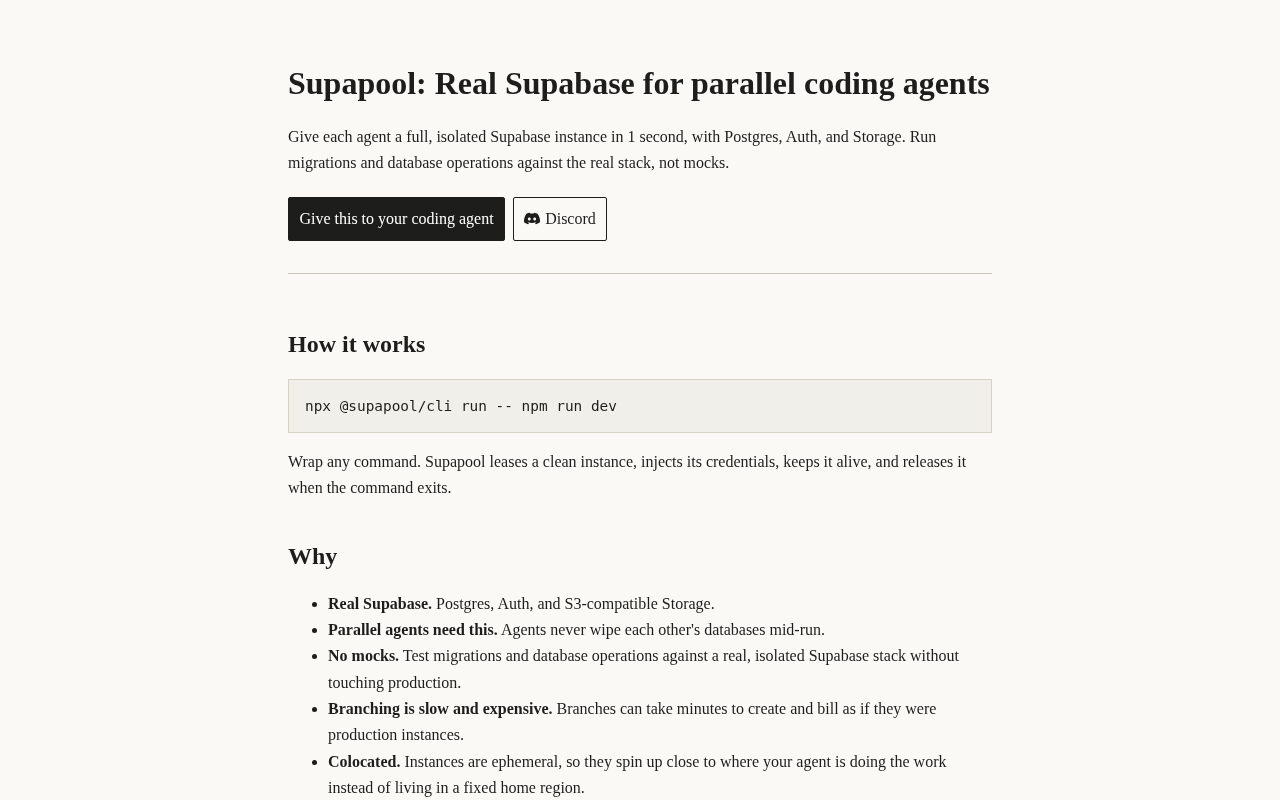
Supapool: Creating Isolated Databases for AI Coding Agents in 400 Milliseconds
Supapool uses pool prewarming to create isolated Supabase database instances in 400ms for AI coding agents like Claude, Cursor, and Devin, solving the database isolation challenge.
Read more →

·2 min
Supapool: Creating Isolated Databases for AI Coding Assistants in 400 Milliseconds
Supapool uses pool prewarming to create isolated Supabase database instances in 400ms for AI coding assistants like Claude, Cursor, and Devin—a prime example of AI-native infrastructure.
Read more →

·2 min
LangChain or LangGraph? Choosing the Right Framework for Production-Grade AI Applications
In-depth analysis of core differences between LangChain and LangGraph, exploring why more teams are migrating to LangGraph for production AI apps, with framework selection guidance.
Read more →