#提示词工程
142 related articles

Midjourney Lighting Prompts: Give Light a Clear Source
A practical guide to Midjourney lighting prompts: drop vague terms like "cinematic lighting" and build a prompt framework around identifiable sources—window light, hard side light, and rim light—verifying results through shadow direction and softness.

Deep Review: The 5 Best Prompt Management Tools of 2026
An in-depth review of the 5 best prompt management tools of 2026: Braintrust, PromptLayer, LangSmith, Langfuse, and Agenta. Compare versioning models, evaluation workflows, deployment, and rollback capabilities to help AI teams choose the right prompt engineering solution.

A Multi-Agent Review Panel Was Confidently Wrong: Lessons from a Million Tokens
A real test of 158 agents and 28M tokens in a multi-agent code review pipeline: one unanimous wrong verdict exposed framing effects, success-shaped failures, and the missing recombination pass. Four reusable fixes.

Customer Service AI Read Its System Prompt Aloud to a User: A Discount Code Leak Incident
A customer service AI prompt leak reveals that users only need to ask the assistant to 'print everything above' to expose a hidden discount code—an OWASP LLM Top 10 risk.

The Truth About Prompt Cache Invalidation: A Misplaced Timestamp Costs You Full Price on Every Call
Prompt caching enabled but not working? The culprit may be a timestamp on line one. This article explains prefix matching and how misplaced dynamic content forces full-price billing on every call.

How to Prompt LLMs to Generate Genuinely Useful Test Cases
LLM-generated test cases often come out generic—but the problem is the prompt, not the model. This guide covers the four elements of effective prompts, five reusable templates, common AI testing pitfalls, and a review checklist to help QA teams actually ship AI-assisted testing.

Vibe Coding Beginner's Guide: I Built a Production-Ready Product with AI Without Writing Code
No-code product building? A Bilibili creator tests Vibe Coding with Claude: from empty folder to a working Hangzhou trip planner, six crashes all fixed, distilling five key actions plus three launch guardrails.

One Prompt, One Job: When to Split a Saved Prompt
Saved prompts getting too long and losing quality? Here are four signals of prompt overload, a four-step splitting method, and how to draw the right split boundaries in prompt management.

Prompt Engineering for Beginners: Core Concepts from Prompts to Engineering
From prompts to prompt engineering: a systematic breakdown of core concepts, six workflow steps, and four goals of AI instruction design, plus an in-depth analysis of prompt limitations.

Prompt Engineering for Absolute Beginners: Eight Chapters from Basics to Mastery
A beginner-friendly prompt engineering tutorial covering eight chapters: from prompt definitions and six core writing principles to basic structures, advanced techniques like CoT, automated optimization, prompt attacks and defense, and real-world LLM scenarios—helping AI users go from beginner to mastery.
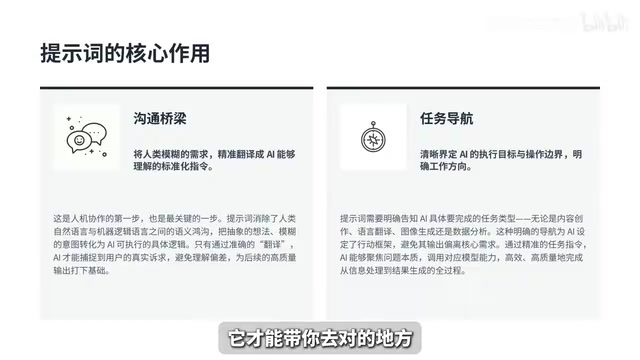
Prompt Engineering for Absolute Beginners: A Complete Guide from Concepts to Practice
A systematic guide to prompt engineering for beginners: prompt definitions and four key roles, the six-step process and four goals of prompt engineering, its value, and limitations including capability ceilings, hallucinations, and context length constraints.

Prompt Engineering for Beginners: From Prompts to a Systematic Approach
A systematic overview of prompt engineering: the difference between prompts and prompt engineering, four roles, six-step process, four goals, and key limitations.

AI Agent System Prompt Template: The Five Essential Modules
Most AI Agent system prompts fail by mixing permanent instructions with perishable facts. This article breaks down the five modules to keep (role and scope, source of truth, cite-only rule, escalation triggers, refusal rules), the four things to remove, and includes a complete reusable template plus testing methods.

Metacognitive Prompting, Five Stages, Tested: One Gate Takes Accuracy from 5/17 to 15/17
A reproducible ablation of metacognitive prompting: a gated self-critique pipeline lifts accuracy from 5/17 to 15/17, while removing the gate zeroes out all gains. Stage-by-stage attribution shows the confidence stage misleads, and over-extrapolation defeats all five stages.

I Audited 27 of My Own AI Prompts and Found 22 Were Broken — A Four-Part Prompt Framework
A developer audited 27 prompts and found 22 unreliable. Learn the 3 failure patterns and a 4-part Role-Context-Constraints-Output framework to make LLMs production-ready.

Stop Writing Prompts Like Prose: Use the Four-Part Contract to Kill LLM Drift
LLM outputs drifting between runs? The fix isn't better wording — it's structure. Learn the four-part prompt contract (Role, Task, Constraints, Output) with code validation to ship stable, debuggable prompts.
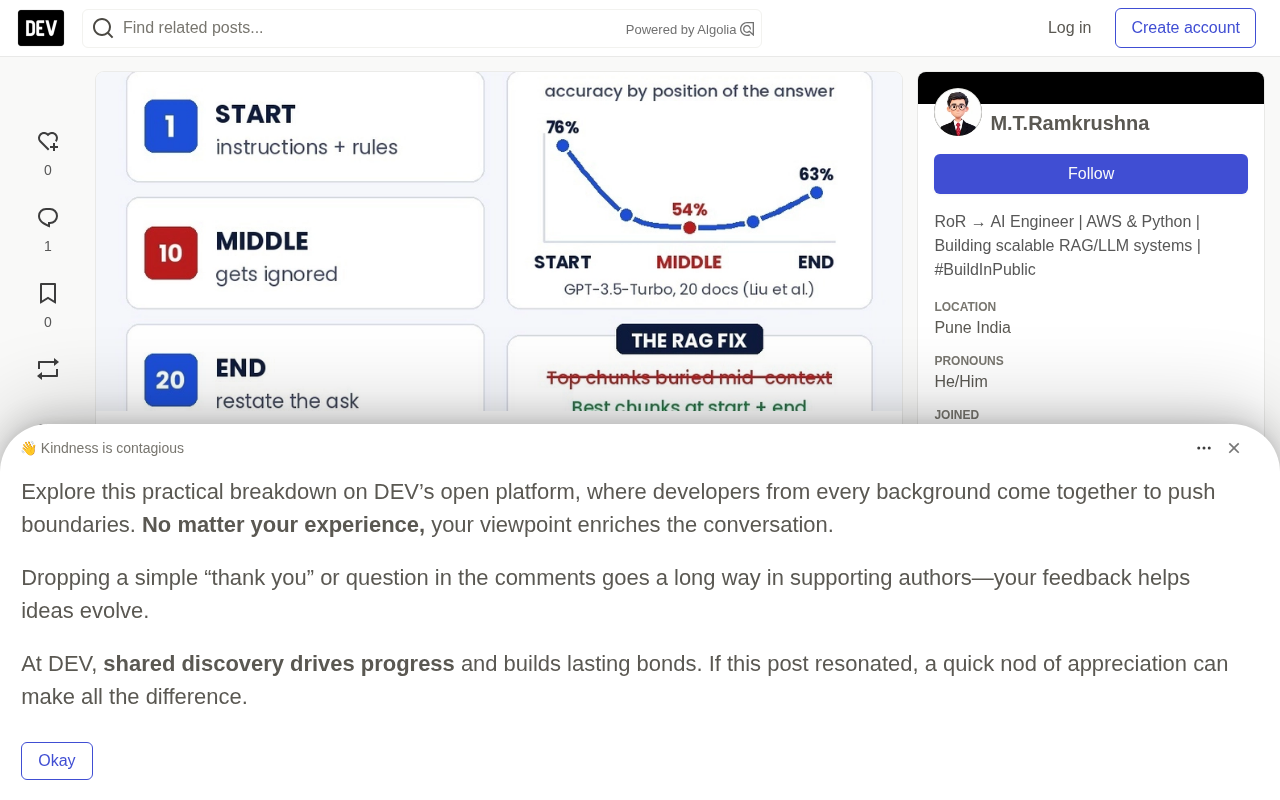
Lost in the Middle: Why LLMs Miss Critical Information in Long Prompts — and What to Do About It
LLMs show a U-shaped accuracy curve on long prompts — middle content gets ignored. Learn what the Lost in the Middle research found and how to fix prompt layout and RAG placement.

AI Character Consistency Across Multiple Scenes: From Character Profiles to Prompt Templates
Learn how to keep AI-generated characters consistent across scenes. This guide covers character profiles, reference image reuse, prompt templates, storyboarding, and image-to-video workflows.

Can LLMs Be Data Detectives? A Benchmark Where Honesty Matters More Than Price
A Kaggle benchmark tests whether LLMs stay honest in data pipeline debugging. The cheapest GPT-6 Luna never guesses; models 40x pricier still do. A rulebook beats a costlier model.

Local LLM Giving Off-Target Responses? A Systematic Debugging Approach: Locate First, Then Adjust
Local LLM giving off-target or confused responses? This guide offers a systematic approach: check task and input first, then the chat template, and only adjust sampling parameters last — one change at a time.