#AI assistant memory
1474 related articles

·3 min
LightMem-Ego: The AI Memory Assistant That Remembers the Details of Your Daily Life
LightMem-Ego is an AI life assistant with long-term memory — tracking object locations, meetings, and life events over time. A deep dive into its technology and real-world challenges.
Read more →
Adaptive Recall: A Deep Dive into Pers…
·2 min
Adaptive Recall: A Deep Dive into Persistent Memory for AI Assistants via MCP
Adaptive Recall uses MCP (Model Context Protocol) to give AI assistants like Claude persistent memory across sessions, featuring vector storage, semantic retrieval, and adaptive forgetting.
Read more →

·5 min
MemoryOps AI: Building a Governable, Auditable Memory Layer for AI Assistants
MemoryOps AI is an open-source governed memory runtime that gives AI assistants policy-before-storage validation, context admission, and deletion-proof lineage—solving compliance, multi-tenancy, and deletion verification challenges in LLM memory systems.
Read more →
 Product Reviews
·2 min
AgentMemory: An Open-Source Solution for Giving AI Coding Assistants Permanent Memory
AgentMemory is an open-source persistent memory layer supporting memory sharing across 16 AI coding tools including Claude Code and Cursor. 95.2% retrieval accuracy, ~1900 tokens per session, local SQLite storage with zero privacy concerns.
Read more →
 Tutorials
·4 min
Hermes Agent in Practice: Building a Memory-Persistent AI Assistant with a Four-Layer Memory System
Deep dive into Hermes Agent's four-layer memory system architecture, covering Harness Engineering principles, Lark integration, persistent memory configuration, and autonomous Skill evolution for building AI assistants that never forget.
Read more →
 Product Reviews
·2 min
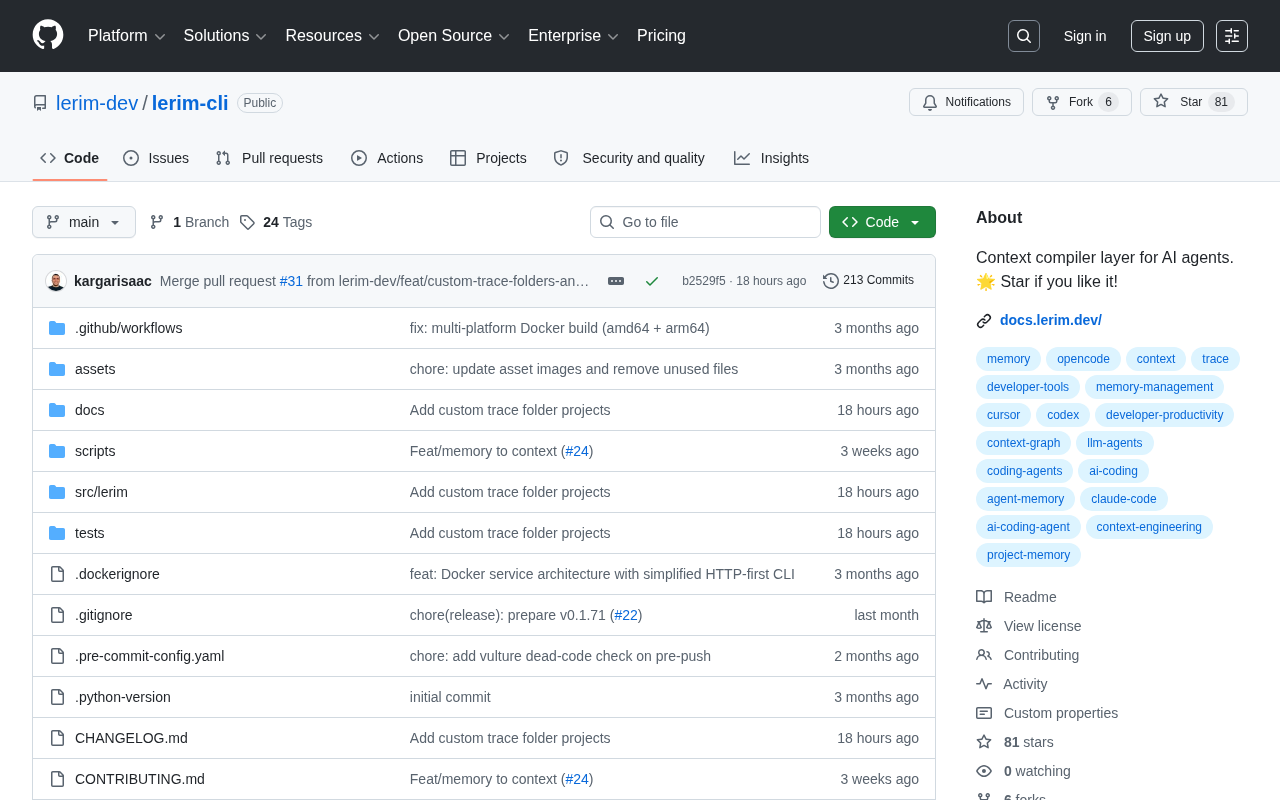
Lerim CLI: A Long-Term Memory Solution for AI Coding Assistants
Lerim CLI is an open-source background memory agent that automatically extracts reusable project memories from AI coding agent sessions, solving the cross-session context loss problem.
Read more →
 Tech Frontiers
·2 min
Claude Memory Compiler: An Open-Source Solution for Giving AI Coding Assistants Persistent Memory
Claude Memory Compiler is an open-source project that builds an evolving memory system for Claude Code through a three-layer automated pipeline, solving the persistent amnesia problem of AI coding assistants.
Read more →

·4 min
HortusFox v5.9 Released: An Anti-AI Open-Source Plant Management Application
HortusFox v5.9 "Summer Plants Release" adds per-plant attachments, sorting preference memory, and 15 bug fixes. This anti-AI open-source self-hosted plant management app prioritizes data sovereignty for gardening enthusiasts.
Read more →

·3 min
GitHub Daily · August 1: The Rise of SuperAgents and Generative AI's Mass Education Moment
GitHub trending Aug 1: ByteDance's deer-flow SuperAgent, Microsoft's GenAI course, 3D generation, voice cloning, and privacy-first tools shape the AI landscape.
Read more →

·2 min
qm: A Deep Dive into the Multiplayer AI Agent Harness for Team Collaboration
Deep dive into qm, a multiplayer AI Agent collaboration framework that uses state sync, real-time observability, and human takeover mechanisms to transform Agents from solo tools into team infrastructure.
Read more →

·3 min
How Cheap Can It Be to Serve a 2.8 Trillion Parameter Model? A Deep Dive into Inference Economics
Deep analysis of the real cost of serving a 2.8 trillion parameter model. From MoE sparse activation to batching scale effects and inference optimization, revealing why model size and serving cost are less correlated than assumed.
Read more →

·3 min
Self-Hosting a Code Review AI Agent: From Architecture Design to Engineering Implementation
A deep dive into building and self-hosting a code review AI Agent from scratch, covering architecture design, context management, model selection, and noise control.
Read more →

·4 min
Heretic Uncensoring Technology Explained: Practical Applications on Jamba2 and Qwen3.5 Open-Source Models
Deep dive into Heretic uncensoring technology applied to Jamba2-Mini, Qwen3.5-9B, and 27B open-source models, exploring how refusal rates dropped from 97% to 4% and the safety debates involved.
Read more →

·5 min
Have AI Doomers Actually Used AI? A Developer Exposes the Gap Between Hype and Reality
AI Doomers warn AI will destroy humanity, but have they actually built AI apps? A developer's sharp critique reveals the vast gap between AI demos and real engineering practice.
Read more →

·1 min
From Request-Based to Token-Based: What the Billing Model Shift in AI Coding Tools Really Means
AI coding tools are shifting from request-based to token-based billing. This article analyzes how the $75 monthly cap impacts developers and what it signals for the industry.
Read more →

·3 min
Practical Guide to Setting Up a Local AI Coding Environment on MacBook Pro M4
Complete guide to setting up a local AI coding environment on MacBook Pro M4, covering Ollama, MLX, Continue, Qwen3-Coder 30B configuration, and performance optimization strategies for 32GB RAM.
Read more →

·3 min
AI Costs Out of Control: Inference Expenses Skyrocketing—Who's Footing the Bill?
An in-depth analysis of why AI costs keep rising—inference expenses, premium model pricing, and context bloat—plus practical optimization strategies including model cascading, caching, and self-hosting.
Read more →

·3 min
GPT-5.6 Luna Review: Outperforms Google's Flagship at a Lower Price
GPT-5.6 Luna tops Google's flagship on the Artificial Analysis Intelligence Index while priced below Google's entry-level model. A deep dive into what this performance-cost breakthrough means.
Read more →

·3 min
13 Models, 4 Agents: Who Is the Best Coding AI?
A systematic evaluation of 13 LLMs, 4 agent frameworks, and 5 programming languages reveals the real differences in AI coding capabilities and optimal model-framework pairing strategies.
Read more →

·4 min
Tiling Window Management: A New Interaction Paradigm for Multi-Agent Conversations
Exploring tiling window management for multi-agent AI conversations: how it solves parallel monitoring and observability challenges, real-world limitations, and the evolution from chat boxes to control consoles.
Read more →