#AI code optimization
2921 related articles
 Tutorials
·3 min
4-bit QLoRA Fine-tuning LLaMA 3 in Practice: A Guide to Training 8 Billion Parameter LLMs on Consumer GPUs
Learn how to fine-tune LLaMA 3 8B on consumer GPUs using QLoRA and Unsloth. Covers 4-bit quantization, LoRA adaptation, Alpaca data format, training pipeline setup, and model deployment—runs on RTX 3090.
Read more →
 Tutorials
·4 min
Agentic RAG in Practice: Architecture Deep Dive and LangChain Implementation Guide
Compare traditional RAG vs Agentic RAG architectures, explore planning, tool use, and multi-step iteration capabilities, with full LangChain/LangGraph ReAct Agent code and ChatBoss project examples.
Read more →
 Product Reviews
·3 min
awesome-LLM-resources: A Comprehensive Analysis of the 8,200-Star LLM Learning Resource Repository on GitHub
In-depth analysis of the 8,200-star GitHub project awesome-LLM-resources, covering multimodal generation, Agents, model training, MCP protocol, and more — a one-stop LLM learning guide.
Read more →
 Tutorials
·2 min
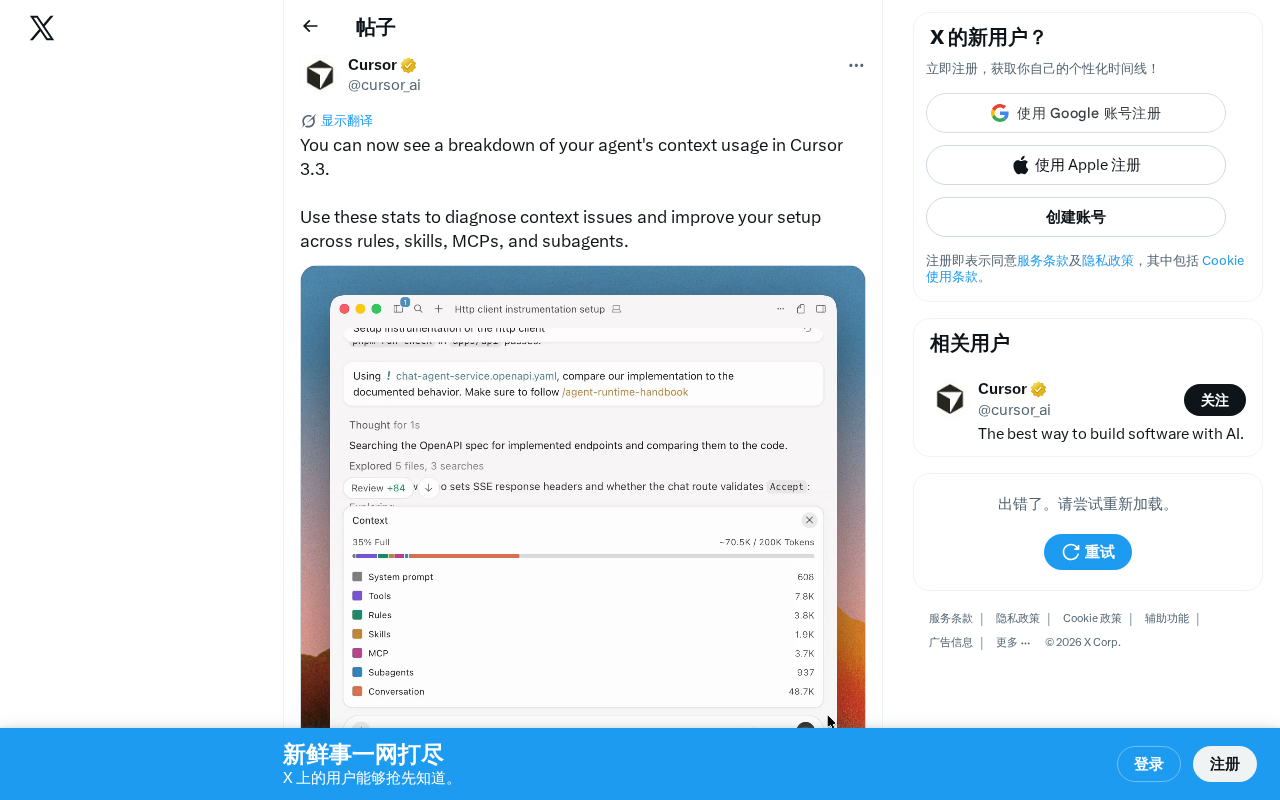
Cursor 3.3 Context Usage Analysis: A Complete Guide to Understanding and Optimization
Cursor 3.3 adds Agent context usage analysis, helping developers visualize Rules, MCP, Skills context consumption. Learn how to optimize AI programming efficiency.
Read more →
 Tech Frontiers
·2 min
Stability AI Composer 2 SDK at Half Price for Limited Time: How Developers Can Seize This Deal
Stability AI announces a limited-time 50% discount on Composer 2 SDK. This article breaks down the deal, Composer 2's core capabilities, and AI market pricing trends to help developers decide.
Read more →
 Tech Frontiers
·2 min
SWE-bench Opens Evaluation Environments and Training Recipes: Dramatically Lowering the Barrier to AI Coding Agent Development
SWE-bench opens evaluation environments, task sets, trajectories, and training recipes, dramatically lowering the barrier to AI coding agent development.
Read more →
 Tech Frontiers
·2 min
Cursor Launches Claude Opus 4 Fast Mode: 2.5x Faster, 6x More Expensive — Is It Worth It?
Cursor launches Claude Opus 4 Fast Mode with 2.5x speed but 6x cost. We analyze use cases, cost tradeoffs, and practical tips to help you decide if it's worth it.
Read more →
 Product Reviews
·3 min
ChuanhuChatGPT: A Comprehensive Analysis of the 15K-Star Open-Source Multi-Model Chat Interface
Deep dive into ChuanhuChatGPT, a 15K-star open-source project with multi-model access, Agent support, RAG file Q&A, GPT fine-tuning, and web search.
Read more →
 Expert Opinions
·3 min
The Blurring Line Between Vibe Coding and Agentic Engineering: Simon Willison's Deep Reflection
Django co-creator Simon Willison finds Vibe Coding and Agentic Engineering converging in practice. As AI tools grow reliable, where should engineers draw the line on trust and responsibility?
Read more →
 Tech Frontiers
·2 min
SWE-agent Multimodal Released: Image Viewing + Browser Debugging, A New Power Tool for Frontend AI Development
SWE-agent Multimodal officially released with image viewing and web browser debugging capabilities for automated frontend visual bug detection and fixes, plus the new SWE-bench Multimodal benchmark.
Read more →
 Tech Frontiers
·2 min
Qwen Continues to Lead on SWE-bench: The Rise of Open-Source AI Coding Models
Qwen team leads open-source models on SWE-bench, demonstrating strong software engineering capabilities. This article analyzes SWE-bench standards, Qwen's progress, and the value of open-source AI coding tools.
Read more →
 Tech Frontiers
·3 min
Cursor 3 PR Review Feature Explained: Complete Code Review Workflow Within Your Editor
Cursor 3 introduces native PR review with in-editor diffs, comments, commits, and review status. Learn about file tree navigation, changes picker, and AI-assisted code review potential.
Read more →
 Deep Dives
·2 min
Cursor SDK /orchestrate Explained: Recursive Multi-Agent Collaboration for Complex Programming Tasks
Cursor SDK launches /orchestrate skill, using recursive multi-agent spawning for complex tasks with 20% Token savings and 80% faster cold starts.
Read more →
 Tech Frontiers
·3 min
Cursor's Parent Company Anysphere Uses Composer to Train Next-Gen AI: How Bootstrapped Iteration Is Changing Code Generation
Anysphere uses previous-gen Composer to build RL training environments for next-gen Cursor AI. Explore how bootstrapped AI training reshapes code generation and the competitive landscape.
Read more →
 Deep Dives
·3 min
AgentPay: A Deep Dive into the Decentralized Payment Marketplace for Autonomous AI Agent Transactions
Deep dive into AgentPay, an open-source project enabling AI agents to autonomously provide DeFi optimization, smart contract auditing services and settle payments via stablecoins in a decentralized marketplace.
Read more →
 Product Reviews
·3 min
AutoGPT: A Deep Dive into the Open-Source AI Agent Platform with 180K Stars
Deep dive into the AutoGPT open-source project, covering its autonomous AI agent architecture, core features, use cases, and future development. Learn how this 184K-Star GitHub project makes autonomous AI accessible to everyone.
Read more →
 Research
·2 min
UK AISI Assessment Report: GPT-5.5 Cybersecurity Capabilities on Par with Claude Mythos
The UK AI Safety Institute (AISI) releases its GPT-5.5 cybersecurity assessment, showing vulnerability discovery capabilities on par with Claude Mythos—but GPT-5.5 is already publicly available, raising greater security implications.
Read more →
 Deep Dives
·4 min
Hugging Face Transformers: Deep Dive into the 160K-Star Open Source AI Framework
Deep dive into Hugging Face Transformers: the 160K-Star open-source framework covering Pipeline API, Auto Classes, multi-modal models, and the full HF ecosystem for AI inference and training.
Read more →
 Tutorials
·4 min
Dify AI Agent Tutorial: Build Tool-Calling & Smart Search with Zero Code
Learn how to build an AI Agent on Dify with zero code, covering Function Call vs ReAct modes, Exa search tool setup, time-awareness solutions, and Agent best practices.
Read more →
 Deep Dives
·4 min
Context Engineering Explained: The AI Paradigm Shift from Prompt to Context Engineering
Deep dive into Context Engineering: its core principles and practices. From Prompt Engineering to context design, orchestration, and optimization—exploring how Karpathy's new AI paradigm reshapes LLM app development and AI Agent construction.
Read more →