#Claude Code Dynamic Workflows
798 related articles

·2 min
Claude Code Dynamic Workflows Explained: How Multi-Agent Collaboration Is Changing AI Programming
Deep dive into Claude Code's Dynamic Workflows: how multi-agent parallel collaboration enables 750K-line code migrations, repo-wide bug hunts, and pre-launch red team validation.
Read more →
·3 min
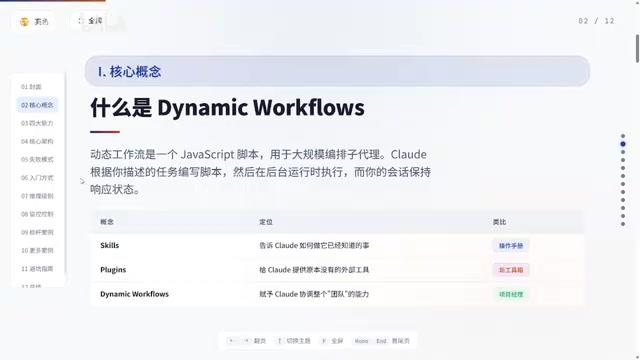
Claude Code Dynamic Workflows: Orchestrating Hundreds of Sub-Agents Working in Parallel
Deep dive into Claude Code Dynamic Workflows: enable parallel sub-agent orchestration via three methods for multi-agent collaboration and automated pipelines.
Read more →

·2 min
Claude Code Dynamic Workflows: A Complete Guide to Six Patterns and Ten Scenarios
Deep dive into Claude Code's dynamic workflow mechanism covering Agent, Parallel, and Pipeline functions, six orchestration patterns, and ten real-world scenarios with cost control tips.
Read more →

·2 min
Claude Code Dynamic Workflows Explained: A Hands-On Guide to Sub-Agent Orchestration and Reuse
Learn how Claude Code Dynamic Workflows orchestrate sub-agents for parallel tasks. Compare four collaboration modes, enable workflows, and save them for reuse.
Read more →

·3 min
Meta Muse Code: A Terminal AI Agent Built for Long-Horizon Programming
Meta launches Muse Code, a terminal AI agent powered by Muse Spark 1.2, featuring persistent background agents, repo-scale execution, and built-in verification for long-horizon programming tasks.
Read more →

·4 min
How Databricks Cut AI Coding Costs by 70%: Strategies and Insights
Databricks cut AI coding tool costs by 70% through intelligent model routing, prompt caching, context optimization, and self-hosted open-source models. Learn actionable strategies for controlling LLM inference costs.
Read more →

·2 min
BrowserOS neo: The Open-Source Tool That Lets AI Agents Control Your Browser
BrowserOS neo is an open-source browser built for AI agents, running locally with your existing credentials. Lets Claude Code, Codex and other AI assistants complete real web tasks on your behalf.
Read more →

·3 min
Reference: A Local Semantic Search Engine Built for AI Agents
Reference is a local semantic search tool for AI Agents that uses tree-sitter code-aware chunking, real-time indexing, and MCP Server integration to eliminate inefficient grep loops in AI coding assistants—all data stays on your machine.
Read more →

·2 min
Crew: A macOS Desktop Pet That Assigns Pixel Monsters to Your Claude Code Agents
Crew is a free macOS app that assigns pixel-style monsters to each Claude Code conversation and subagent, visually showing AI agent status through digging, sleeping, and waving animations with fully local data processing.
Read more →

·2 min
AI Programming Is Like Cooking Steak: It's All About Getting the Heat Right
Exploring the viral Hacker News analogy between AI programming and cooking steak: why developer judgment and experience are the critical "heat" that determines AI coding output quality.
Read more →

·3 min
Cursor's Auto Model Selection Controversy: Why Users Prefer Composer 2.5 Over Grok
Cursor users complain about auto model selection forcing Grok over their preferred Composer 2.5. Analysis of AI coding tool design flaws and user retention impact.
Read more →

·4 min
The Self-Building Agentic IDE: The Next Evolutionary Direction for AI Programming Tools
Exploring the Agentic IDE concept: a self-building, self-iterating intelligent development environment. A deep analysis of how AI programming tools evolve from passive assistance to autonomous evolution.
Read more →

·3 min
Qwen 3.8 Max Tops Agentic Benchmark: Is the Tipping Point for Local Deployment Approaching?
Qwen 3.8 Max tops the Artificial Analysis Agentic Index ahead of Opus 5. Reddit debates the gap between benchmark scores and real-world agent performance, and what it means for local deployment.
Read more →

·2 min
ChatGPT Reasoning Effort Slider Explained: A New Feature for Customizing AI Thinking Depth
OpenAI launches a reasoning effort slider for ChatGPT Plus and Pro users, enabling manual control over model thinking depth. Learn how it impacts speed, quality, and AI product design trends.
Read more →

·3 min
GPT-5.6 Released: A Deep Dive into the Sol and Luna Dual-Model System
OpenAI launches GPT-5.6 dual-model system: Sol delivers instant response and deep reasoning for paid users, while Luna offers unlimited text chat for free users. A detailed breakdown of capabilities, tiering strategy, and real-world impact.
Read more →

·3 min
Channels SDK: Seamlessly Connect AI Agents to Slack, Teams, and Any Platform
How Channels SDK solves AI Agent channel distribution through a unified middleware abstraction layer, enabling one-time development with multi-channel deployment to Slack, Teams, and beyond.
Read more →

·3 min
Open-Source vs Closed-Source Models, Reward Hacking & Benchmark Gaming: A Deep Dive into Core AI Model Technical Issues
Deep analysis of six core AI model issues: open-source vs closed-source models, inference throughput vs accuracy tradeoffs, benchmark gaming, distillation vs RL, reward hacking defenses, and dynamic quantization technology.
Read more →

·2 min
Acrux Core: Open-Source LLM Observability Platform, a Self-Hosted Alternative to LangSmith
Acrux Core is an open-source LLM observability platform supporting self-hosted deployment with prompt management, dynamic tool binding, user feedback loops, and full-chain tracing—a free alternative to LangSmith and Langfuse.
Read more →

·2 min
Prime Agent: A Deep Dive into the RLM-Based Self-Evolving AI Agent
Deep analysis of Prime Agent's RLM architecture, exploring how self-improving AI agents achieve continuous evolution through runtime feedback loops.
Read more →

·3 min
Cursor India Pricing Breakdown: Is the ₹649 Starter Plan Enough?
In-depth analysis of Cursor's India ₹649 localized pricing, evaluating model access, Token quotas, and fast request limits to determine if the starter plan is sufficient for developers.
Read more →