#DeepMind robotics
55 related articles

·3 min
Inside DeepMind's Robotics Lab: How VLA Models Teach Robots to Think Before They Act
Inside DeepMind's robotics lab: how VLA models give robots generalization and 'think-before-act' reasoning — from packing lunches to sorting trash, the path to general-purpose robots.
Read more →

·3 min
Control Theory Meets Machine Learning: A Learning Roadmap from Fundamentals to the Cutting Edge
A tailored ML guide for control theory learners covering reinforcement learning, data-driven control, Learning-based MPC, and a three-stage roadmap with practical advice.
Read more →

·3 min
Deep Dive into Gemini Robotics ER 2: Breakthroughs in Video Understanding and Multi-Robot Collaboration
Deep analysis of Google Gemini Robotics ER 2's three core breakthroughs: video understanding, tool orchestration, and multi-robot collaboration, exploring how embodied reasoning drives robots from passive execution to autonomous intelligence.
Read more →

·3 min
The AI Replacement Wave: Can Switching to a Trade Really Save You?
Can switching to plumbing or electrical work really protect you from AI long-term? This article analyzes white-collar vs. blue-collar replacement timelines, the durability of the physical moat, and personal strategies more important than picking the right career track.
Read more →

·3 min
James Kuffner Deep Dive: From the RRT Algorithm to Symbotic's Large-Scale Warehouse Robotics
Explore RRT co-inventor James Kuffner's career from Cloud Robotics and Google Robotics to Symbotic CTO, driving robots from labs to Walmart warehouse-scale deployment.
Read more →

·3 min
AI Modeling of Human Spatial Reasoning: A Breakthrough Path from Cognitive Experiments to Computational Models
Exploring how AI builds cognitive computational models from human spatial reasoning experiments, analyzing LLM spatial cognition gaps and Embodied AI applications.
Read more →

·3 min
Gemini Robotics 2 Explained: Google's AI Brain for Embodied Intelligent Robots
Deep dive into Google DeepMind's Gemini Robotics 2: its whole-body intelligence, dexterous manipulation, adaptive reasoning, and how multi-robot collaboration is advancing embodied AI from lab to reality.
Read more →

·3 min
Gemini Robotics 2 Explained: Google's AI Brain for Embodied Intelligent Robots
Deep dive into Google DeepMind's Gemini Robotics 2: its three core capabilities of whole-body intelligence, dexterous manipulation, and adaptive reasoning, plus how multi-robot collaboration is pushing embodied AI from labs into the physical world.
Read more →

·3 min
Gemini Robotics 2 Empowers Apollo 2: How Whole-Body Intelligence Is Redefining Humanoid Robots
Deep analysis of how Google DeepMind's Gemini Robotics 2 empowers Apptronik's Apollo 2 humanoid robot with whole-body intelligence, exploring VLA model breakthroughs and the commercialization outlook for general-purpose robots.
Read more →

·3 min
Gemini Robotics 2 Explained: Full-Body Control, Multi-Robot Coordination, and On-Device Deployment
Google DeepMind releases Gemini Robotics 2, achieving humanoid full-body control, multi-step error recovery, multi-robot coordination, and on-device deployment with built-in safety mechanisms.
Read more →

·3 min
Gemini Robotics 2 Explained: Full-Body Control, Multi-Robot Coordination, and On-Device Deployment
Google DeepMind releases Gemini Robotics 2, a robot foundation model enabling humanoid full-body control, multi-step error recovery, multi-robot coordination, and on-device deployment.
Read more →

·3 min
Gemini Robotics 2 Deep Dive: How Whole-Body Intelligence Is Reshaping the Future of Robotics
Deep dive into Google DeepMind's Gemini Robotics 2: how whole-body intelligence unifies perception, reasoning, and motor control, and the challenges of bringing embodied AI from lab to commercial deployment.
Read more →

·3 min
Gemini Robotics 2 Deep Dive: How Whole-Body Intelligence Is Reshaping the Future of Robotics
Deep dive into Google DeepMind's Gemini Robotics 2: how whole-body intelligence unifies perception, reasoning, and motor control, and the challenges from lab demos to commercial deployment.
Read more →

·2 min
Transformer²: Achieving Co-Design of Robot Morphology and Control with a Unified Architecture
Deep dive into how Transformer² uses a unified Transformer architecture to integrate robot morphology design and motion control into one model, enabling task-driven end-to-end co-design for embodied AI.
Read more →

·4 min
GPT-6 Reportedly Completed, Claude Opus 5 Leaked: The AI Model Race Accelerates
GPT-6 may be completed, Anthropic's Claude Honeycomb appears to be an early Opus 5 version, Kimi K3 is imminent, and Google Gemini faces further delays. Deep analysis of the latest AI model competition.
Read more →

·4 min
GPT-6 Reportedly Completed, Claude Opus 5 Leaked: The AI Model Race Accelerates
GPT-6 may be complete, Anthropic's mysterious Claude Honeycomb appears to be an early Opus 5 version, Kimi K3 is imminent, and Google Gemini continues to delay. Deep analysis of the latest AI model competition.
Read more →

·3 min
Kimi K3 Launch: A 2.8 Trillion Parameter Flagship Model Makes Its Grand Entrance
Moonshot AI launches Kimi K3 with 2.8 trillion parameters and 1M token context. Google delays Gemini 3.5 Pro, AI coding tools upgrade collectively as competition shifts to coding and Agent capabilities.
Read more →
·3 min
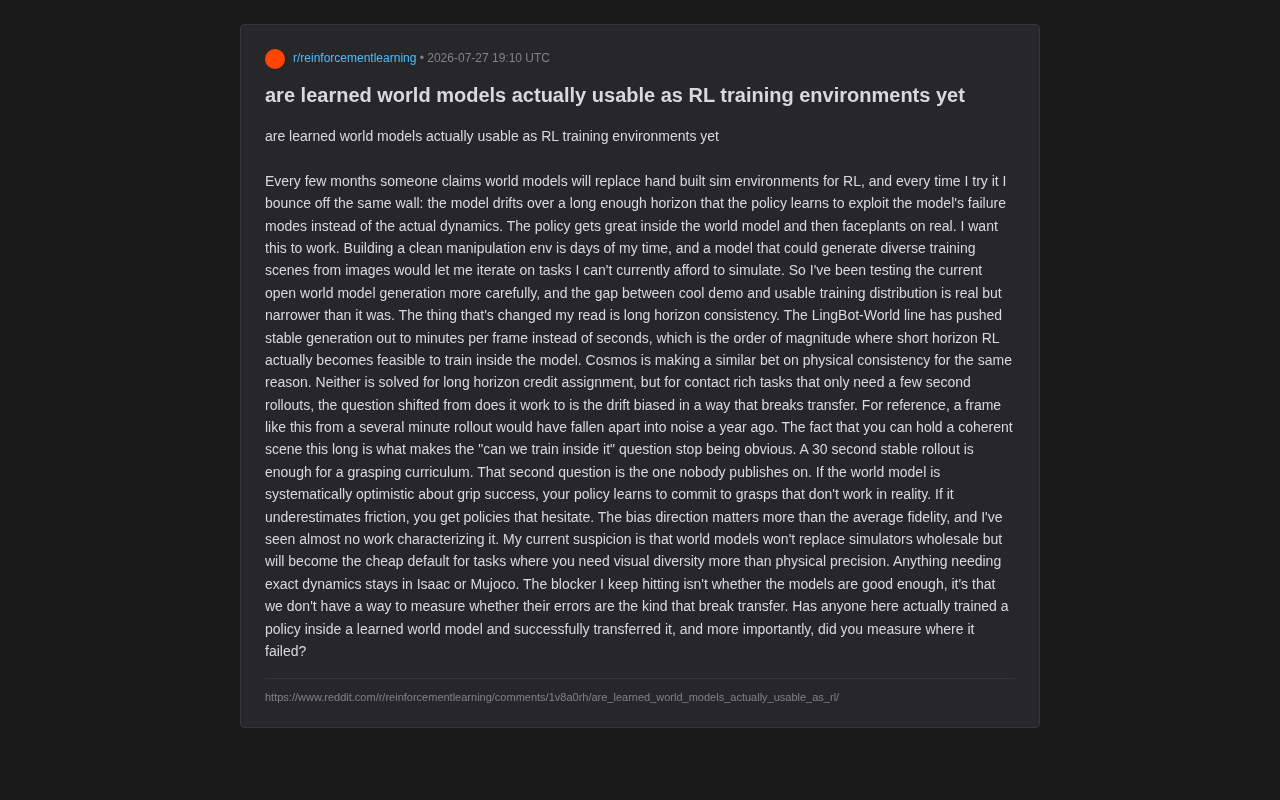
Can World Models Replace RL Training Environments? The Key Lies in the Direction of Error Bias
Analysis of world models as RL training environments: long-horizon consistency progress, how systematic error bias poisons policy transfer, and the emerging division of labor with traditional simulators.
Read more →

·5 min
DeepSeek's Five-Step Ladder to AGI: A Restrained Roadmap Built on 20,000 GPUs
DeepSeek founder Liang Wenfeng reveals a five-step AGI roadmap—from chain-of-thought to embodied intelligence—under a 20,000-GPU constraint, using the TileLang compiler to break domestic substitution challenges while API cash flow backs AGI exploration.
Read more →

·5 min
DeepSeek's Five-Step Ladder to AGI: A Restrained Roadmap Built on Twenty Thousand GPUs
DeepSeek founder Liang Wenfeng reveals a five-step AGI roadmap from chain-of-thought to embodied intelligence. How does TileLang crack domestic GPU substitution under a 20,000-card constraint?
Read more →