#DeepSeek coding
808 related articles
·3 min
Rocky: An Open-Source Coding Agent with Minimal Architecture and Native DeepSeek Integration
Rocky is a minimal, transparent open-source coding agent with a core loop under a few hundred lines of Python, native DeepSeek search, Research mode, and built-in SWE benchmarking for reproducible agent experiments.
Read more →

·5 min
The DeepSeek Investor Q&A with Liang Wenfeng: Decoding Restrained Pricing and the AGI Roadmap
Decoding DeepSeek's Liang Wenfeng 4-hour investor Q&A: 10-month-payback restrained pricing, why open source doesn't hurt revenue, the Agent-continual learning-self-iteration AGI roadmap, plus domestic chips, talent, and your moat.
Read more →

·3 min
DeepSeek Open-Sources DeepSpec: A Full-Stack Speculative Decoding Library with 60–85% Inference Speedup
DeepSeek open-sources DeepSpec, a full-stack speculative decoding library delivering 60–85% inference speedup and up to 661% throughput gains in production. MIT license, 9 checkpoints, 9 benchmarks.
Read more →

·3 min
Qwen 3.8 Open Source Incoming, DeepSeek Coding Agent, and the Latest in China's AI Ecosystem
Qwen 3.8 open source incoming, DeepSeek Resonics native coding agent debuts, Kimi pauses new subscriptions amid compute pressure, and Qiyimole shows domestic GPU interconnect solution at WAIC.
Read more →

·4 min
DeepSeek Open-Sources DeepSpec: A Full-Stack Breakdown of Speculative Decoding
DeepSeek open-sources DeepSpec, a full speculative decoding training and evaluation toolkit featuring three draft model algorithms (Ego3, DeepFlash, DeepSpark), 12 checkpoints, MIT license, and 60–85% real-world speedup.
Read more →

·2 min
Waveloom: An Open-Source Terminal AI Coding Agent Deeply Optimized for DeepSeek
Waveloom is an open-source terminal coding Agent deeply optimized for DeepSeek, with cache hit rates near 99% to drastically cut token costs. Supports Linux, Windows, macOS, and Claude Code Skills.
Read more →

·3 min
30 Cents vs $27: Open-Source Models Face Off in Coding, With DeepSeek Leading at 100x Cost-Efficiency
A hands-on comparison of AI models—Fable 5, DeepSeek V4 Flash, GLM 5.2, Qwen 3.6—building a sales CRM. The priciest cost $27.69, the cheapest just 30 cents. A deep dive into open-source LLM coding value.
Read more →

·2 min
DeepSeek Speculative Decoding Algorithm Merged into vLLM Main Branch — Single-User Token Speed Jumps Dramatically
DeepSeek's speculative decoding algorithm (DSpark) is now merged into vLLM main branch, natively supporting Qwen3 and Gemma. Tests show ~150× single-user token speed gains and ~40–50% throughput improvement.
Read more →

·4 min
Kun: An Open-Source AI Coding Agent Deeply Optimized for DeepSeek
Kun is an open-source AI coding agent optimized for DeepSeek and domestic users, with nearly 5,000 GitHub stars. Features include requirements drafting, inline diffs, cost visualization, and mobile monitoring. Real-world cache hit rates reached 97%, keeping costs extremely low.
Read more →

·5 min
DeepSeek Boosts Inference Speed by 85%: How Speculative Decoding Is Reshaping the AI Speed Race
DeepSeek and Peking University's DS Spark paper boosts AI inference speed by up to 85% via confidence scheduling and semi-autoregressive speculative decoding — no model or GPU changes.
Read more →
·5 min
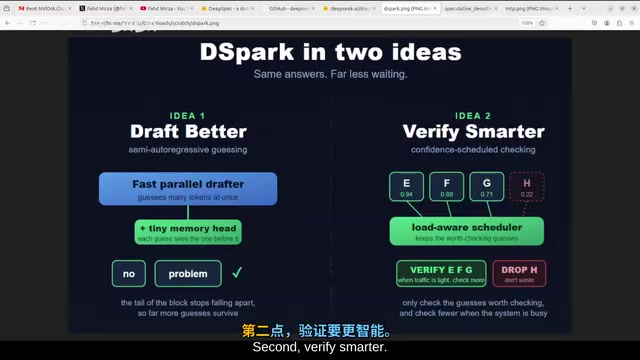
DeepSeek DSpec Hands-On: How Speculative Decoding Accelerates LLM Inference by 6x
Hands-on report on DeepSeek's open-source inference acceleration toolkit DSpec: draft model + smart scheduling delivers lossless speedup, hitting acceptance length 6 on GSM8K and reproducing official data.
Read more →

·4 min
DeepSeek + Resonix: A Low-Cost AI Coding Solution — 150 Million Tokens for Just $1.10
Real-world test: DeepSeek API + Resonix coding tool consumed 150M tokens for just $1.10. Deep dive into DeepSeek pricing, Resonix's 95% cache hit rate, and honest comparison with GPT models.
Read more →

·4 min
DeepSeek Forms Harness Team: AI Coding Competition Enters the Second Half
DeepSeek forms a dedicated Harness team to rival Claude Code. Analysis of the four-layer architecture, three core advantages, and 40x cost edge driving AI competition from model wars to engineering deployment.
Read more →

·3 min
DeepSeek Open-Sources a Terminal Coding Agent: A Claude Code Alternative with 38K GitHub Stars
DeepSeek's open-source terminal coding Agent: zero dependencies, million-token context, 20 parallel sub-agents, 38K+ GitHub Stars. A detailed comparison with Claude Code.
Read more →

·3 min
DeepSeek + Cline Setup Guide: A $1.50 Alternative to $20/Month AI Coding Subscriptions
Step-by-step guide to configuring DeepSeek API with VS Code plugin Cline, including API Key setup, Plan/Act dual-model strategy, and project management files for a $1.50 AI coding alternative.
Read more →

·3 min
DeepSeek-Reasonix: An AI Coding Agent Built for DeepSeek That Cuts Costs by 80%
DeepSeek-Reasonix is an open-source AI coding agent optimized for DeepSeek models. With 12K stars in 3 days, it offers 5 reasoning levels, 4 execution modes, MCP integration, and smart caching that cuts long-session costs by 80%.
Read more →
·3 min
DeepSeek + Codex Tutorial: Achieve Low-Cost AI Coding with Codex++
Learn how to connect DeepSeek to Codex using the open-source tool Codex++. Covers provider setup, connection testing, and launch verification for low-cost AI coding.
Read more →

·4 min
5 Models Coding Showdown: Claude, GPT, DeepSeek, M3 — Who's the Best Engineering Tool?
Hands-on comparison of Claude Opus 4.8, GPT 5.5, MiniMax M3, DeepSeek V4 Pro, and Mimo 2.5 Pro across SVG drawing, 3D game generation, elevator scheduling, and real bug fixing.
Read more →

·2 min
Claude 4.6 vs GPT-5.1 vs DeepSeek-R1: A Hands-On Comparison of Coding Capabilities
In-depth comparison of Claude Sonnet 4.6, GPT-5.1 Codex, and DeepSeek-R1 across API pricing, specs, and SWE-Bench Verified scores to help developers pick the best AI coding assistant.
Read more →

·2 min
DeepSeek GUI Hands-On Review: How Powerful Is This Cache-First Local AI Coding Assistant?
Hands-on review of DeepSeek GUI's full agent workbench: KUN local runtime, cache-first architecture, task scheduler, and Token cost advantages for developers.
Read more →