#RAG hallucination detection
169 related articles

·3 min
Orca-Bench: Evaluating Whether AI Agents Can Handle Production Oncall Duties
Orca-Bench is a benchmark for evaluating AI agents' operational capabilities, testing LLMs on fault diagnosis, multi-tool orchestration, and risk decisions in simulated Oncall scenarios.
Read more →

·3 min
Poth Labs: Reshaping Enterprise Customer Knowledge Management with Relationship Networks
Poth Labs models customer knowledge as a dynamic relationship network, using cross-source reasoning and adaptive surveys to help enterprises understand churn drivers and feature adoption.
Read more →

·4 min
Poth Labs: Reshaping Enterprise Customer Knowledge Management with Relationship Networks
Poth Labs models customer knowledge as a dynamic relationship network, using cross-source reasoning and adaptive surveys to help enterprises understand churn and feature adoption.
Read more →

·3 min
TraceLLM: An Open-Source LLM Observability Platform Built on OpenTelemetry
TraceLLM is an open-source observability platform for production AI apps, built on OpenTelemetry, offering Prompt tracing, Token monitoring, latency analysis, and full distributed tracing.
Read more →

·2 min
OpenAI and US Government Meeting Map Error: A Crisis of Trust in AI Accuracy
An Africa map labeling error at a joint OpenAI-US government AI meeting sparks debate about AI accuracy, data bias, and public trust in the AI era.
Read more →

·2 min
OpenAI and US Government Meeting Map Error: A Crisis of Trust in AI Accuracy
An Africa map labeling error at a joint OpenAI-US government AI meeting sparks debate about AI accuracy, data bias, and public trust in the AI era.
Read more →

·2 min
LangWatch Open-Source Tool: Making Every Token Cost in Claude Code Crystal Clear
LangWatch launches an open-source tool for Claude Code usage tracking — one command to trace token consumption, cache breakdowns, call chains, and terminal replay to optimize AI coding costs.
Read more →

·3 min
Yoggi: A Safe AI Chat Assistant Built Specifically for Children Ages 3-15
Yoggi is a safe AI chat assistant for children ages 3-15, offering age-adaptive answers, real-time voice chat, image generation, strict content filtering, and parental controls.
Read more →

·2 min
Peekinduck: Dual AI Voice Agents with Shared Memory Bridging the Entire B2B Customer Journey
Peekinduck uses two AI voice agents—Demo Duck and Guide Goose—sharing customer memory to unify pre-sales demos, onboarding, and post-sales support for B2B SaaS teams.
Read more →

·3 min
Can AI File Tickets for Its Own Programmers? Exploring the Future of AI Feedback Loops from a Viral Reddit Discussion
Exploring whether AI can proactively file tickets for programmers. From architectural constraints and security risks to AI Agent solutions, analyzing the current state and future of AI feedback loops.
Read more →

·3 min
Two Highly Effective AI Debugging Prompts: Cracking YOLOv8 and OpenCV Challenges
In-depth analysis of two battle-tested AI debugging prompts for diagnosing YOLOv8 training mAP collapse and OpenCV RTSP stream corruption, revealing structured debugging prompt design patterns.
Read more →

·3 min
A Guide to Selecting Datasets for RAG Experiments: Evaluating Dense, Sparse, and Hybrid Retrieval
A systematic guide to standardized datasets for RAG retrieval experiments, covering BEIR, MS MARCO, Natural Questions, and TREC benchmarks for dense, sparse, and hybrid retrieval evaluation.
Read more →

·3 min
AI Fact-Checking Tools Explained: How Agent Skills Automatically Detect Misinformation
Deep dive into how AI fact-checking tools like Bullshit Detector work, exploring how Agent Skills extract claims, retrieve evidence, and cross-validate to automatically detect online misinformation.
Read more →

·4 min
11-Node LangGraph in Practice: Complete Architecture Breakdown of a Compliance-Grade RAG Agent
Deep dive into an 11-node Agentic RAG agent built with LangGraph, featuring 6-way intelligent routing, hallucination guards, PII masking, circuit breakers, and zero-cost deployment.
Read more →

·2 min
CodeCrucible: A New Paradigm for LLM-Driven Static Code Security Analysis
Explore how CodeCrucible uses LLMs to revolutionize static code security analysis (SAST), comparing traditional tool limitations with semantic-driven vulnerability detection.
Read more →

·2 min
CodeCrucible: A New Paradigm for LLM-Driven Static Code Security Analysis
Explore how CodeCrucible uses LLMs to revolutionize static code security analysis (SAST), comparing traditional tool limitations with semantic-driven vulnerability detection approaches.
Read more →

·3 min
LLMOps Tool Selection Guide: An In-Depth Comparison of Tracing, Evaluation, and Governance Capabilities
In-depth analysis of LLMOps tool selection, comparing Langfuse, LangSmith, Helicone, and Orq.ai across tracing, evaluation, and governance capabilities with practical recommendations.
Read more →

·3 min
The ISNAD Framework: Building a Trust Verification Layer for Multi-Agent AI Systems Using a Millennium-Old Scholarly Tradition
The ISNAD framework adapts Islamic chain-of-transmission verification to build a trust layer for multi-agent AI systems, focusing on claim verification over agent authentication to combat hallucinations and silent failures.
Read more →
·4 min
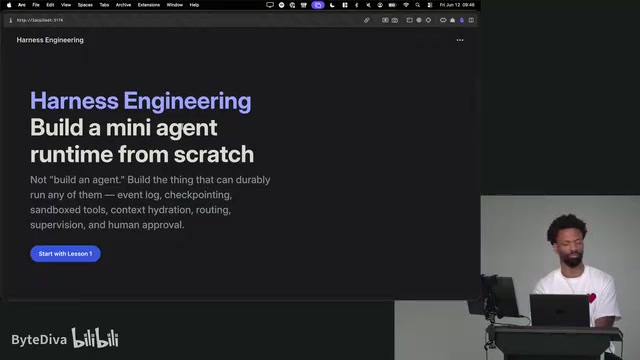
Harness Engineering: The Core Infrastructure for Taking AI Agents from Demo to Production
Deep dive into Harness Engineering: why AI Agents need memory management, durable execution, guardrails & approvals to go from demo to production.
Read more →

·4 min
Harness Engineering: The Core Infrastructure for Taking AI Agents from Demo to Production
Deep dive into Harness Engineering: why AI Agents need memory management, durable execution, guardrails & approvals to reach production. Based on Scott Moss's workshop.
Read more →