#RAG
287 related articles

RAG Hybrid Retrieval: Does Combining BM25 and Vector Search Improve Evidence Retrieval?
Comparing BM25, vector search, and RRF hybrid retrieval in RAG: their strengths and limits, how RRF can rank generic advice first, and metrics like Hit@5 and MRR@5.

Hand-Building an AI Customer Service Agent in Kotlin: Engineering Practices for RAG, MCP, and Multi-Agent Systems
An in-depth look at DSupport, a hand-built Kotlin Multiplatform AI customer service project: no Agent framework, using RAG relevance thresholds, MCP remote tools, multi-agent orchestration, and code-level guardrails to achieve an engineering architecture where models handle understanding and code handles guarantees.

Building a Company Brain in 3 Days: How Graph Memory Makes Every AI Answer Traceable
Developer Anshu built Recall in three days: a FalkorDB graph holds company causal knowledge so every AI answer is traceable, memory is per-person and versioned, and Agents wait for human approval. Graph retrieval beat flat RAG 24.667 to 19.251, with all missed points disclosed.

Treat the Context Window as a Budget: Token Allocation and Retrieval Strategies
The context window isn't an unlimited container—it's a budget to manage. Five budget lines, an 8,192-window arithmetic example, and bundle-based retrieval to avoid 'rules without exceptions' errors.

When Word Styles Can't Be Trusted: Practical Lessons from DOCX-to-Markdown Conversion
A developer shares lessons from DOCX-to-Markdown conversion: Word styles are often bypassed, requiring heuristic fallbacks to detect manually formatted headings—key for RAG and Agent parsing.

How to Choose a RAG Chunking Strategy: A Practical Guide from Fixed Splitting to Late Chunking
How to choose a RAG chunking strategy? This article analyzes the applicable scenarios and pitfalls of fixed splitting, recursive splitting, semantic chunking, structure-aware chunking, parent document retrieval, and late chunking, combining Chroma's research report and an ACL 2025 paper to help you avoid the common problem of RAG retrieving the answer but answering incompletely.

RAG Without Writing Code? An Offbeat Use of Gemini Workspace Integration
No vector database needed — Gemini's Google Workspace integration enables folder-scoped context retrieval and writing style imitation. This article breaks down this "user-level RAG" approach: its actual usage, token overhead mechanics, and key differences from standard RAG in retrieval principles.

RAG Systems: The LLM Isn't the Hard Part—Retrieval Quality Is
RAG failures often stem from retrieval quality, not model capability. This article analyzes retrieval relevance, chunking, hybrid search, multi-document issues, evaluation, and lifecycle management to reveal what's truly hard in RAG engineering.

Metrics First, Dashboard Second: A Guide to Choosing Metrics for LLM Evaluation
A polished LLM evaluation dashboard is useless if you pick the wrong metrics. This guide breaks down metric selection by feature type: F1 and AUC for classifiers, caution with perplexity for generators, faithfulness for RAG—with F1/AUC code examples on a labeled held-out set and a complete checklist.

From Substack Newsletters to a RAG Knowledge Base: A Clean Markdown Pipeline in Practice
A complete pipeline for building a RAG knowledge base from Substack newsletters: paginated archive API fetching, body scraping, targeted HTML-to-Markdown cleaning with turndown, heading-aware chunking, incremental updates, and respecting paywalls. Includes ready-made tools and code references.

Building a Production-Grade AI Agent from Scratch: A Practical Guide to RAG and MCP
Based on the Edureka hands-on tutorial, this guide explains the complete build process for a production-grade AI Agent: four-layer architecture design, RAG retrieval-augmented generation, MCP protocol tool calling, ChromaDB vector database, model selection, and cost optimization, with local deployment verification steps.

Why MCP Retrieval Service Citations Get Lost: A Deep Dive into CSR Benchmarking
A CSR benchmark built on FastAPI docs reveals citation format drift vs. genuine loss in MCP retrieval; the OpenAI Agents SDK's default Responses API causes 40% of answers to ignore citation format, and server-side short IDs can fix it.

PDF to Markdown: Fixing Reading Order and Tables Before RAG Chunking
RAG giving inaccurate answers to PDF questions? The problem often lies in extraction. This article analyzes how two-column reading order, table structure, and heading hierarchy get destroyed by plain text extraction, compares open-source libraries like pypdf, pdfplumber, Docling, and Marker, and provides a runnable PDF-to-Markdown Python script to fix chunking quality at the source.

LangChain4J in Practice: Building Enterprise-Grade Agents and RAG Applications from Scratch
A hands-on LangChain4J tutorial for beginners: explore Components, Chains, and Agents, and learn how to build privately deployed enterprise Agents in Java, covering RAG vector stores and TextToSQL to connect LLMs with enterprise private data.
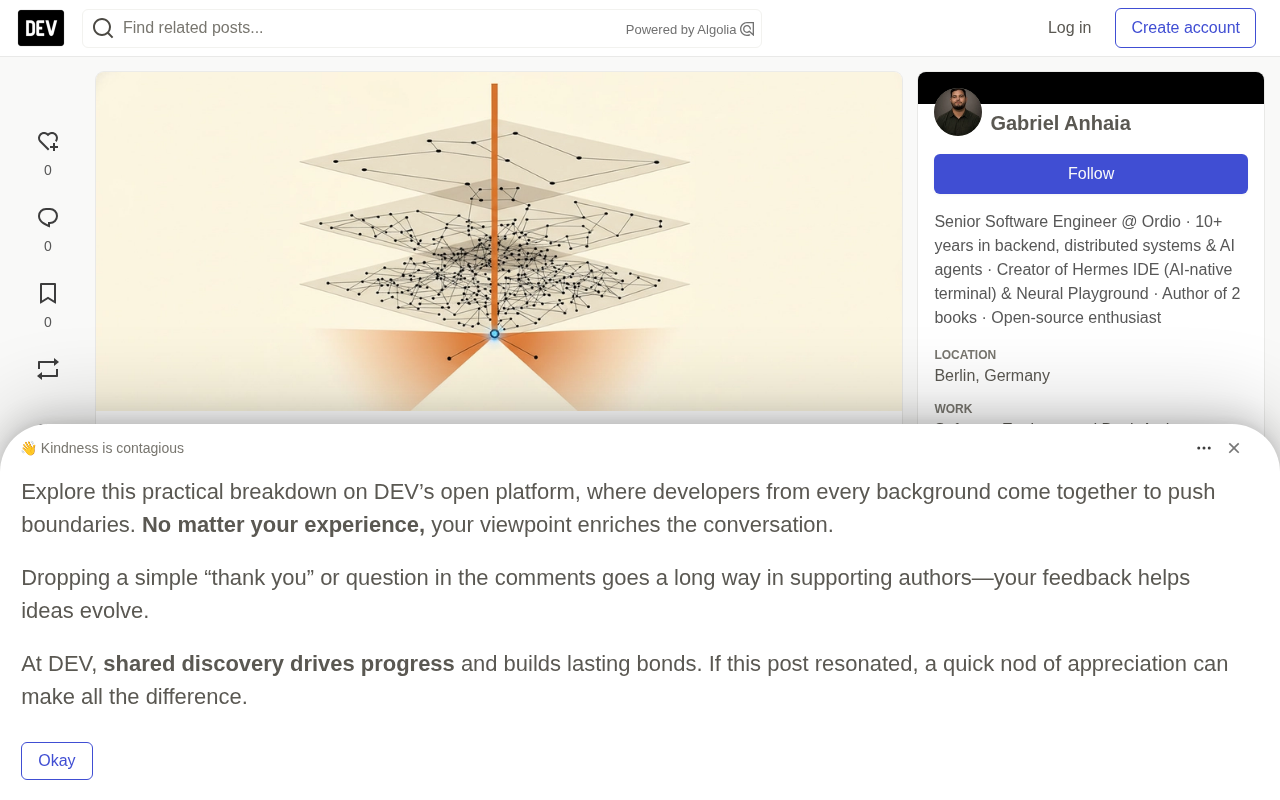
Building HNSW by Hand in TypeScript: Measuring the efSearch–Recall Tradeoff
Implement HNSW from scratch in TypeScript, index 50K vectors in Node, and measure recall@10 vs. latency as efSearch goes from 10 to 200—plus pgvector and Qdrant production parameters and filtering pitfalls.

Refusal Capability in RAG Applications: Teaching AI to Say 'I Don't Know'
How can RAG applications learn to refuse? A developer explores teaching RAG systems to recognize missing answers in documents, avoiding confident unsupported responses.

Building Semantic Search and RAG with pgvector + Java: No Separate Vector Store Needed
pgvector turns PostgreSQL into a vector store: build semantic search and RAG with Java and Spring Boot, no separate vector database. Covers HNSW indexes, JDBC vector queries, RAG pipelines, tenant isolation, and recall evaluation.
3 Agent Patterns Behind Successful AI Products: The Real Key Beyond the Framework Wars
Successful AI Agent products rely on three patterns—plan-then-execute, retrieval-reasoning separation, and explicit handoffs—not new frameworks. Plus RAG chunking pitfalls and the road ahead.

Inside Loreflow's Architecture: Making Three Classes of AI Data Leaks Structurally Impossible
Loreflow uses pure-function evidence projection, fixed evidence budgets, and field-by-field enumeration to make cross-tenant leaks, prompt injection exfiltration, and silent field leaks structurally impossible.

AI Keeps Making the Same Mistake? 7 Engineering Solutions That Fix It at the Root
AI keeps making the same mistakes? This article explains 7 engineering approaches—context management, permanent rules, error logs, RAG retrieval, and automated verification—to help AI truly learn from errors.