#async logging
85 related articles
 Tutorials
·3 min
Cursor 2.0 in Practice: Vibe Coding Methodology & Guide to 10x Coding Efficiency
Deep dive into Cursor 2.0's Vibe Coding methodology with two real-world scenarios: full-stack site building and enterprise bug fixing using the Rules, Commands, Context architecture for 10x dev efficiency.
Read more →
 Tutorials
·3 min
8 Free AI Coding Tools: Build a Complete Development Workflow at Zero Cost
A systematic review of 8 free AI coding tools covering UI design, terminal agents, IDE integration, and async coding to help developers build a complete zero-cost AI development workflow.
Read more →
 Tech Frontiers
·2 min
The Gaming DNA of an AI Game Team: From Battle City to Fruit Ninja
An AI game dev team's gaming origins span 30 years—from NES Battle City to mobile Fruit Ninja. How does this diverse gaming DNA fuel AI game innovation?
Read more →
 Product Reviews
·2 min
Cursor Web and Mobile Launch: Hands-On with Cloud AI Coding Agents
Cursor launches web and mobile versions supporting multi-agent parallel execution and mobile code review. A detailed look at core features, comparison with Google Jules and OpenAI Codex, and the PWA mobile experience.
Read more →
 Research
·3 min
Inside Cursor Composer 2 Training: A Complete Breakdown of Its Distributed Reinforcement Learning Architecture
Deep dive into how Cursor trained Composer 2 on Fireworks: async pipeline architecture, MoE numerical precision challenges, Router Replay, and global distributed GPU coordination.
Read more →
 Tutorials
·2 min
How Frontend Engineers Can Systematically Build AI Agent Architecture Skills
How frontend engineers can move beyond API calls to build production AI systems — covering streaming output, BFF layers, RAG pipelines, and Agent orchestration with LangChain.js/LangGraph.js.
Read more →
 Product Reviews
·2 min
Google Jules Hands-On Review: Testing the Real Capabilities and Limitations of This AI Coding Agent with a Java Project
In-depth testing of Google Jules AI coding agent with a real Java backend project, revealing code generation quality, hallucination issues, and capability boundaries.
Read more →
 Product Reviews
·4 min
Manus Hands-On Review: One Prompt to Build a Snake Game — What AI Agents Can Really Do
Hands-on Manus AI Agent review: generate a playable Snake game and physics animation site with one prompt. Covers registration, how it differs from ChatGPT, cloud execution, and current limitations.
Read more →
 Deep Dives
·2 min
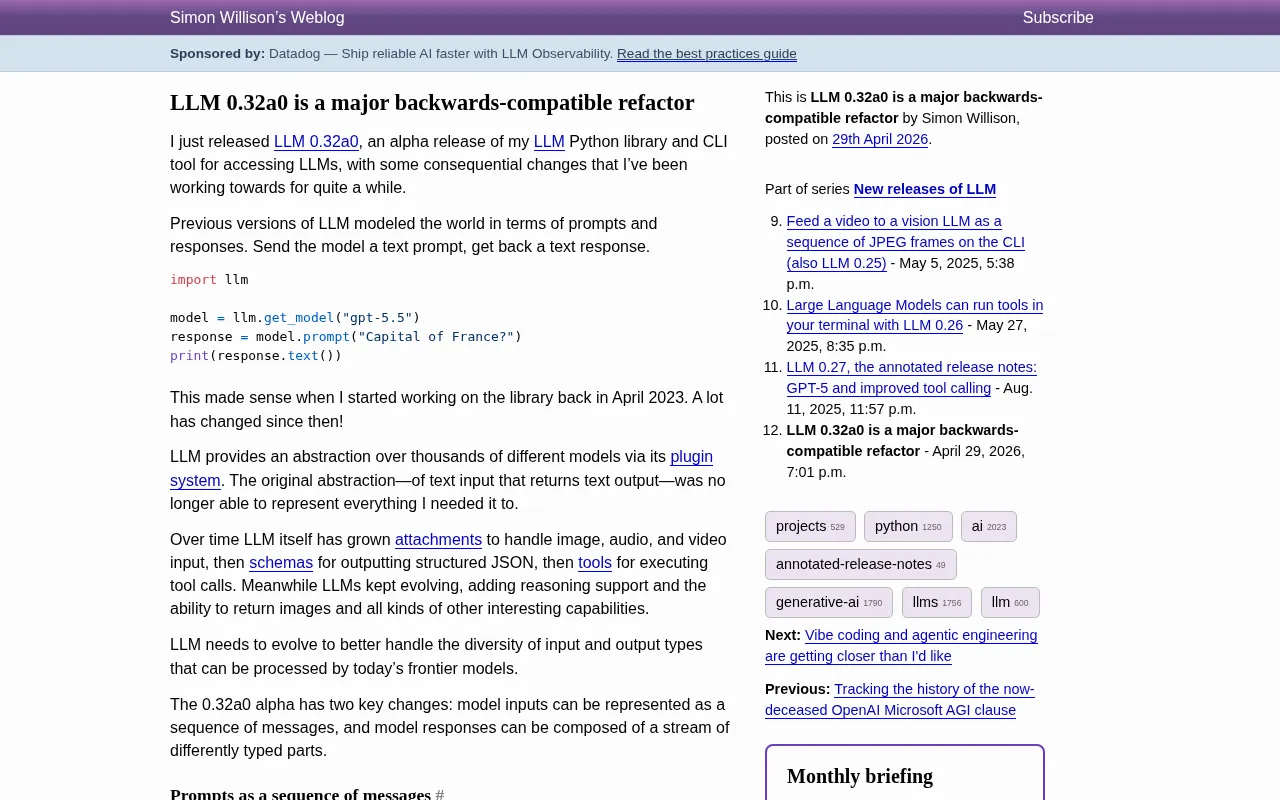
LLM 0.32 Refactor: An Architecture Upgrade from Text Q&A to Multimodal Streaming Interaction
Simon Willison releases LLM 0.32a0 alpha with a major refactor introducing message sequence API, typed streaming output, and flexible serialization while maintaining backward compatibility.
Read more →
 Product Reviews
·3 min
Cursor 1.0 BugBot Hands-On: Can AI Automated Code Review Actually Find Bugs?
Hands-on testing of Cursor 1.0's BugBot: how AI automated code review finds real bugs like JWT exceptions and race conditions in 2 minutes, with one-click fixes via GitHub PR integration.
Read more →
 Product Reviews
·3 min
Haiku 4.5 vs GPT-5 Mini vs GLM-4.6: Real-World Benchmark of Budget Coding Models
In-depth comparison of Claude Haiku 4.5, GPT-5 Mini, and GLM-4.6 across speed, cost, code quality, concurrency safety, and tool calling to help developers choose the right budget AI coding model.
Read more →
 Tutorials
·3 min
Jules MCP Server: Using the MCP Protocol to Let Claude Orchestrate Google Jules for Autonomous Coding
Jules MCP Server is an open-source project providing a production-grade MCP server for Google Jules API, enabling Claude and Cursor to orchestrate autonomous coding via multi-Agent collaboration.
Read more →
 Tech Frontiers
·2 min
LLM 0.32 Refactoring Deep Dive: Message Sequence Input and Streaming Multi-Type Response Design
Deep dive into LLM 0.32 alpha's two core refactorings: message sequence API aligned with OpenAI format, stream_events for typed streaming responses, serialization design, and backward compatibility.
Read more →
 Deep Dives
·3 min
LLM 0.32 Refactor: How Message Sequences and Streaming Chunks Are Reshaping Python LLM Interactions
Simon Willison releases LLM 0.32a0 alpha with message sequences and typed streaming chunks, redefining how Python developers interact with LLMs while maintaining full backward compatibility.
Read more →
 Deep Dives
·3 min
AI-Assistant Open Source Project Analysis: Building a Local AI Agent with the Anthropic API
Deep analysis of the open-source AI-Assistant project built on Anthropic Claude API for local AI Agents, covering architecture, use cases, security, and agentic AI trends.
Read more →
 Tech Frontiers
·2 min
LLM 0.32a0 Major Refactor: A Deep Dive into Message Sequences and Typed Streaming Responses
Simon Willison releases LLM Python library 0.32a0 alpha with message sequence prompts and typed streaming responses, redesigning model interaction abstractions for multimodal output, tool calls, and modern LLM features.
Read more →
 Tech Frontiers
·3 min
LLM 0.32 Refactoring Explained: How Message Sequences and Streaming Chunks Are Reshaping This Python LLM Library
Simon Willison releases LLM library 0.32 alpha with message sequences and typed streaming chunks, replacing the old text-in-text-out model to fully support multi-turn dialogue, multimodal output, and tool calling.
Read more →
 Deep Dives
·2 min
LLM 0.32 Refactoring Deep Dive: Message Sequences and Multimodal Streaming Event Design
Deep dive into LLM 0.32a0 alpha: a major refactoring from text conversations to message sequences and typed streaming events, supporting multimodal output, tool calls, and flexible serialization.
Read more →
 Tech Frontiers
·3 min
LLM 0.32 Refactoring Explained: Message Sequence API and Typed Streaming Responses
Deep dive into Simon Willison's LLM Python library 0.32 refactoring: new message sequence API, typed streaming responses, and universal serialization for multimodal AI and tool calling.
Read more →
 Deep Dives
·3 min
LLM 0.32 Major Refactor: Message Sequences and Streaming Multi-Type Responses Explained
Simon Willison releases LLM 0.32a0 alpha with message sequences API and streaming multi-type parts, redesigning how the Python LLM library handles model interactions for complex inputs and outputs.
Read more →