#coding LLM
2336 related articles
·1 min
Agentic Coding in Practice: Test Feedback Loops, LLM Benchmarks, and an Engineering Adoption Guide
An in-depth look at agentic coding: how test-driven loops enable AI self-correction, the real limits of LLM benchmarks, and key engineering lessons on context management and human-AI collaboration.
Read more →

·4 min
From Enter to First Token: Decrypting the Full LLM Inference Pipeline (Autoregression, KV Cache & Decoding Strategies)
From pressing Enter to the first character appearing, what happens inside an LLM? This article breaks down autoregressive generation, KV cache acceleration, and decoding strategies like temperature, Top-k, and Top-p.
Read more →

·2 min
DeepSeek Speculative Decoding Algorithm Merged into vLLM Main Branch — Single-User Token Speed Jumps Dramatically
DeepSeek's speculative decoding algorithm (DSpark) is now merged into vLLM main branch, natively supporting Qwen3 and Gemma. Tests show ~150× single-user token speed gains and ~40–50% throughput improvement.
Read more →

·7 min
AI Coding in Practice: Generating a Minecraft Clone in 90 Minutes as LLMs Enter Project-Level Development
A major breakthrough in AI coding! Hands-on tests show new LLMs generating a Minecraft clone in 90 minutes and a TMNT game in 30 minutes, building 3D scenes, animation, and game logic in one shot.
Read more →

·5 min
Why Did Ollama Rise So Fast? Decoding the Success of a Local LLM Tool
How did Ollama grow from a niche open-source project into developers' default choice for running local LLMs? This article breaks down its rise across product design, technical strategy, and ecosystem building.
Read more →
·5 min
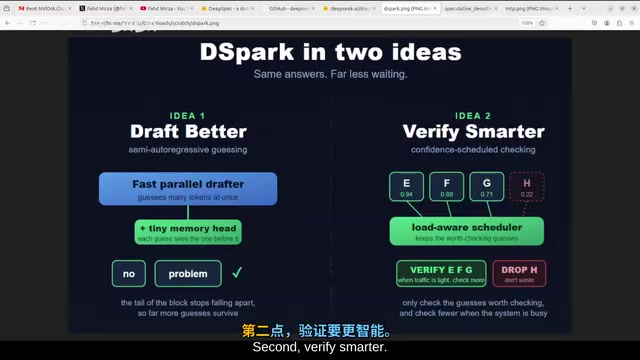
DeepSeek DSpec Hands-On: How Speculative Decoding Accelerates LLM Inference by 6x
Hands-on report on DeepSeek's open-source inference acceleration toolkit DSpec: draft model + smart scheduling delivers lossless speedup, hitting acceptance length 6 on GSM8K and reproducing official data.
Read more →
Building a Coding Agent with LLM: A De…
·3 min
Building a Coding Agent with LLM: A Deep Dive into Simon Willison's llm-coding-agent Experiment
Simon Willison built llm-coding-agent — an open-source Claude Code-style agent — using just two prompts and TDD. Explore its tool design, bootstrapped dev process, and real-world test results.
Read more →

·6 min
What Is Vibe Coding? A Complete Breakdown of the LLM + Agent + Workflow Three-Layer Architecture
Vibe Coding, coined by ex-Tesla AI Director Karpathy, redefines AI programming. This article breaks down the LLM + Agent + Workflow three-layer architecture.
Read more →
 Tutorials
·3 min
Decoding LLM Naming Conventions: Parameter Counts, Quantization Formats & VRAM Requirements Quick Reference
Decode LLM naming conventions, understand 32B parameters & AWQ/GGUF quantization formats, with 4-bit VRAM estimation formulas, MOE model pitfalls, and model selection by GPU tier.
Read more →
 Product Reviews
·2 min
AI Coding Appliance vs Cloud LLMs: Can ¥480K in Annual Fees Buy 4 Local Deployment Solutions?
A deep cost comparison between AI coding appliances and cloud LLM APIs. A 20-person team spending ¥480K/year on tokens can deploy 4 local OnePanel units at ¥99K each, breaking even in 2.5 months.
Read more →
 Expert Opinions
·1 min
Six Months of Massive LLM Changes: The Rise of Coding Agents, OpenClaw Explosion, and Local Models Fighting Back
Simon Willison reviews six months of LLM changes at PyCon US 2026: coding agents crossing quality thresholds in Nov 2025, OpenClaw sparking personal AI assistants, and open-source models rivaling frontier models on laptops.
Read more →

·3 min
AI Can't Build Usable Products — Developers' Jobs Haven't Disappeared
AI can generate code snippets and demos, but usable products still require human engineers' judgment and responsibility. This article analyzes AI coding tools' limits and developers' evolving roles.
Read more →

·2 min
Game Benchmarks: A New Approach to Evaluating Large Language Model Capabilities
Traditional AI benchmarks are losing discriminative power. Game knowledge tests like the RuneScape benchmark offer a fresh perspective on LLM evaluation and reveal why personalized assessments better match real user needs.
Read more →

·2 min
General Agents Are Essentially Coding Agents: The Paradigm Shift from Tool Calling to Code Execution
Explore why general AI agents are essentially coding agents. From Turing completeness to composability and verifiability, discover the paradigm shift from Function Calling to Code as Action.
Read more →

·4 min
HortusFox v5.9 Released: An Anti-AI Open-Source Plant Management Application
HortusFox v5.9 "Summer Plants Release" adds per-plant attachments, sorting preference memory, and 15 bug fixes. This anti-AI open-source self-hosted plant management app prioritizes data sovereignty for gardening enthusiasts.
Read more →

·2 min
Grok 4.5 Tops Community Sentiment Rankings: The Truth and Controversy Behind the Data
Grok 4.5 tops the ai-census community sentiment leaderboard, leading 15 frontier AI models. We analyze the value and limitations of this Reddit sentiment data and why the same model gets vastly different reviews across communities.
Read more →

·3 min
DeepSeek V4 Flash Released: Performance Approaching Claude at Just $0.18 per Million Tokens
DeepSeek V4 Flash launches with benchmark scores approaching Claude Opus 4.8 at just $0.18 per million output tokens. Deep analysis of performance, pricing, and industry impact.
Read more →

·6 min
Using RL to Please the Reward Model: The Reward Hacking Concern Behind Soaring Elo Scores
When RL continuously optimizes models to please reward models, do soaring Elo scores truly represent capability gains? A deep dive into Reward Hacking in RLHF, Goodhart's Law in AI, and industry countermeasures.
Read more →

·2 min
A Slow-Mode Vision for Codex: Doubling Coding Quota with Flex API
A developer proposes a Flex API-based slow mode for Codex, trading speed for nearly double the usage quota. We analyze the product logic, technical feasibility, and business challenges.
Read more →

·3 min
How Cheap Can It Be to Serve a 2.8 Trillion Parameter Model? A Deep Dive into Inference Economics
Deep analysis of the real cost of serving a 2.8 trillion parameter model. From MoE sparse activation to batching scale effects and inference optimization, revealing why model size and serving cost are less correlated than assumed.
Read more →