#component testing
1200 related articles
 Tech Frontiers
·2 min
SWE-agent Multimodal Released: Image Viewing + Browser Debugging, A New Power Tool for Frontend AI Development
SWE-agent Multimodal officially released with image viewing and web browser debugging capabilities for automated frontend visual bug detection and fixes, plus the new SWE-bench Multimodal benchmark.
Read more →
 Research
·2 min
UK AISI Assessment Report: GPT-5.5 Cybersecurity Capabilities on Par with Claude Mythos
The UK AI Safety Institute (AISI) releases its GPT-5.5 cybersecurity assessment, showing vulnerability discovery capabilities on par with Claude Mythos—but GPT-5.5 is already publicly available, raising greater security implications.
Read more →
 Product Reviews
·2 min
IBM Granite 4.1 Open-Source Models: Real-World SVG Generation Comparison Across 21 GGUF Quantization Variants
IBM releases Granite 4.1 Apache 2.0 open-source LLMs. Simon Willison tests all 21 GGUF quantization variants from Unsloth, revealing that 3B model limitations overshadow precision differences.
Read more →
 Product Reviews
·3 min
Open WebUI: 130K-Star Open-Source AI Interface — Deployment Guide & Complete Feature Breakdown
Deep dive into Open WebUI, the 135K-star open-source AI interface covering Ollama integration, one-click Docker deployment, RAG document Q&A, multi-user management, and more.
Read more →
 Deep Dives
·4 min
Kortix Open-Sources Agent Computer Use: A Rust-Powered CLI Tool for AI Computer Control
Kortix AI open-sources Agent Computer Use, a high-performance Rust CLI tool enabling AI agents to control computers. Explore its architecture, advantages over Anthropic's Claude Computer Use, and future of open-source computer control tools.
Read more →
 Tutorials
·3 min
Building an AI Digital Human Agent from Scratch: Architecture Design & Full Technical Breakdown
Complete guide to building an AI digital human Agent, covering Agent, RAG, WebRTC, and Docker deployment with architecture design and engineering best practices.
Read more →
 Industry Insights
·3 min
AI-Native Engineering Transformation: Real Emotions and Coping Strategies from 218 Technical Leaders
Based on research with 218 engineering leaders, this deep dive explores the contradictory emotions in AI-native transformation — excitement and anxiety coexisting — and how leaders navigate successful change.
Read more →
 Product Reviews
·3 min
Real-World LLM Reliability Testing: Three Core Problems Exposed by a Pizza Shop AI Chatbot
A fictional pizza shop AI chatbot reveals three core LLM reliability challenges in 2025: topic control, information security, and response accuracy.
Read more →
 Deep Dives
·3 min
Why Is AI Agent Testing So Hard? How Simulation Testing Cracks the Infinite Input Space Problem
AI Agents face infinite input spaces and non-deterministic outputs. Learn how simulation testing systematically validates Agent reliability through scenario generation, environment simulation, and behavior evaluation.
Read more →
 Tech Frontiers
·3 min
Simulation Reshaping AI Testing: A New Paradigm for Systematically Validating AI Application Reliability
Explore how simulation solves AI testing challenges, covering scenario simulation, large-scale regression testing, and multi-agent verification to build reliable AI systems.
Read more →
 Tech Frontiers
·2 min
Windows 11 Low Latency Mode Explained: How Smart CPU Frequency Scaling Improves System Responsiveness
Microsoft is testing Low Latency Profile in Windows 11, using smart CPU frequency bursts to speed up Start Menu, app launches, and UI interactions — borrowing from macOS optimization strategies.
Read more →
 Tutorials
·3 min
The Complete Guide to MLflow: An Open-Source AI Engineering Platform from Experiment Tracking to LLM Deployment
A deep dive into the MLflow open-source AI engineering platform, covering experiment tracking, LLM evaluation, model deployment, and monitoring to help teams efficiently manage the ML lifecycle.
Read more →
 Tech Frontiers
·2 min
DeepAgents: LangChain's Deep Agent Development Framework Built on LangGraph
DeepAgents is LangChain's open-source Agent framework built on LangGraph, supporting multi-step reasoning, state management, and multi-Agent collaboration for production-grade AI development.
Read more →
 Product Reviews
·3 min
Team Memory MCP: A Deep Dive into the Shared Memory System for AI Coding Agents
Deep dive into team-memory-mcp, an open-source shared memory system for AI coding agents like Claude Code and Cursor, featuring Bayesian confidence scoring and temporal decay via MCP protocol.
Read more →
 Product Reviews
·3 min
AI Coding Assistant System Prompts Collection: Open-Source Repository Featuring Claude Code, Cursor, and Other Leading Tools
The awesome-system-prompts open-source project collects system prompts and tool definitions from leading AI coding assistants like Claude Code, Cursor, Gemini, and Codex — an essential resource for prompt engineering and AI product design.
Read more →
 Product Reviews
·3 min
Deep Dive into AGGO Framework: A New Go-Based Choice for Enterprise AI Agents
Deep dive into AGGO—an enterprise AI Agent framework built with Go and CloudWeGo Eino, covering conversational AI, RAG, memory systems, and tool calling, with Go's performance advantages.
Read more →
 Tutorials
·3 min
LangGraph E-commerce AI Agent in Practice: From RAG Q&A to Automated Return Workflows
Deep dive into the E-commerce-Smart-Agent open-source framework built with LangGraph and FastAPI, covering RAG knowledge base Q&A, return workflow automation, and graph-based orchestration.
Read more →
 Product Reviews
·3 min
PaperOrchestra Open Source Project Explained: Automatically Generating Research Papers with Coding Agents
PaperOrchestra is an open source AI paper writing tool based on Google's research. It uses coding agents like Claude Code and Cursor to automate the full research paper workflow without API keys.
Read more →
 Tutorials
·3 min
Agentic Flow: A Guide to Low-Cost Model Switching in Claude Code and Production Agent Deployment
Deep dive into Agentic Flow, an open-source project enabling flexible low-cost model switching in Claude Code and one-click Agent deployment to cloud production environments.
Read more →
 Deep Dives
·3 min
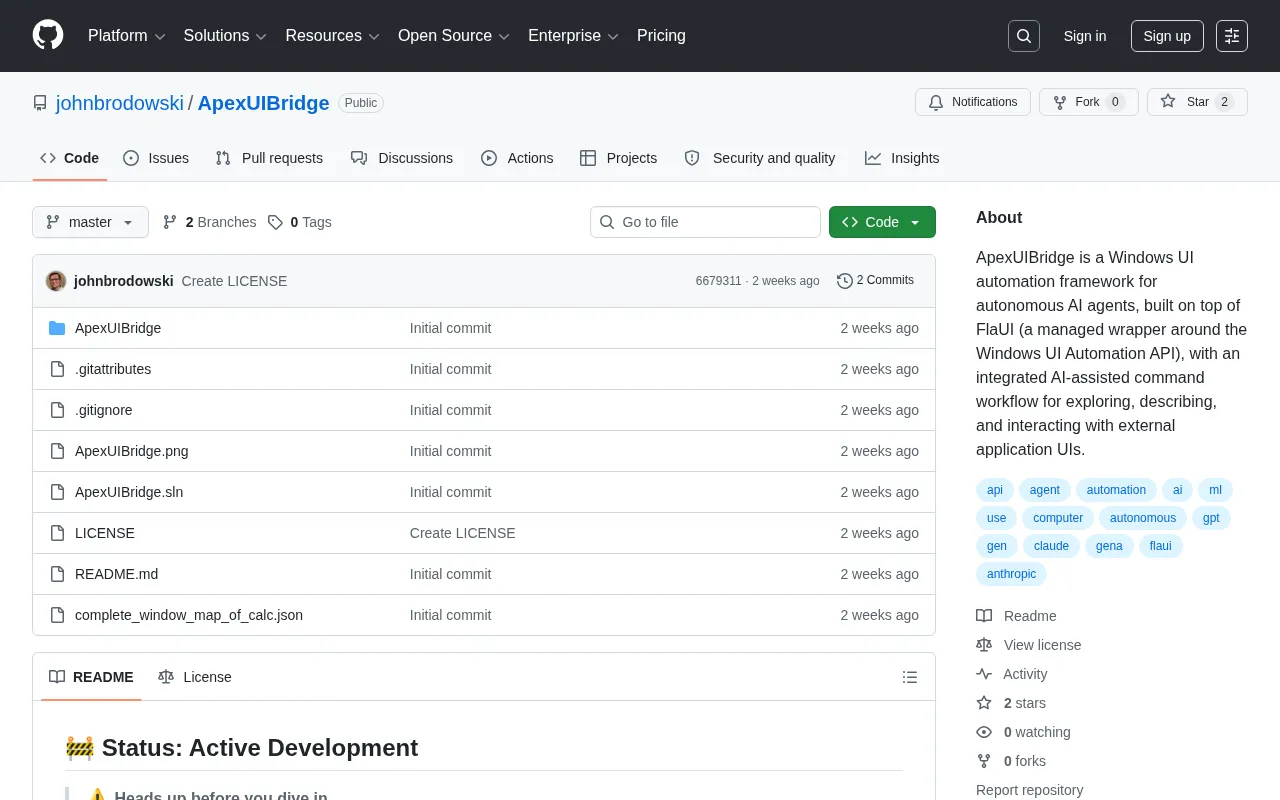
ApexUIBridge: A UI Automation Framework That Lets AI Agents Control Windows Desktop Applications
Deep dive into ApexUIBridge, an open-source AI agent automation framework built on FlaUI and Windows UI Automation API, enabling UI exploration, semantic description, and interaction with desktop apps.
Read more →