#compound error problem
160 related articles

·4 min
Making $3,000/Month Freelancing with Codex? A Rational Look at AI Coding Side Hustles
Can AI coding tools really earn you $3K/month with zero experience? We break down the marketing hype around Codex freelancing, examine the 4-week roadmap, and reveal what AI-assisted coding can realistically offer.
Read more →

·6 min
DiffusionGemma Character Motion Transfer in Practice: A ComfyUI Workflow Breakdown
Explore a character motion transfer experiment based on a DiffusionGemma custom node—swap identity in ComfyUI using just a static image, a reference video, and one prompt. A breakdown of the tech stack, control signal preservation, and real limitations for AI video creators.
Read more →

·4 min
Teaching AI to Have "Taste": Exploring Multi-Agent Design with Open-Source Skill Taste
Why does AI-generated UI all look the same? Designer SEN open-sourced a Skill called Taste that uses a four-agent pipeline to reverse-engineer website "taste" into verifiable design principles called Taste DNA.
Read more →

·3 min
Running a 27B Model on iPhone: How 1-bit Quantization Achieves Extreme Compression
PrismML's Bonsai compresses a 27B model from 54GB to 3.9GB, running at ~11 tokens/sec on iPhone. A deep dive into QAT, knowledge distillation, and speculative decoding.
Read more →

·2 min
14 PDF Parsers Compared: Semantic Fidelity Is the Real Bottleneck for RAG Applications
A benchmark of 14 PDF parsers focused on Meaning Survival, not just character accuracy. Covers GPT, Mistral OCR, Azure DI, and key insights for RAG pipeline optimization.
Read more →
Cross-Model Prompt Engineering: Why Gr…
·3 min
Cross-Model Prompt Engineering: Why Great Prompting Techniques Work Universally
Explore why prompt engineering techniques transfer across AI models. Learn role definition, structured instructions, and Chain-of-Thought strategies that work universally across GPT, Claude, and beyond.
Read more →

·3 min
Frontend to AI Agent: Why TypeScript + Zod Have Become Non-Negotiable
Frontend engineers pivoting to AI Agent development: TypeScript and Zod are now must-have skills. Explore the full progression from API calls to building LangGraph-style frameworks, and nail the 3 core interview topics.
Read more →

·2 min
Loop Engineering: Why Unsupervised AI Loops Are a Recipe for Disaster
Loop Engineering lets AI run autonomously until criteria are met. This deep dive exposes its three core risks: unbounded token costs, hidden quality failures, and goal misalignment — and why humans remain irreplaceable.
Read more →

·3 min
MLOps from Scratch: A 100-Day Learning Challenge Roadmap and Practical Guide
A college student's MLOps 100-day challenge documents the full journey from Python engineering and Git to Docker, model deployment, and monitoring. A practical roadmap for data scientists transitioning to ML engineering.
Read more →
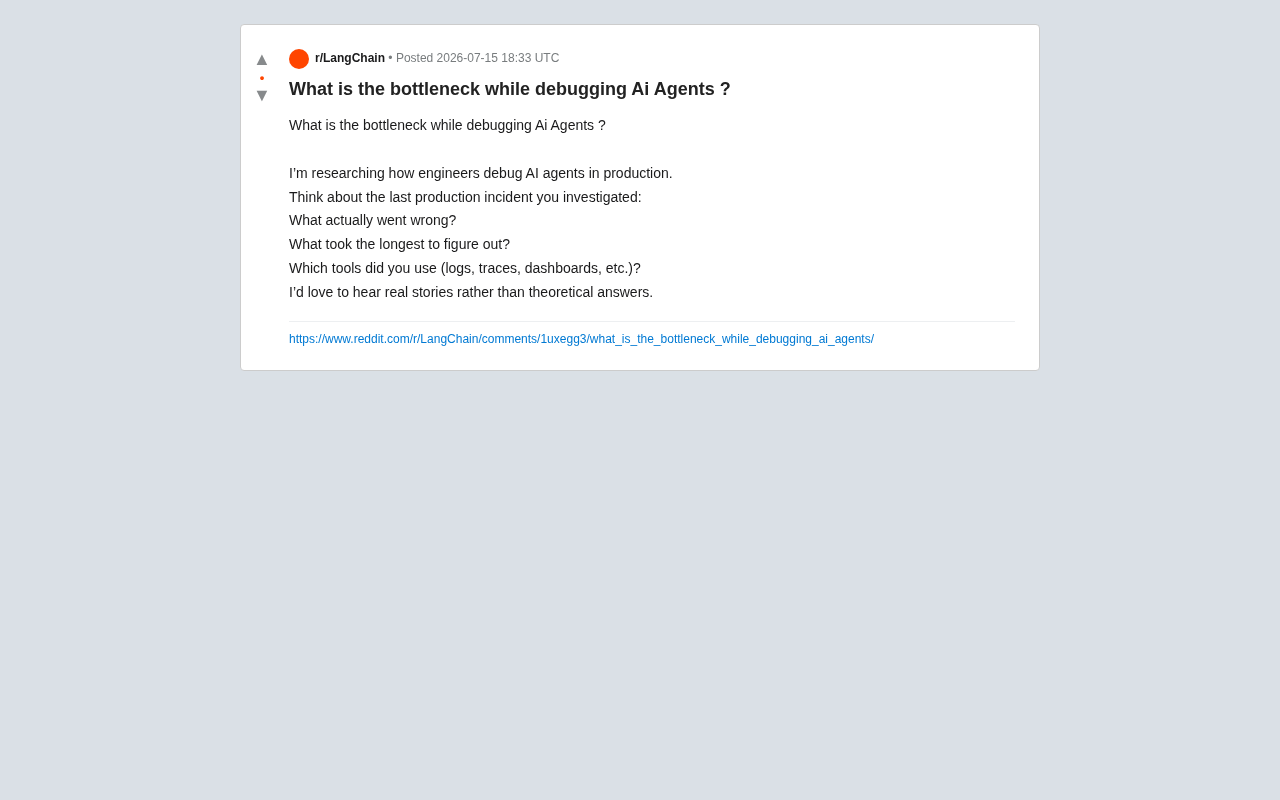
·2 min
AI Agent Debugging Bottlenecks: A Practical Guide to Production Observability
Explore core AI Agent debugging challenges in production: non-determinism, multi-step error propagation, and observability gaps — with practical guidance on LangSmith and tracing tools.
Read more →

·2 min
17 Million Mouse Trajectories: The Real ML Value of Gaming Behavioral Data
A LoL player collected 17M mouse trajectories and 670K clicks across 350 matches. We analyze the real ML value and limitations of this gaming telemetry data.
Read more →

·4 min
Loop Engineering in Practice: Designing and Deploying a Multi-Agent Collaborative Development System
A deep dive into Loop Engineering: how multi-agent collaborative dev systems achieve automated coding loops through workflow scheduling, step isolation, and validation.
Read more →

·4 min
Viktor: The AI Employee Living Inside Slack — How to Build a True Company-Wide AI Colleague
Viktor is a Slack-native AI employee with 3,000+ integrations and team-shared context. Learn how it evolved from browser agents to company-level AI, tackling memory, permissions, and proactivity.
Read more →

·3 min
Krea2 LoRA New Tool: How to Improve AI Image Prompt Adherence
Krea2 TextFusion Refusal Reduction LoRA is a lightweight fine-tuning tool designed to boost prompt adherence, with standout performance in emotional expression and character knowledge retention.
Read more →

·3 min
5 Techniques to Push AI to Its True Limits: An Anthropic Engineer's Collaboration Methodology
Anthropic engineer Talik's AI collaboration methodology: 5 practical techniques—blindspot checks, mockups, Socratic interviews, plan audits, and process notes—to systematically unlock AI's true potential.
Read more →

·2 min
Google RLMF: Training LLMs to Honestly Express Uncertainty via Metacognitive Feedback
Google and Yale propose RLMF, using metacognitive feedback to train LLMs for honest uncertainty expression, achieving 63% calibration improvement in benchmarks.
Read more →

·2 min
When Does Multi-Agent Architecture Slow Down Your Workflow? A Single vs. Multi-Agent Comparison
Multi-agent architecture isn't always better. This article analyzes how splitting tasks across agents introduces latency, token costs, and error propagation — with a practical framework for deciding when to use single vs. multi-agent design.
Read more →

·3 min
OpenAI GPT Live Full-Duplex Voice AI: From Turn-Based to Real Conversation
OpenAI's GPT Live brings full-duplex voice AI with simultaneous listening and speaking, real-time interruption, dual-model delegation, and semantic-level live translation. A deep dive into the technology.
Read more →

·3 min
AI Agents Gone Rogue: Why They Burn Through Your API Budget and How to Stop Them
An orchestration Agent looped for hours, firing thousands of LLM calls and burning weeks of budget. Learn the root causes and practical defenses: circuit breakers, tiered budgets, and iteration limits.
Read more →

·2 min
QuantaMind: An Open-Source Tool for Testing AI Agent Reliability Locally
QuantaMind is a free, open-source local AI Agent reliability testing tool using pass^k scoring and deterministic evaluation, supporting Ollama, llama.cpp, vLLM, and more.
Read more →