#compound error problem
165 related articles

·4 min
Ali Abdaal's Complete Hands-On Guide to Building AI Tools with Claude Code
YouTuber Ali Abdaal shares 3 months of Claude Code experience, building a YouTube tracker, Slack bots, and AI tools from scratch with his AI Flywheel method.
Read more →

·4 min
GitHub Spec-Kit in Practice: 5 Core Commands to Keep AI Coding on Track
Deep dive into GitHub's open-source Spec-Kit: 5 core commands and 2 optional checkpoints that solve AI coding drift. From setting Rules to generating code, every step makes the AI pause for your approval.
Read more →

·4 min
Building an Enterprise Knowledge Base with RAG: A Complete Guide from Principles to Optimization
A comprehensive guide to building enterprise knowledge bases with RAG, covering vector database selection, text chunking, Embedding models, multi-strategy retrieval, re-ranking, and Agent integration for high-accuracy AI Q&A systems.
Read more →

·3 min
Claude Code Debugging Guide: From Context Management to the Observability Flywheel
A systematic guide to Claude Code debugging and observability, covering Token monitoring, context management, Compact compression, security, and Skills ecosystem.
Read more →

·3 min
What Is AI Loop Programming? A Deep Dive into the Real Value and Hype Behind Loop Engineering
AI Loop Engineering is called a new programming paradigm, but is it truly revolutionary? This article analyzes its core principles, mathematical limitations, real-world details, and the hype behind it.
Read more →

·3 min
BioAgents: A Multi-Agent AI Framework for Autonomous Research in Biological Sciences
Deep dive into BioAgents multi-agent AI framework: how literature analysis and data scientist agents collaborate for autonomous deep research in biological sciences.
Read more →

·2 min
Sakana AI Establishes Recursive Self-Improvement Lab, Replacing Brute-Force Compute with Creativity to Pioneer a New AI Paradigm
Sakana AI launches its Recursive Self-Improvement Lab, focusing on using AI to redesign AI development. From LLM² to AI Scientist, this Tokyo company proposes a sample-efficient path to AI self-evolution without brute-force compute.
Read more →

·3 min
Codex vs Claude Code Cost Comparison: Breaking Down the Real Reasons Behind the 10x Price Gap
Codex costs $15 vs Claude Code's $155 for the same task. We break down the 10x price gap across Token pricing, consumption, and work patterns with practical tips.
Read more →

·2 min
Struggling to Deploy AI Agents? Engineering Is the Key to Going from Demo to Product
57% of projects have deployed AI Agents, but 40% will be killed. This article analyzes the engineering methodology for taking AI Agents from Demo to enterprise product, covering the full process from requirements to deployment.
Read more →

·2 min
Codex Beginner's Practical Guide: Master Core AI Programming Skills in One Weekend
OpenAI Codex beginner's practical guide covering environment setup, code generation, bug fixing, and project refactoring. Includes efficient learning tips and Prompt techniques for fast AI programming mastery.
Read more →

·3 min
Codex VS Claude Code: The Token Economics Behind a 10x Price Gap
Same coding task: Codex costs $15, Claude Code costs $155. Deep dive into the real reasons behind the 10x gap — it's not pricing, it's token volume, output style, and context strategy.
Read more →

·2 min
AI Automated Review Becomes the Default: How a Sub-Agent Classifier Achieves 97% Accuracy
AI agent auto-review is now default for all users. A classifier subagent achieves 97% accuracy with three-tier safety decisions. Deep dive into how it works and its impact on AI safety.
Read more →

·3 min
4 Iron Rules of Industrial Agent Development: Why AI Deployments in Factories Are Doomed to Fail
Deep dive into why industrial AI Agents fail: 4 critical strategies covering edge deployment, closed-loop control, rule verification, and safety mechanisms for reliable factory AI systems.
Read more →

·4 min
AI Agent in Practice: Building a Commercial-Grade Programming Agent from Scratch
A deep dive into AI Agent development, from the core principles of perception-decision-action to a Vue3 auto-creation demo, covering LangChain, LangGraph, MCP, and the full tech stack.
Read more →

·3 min
Hermes Agent Deep Dive: A Self-Evolving Agent Architecture with Practical Implementation Guide
Deep dive into Hermes Agent's core architecture: four-layer memory system, Skill self-evolution mechanism, Harness Engineering methodology, OpenCloud comparison, and Feishu integration tutorial.
Read more →

·3 min
The Origin Story of Claude Code: From Internal Experiment to Programming Paradigm Shift
Deep dive into Claude Code's origin: from Anthropic's internal Labs Team prototype to a coding agent reshaping engineering productivity and the future of programming.
Read more →
·2 min
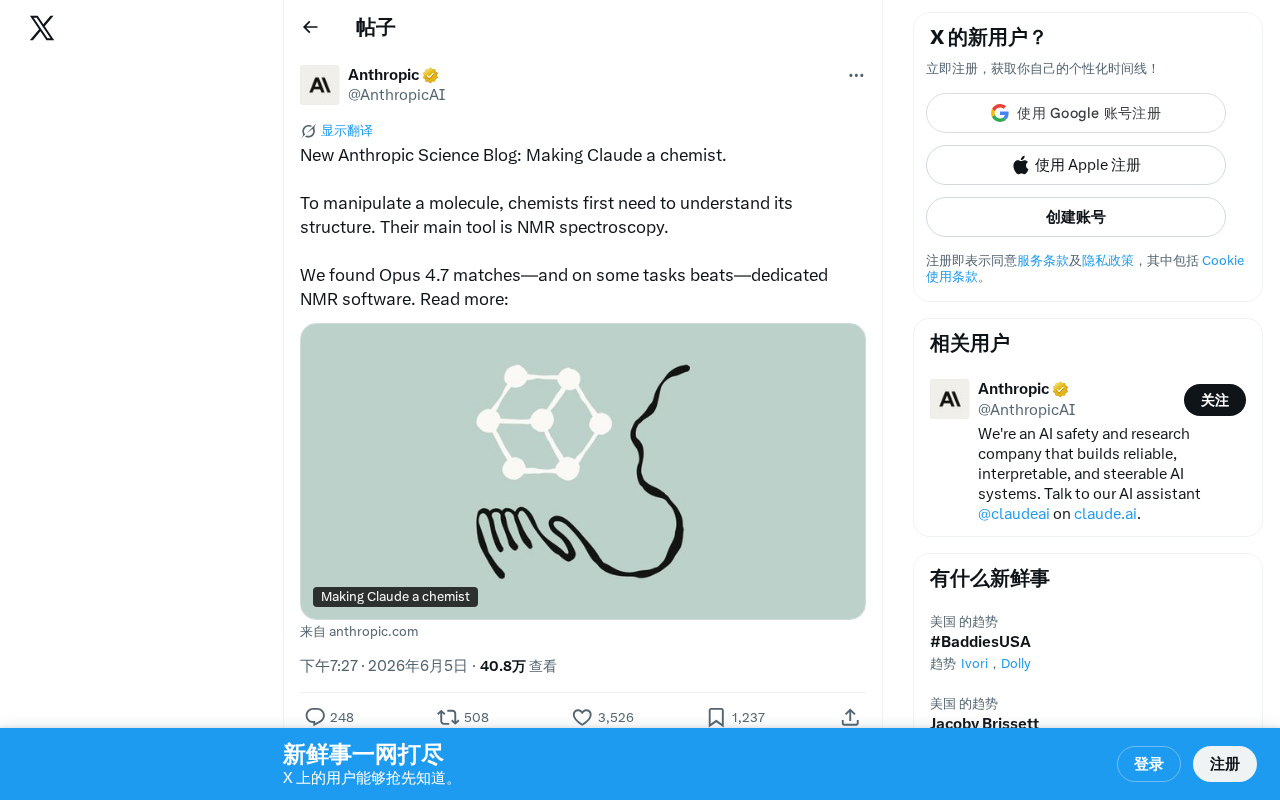
Claude Opus 4.7 Conquers NMR Spectroscopy Analysis: A General-Purpose AI Rivaling Specialized Chemistry Software
Anthropic's latest research shows Claude Opus 4.7 matches or surpasses dedicated NMR spectroscopy software. Explore the technical significance, drug discovery implications, and future of AI science tools.
Read more →

·2 min
GPT-Rosalind: A Detailed Look at OpenAI's AI Model Built for Life Sciences
OpenAI launches GPT-Rosalind, an enterprise AI model for life sciences. Integrating GPT-5.5 agentic coding and tool use, it covers drug discovery, molecular design, data analysis, and experimental workflows.
Read more →

·3 min
Deep Dive into Closco: The Research Automation Platform That Goes from Natural Language to Complete Reports
Deep analysis of Closco's research automation platform covering cloud sandbox architecture, self-healing execution, batch computing, and applications in computational materials science, drug design, and genomics.
Read more →
The Moat for AI Products Isn't Technol…
·1 min
The Moat for AI Products Isn't Technology — It's Trust: Decoding Lovable CEO's Competitive Strategy
Lovable CEO Anton Osika argues trust is AI's most underrated moat. Learn how craft, care, and obsession build lasting competitive advantage in AI products.
Read more →