#compute bloat
121 related articles

·3 min
Local LLM Agent Lagging? Lowering num_gpu Is the Key
Local LLM crashing in Agent frameworks? The issue may be num_gpu set too high. Learn what num_gpu really controls (GPU layer offloading, not GPU count) and how to tune it for stable Agent performance.
Read more →

·3 min
Antigravity CLI Weekly Usage Limits in Practice: A Practical Guide to Maximizing Quota for Ops Workflows
Analyzing Google Antigravity CLI weekly usage limits, Flash vs Pro quota weights, and practical tips like trimming context and batching requests to help sysadmin and homelab users maximize subscription quotas.
Read more →

·3 min
Antigravity CLI Weekly Limit Real-World Testing: A Practical Guide to Maximizing Quota for Ops Workflows
Deep analysis of Google Antigravity CLI weekly usage limits, Flash vs Pro quota weights, and practical tips for sysadmin/homelab users to maximize subscription quota.
Read more →

·4 min
OpenAI Employee Shares How to Build an AI Work Operating System with Codex
OpenAI's Jason Liu shares how he uses ChatGPT Workbench and Codex to build an AI work OS: Chief of Staff automation, persistent threads, Skills/Plugins, browser control, and app-building methodology.
Read more →

·5 min
Running GPT-5.6 Inside Claude Code: Best Practices for Subagent Orchestration and System Prompts
Deep dive into running OpenAI GPT-5.6 inside Claude Code: comparing Codex vs Claude Code on subagent orchestration, workflow design, and system prompt quality, revealing how harness engineering determines model output.
Read more →

·4 min
Fable 5 vs GPT-5.6: An In-Depth Head-to-Head Comparison of Two Top-Tier Coding Models
In-depth comparison of Fable 5 vs GPT-5.6 (Sol) for AI coding. Covering token efficiency, code quality, design, cost, and safety based on $10K+ real usage data.
Read more →

·4 min
Fable 5 vs GPT-5.6: An In-Depth Head-to-Head Comparison of Two Top-Tier Coding Models
In-depth comparison of Fable 5 vs GPT-5.6 (Sol) for AI coding. Real-world data on token efficiency, code quality, design capability, and cost from $10K+ testing.
Read more →

·4 min
Deep Dive into the EYG Programming Language: A New Portable Programming Paradigm Designed for Humans
Deep analysis of the EYG programming language's core design, including algebraic effects, program state persistence, and cross-platform portability, exploring how it addresses modern software fragmentation.
Read more →

·3 min
Deconstructing Agents: Task Decomposition, Context Compression, and the Case Against Heavy Frameworks
A deep engineering analysis of Agent internals: how LLMs decompose tasks via tool calling, why context compression and memory are essential, and why solo developers should avoid heavy frameworks.
Read more →

·3 min
Gemini Can Generate a PDF One Moment but Claims It Can't the Next? Here's Why
Analysis of why Gemini and other AI LLMs exhibit capability drift, including tool-calling mechanisms, context window limits, and safety policy triggers, plus practical strategies for PDF generation failures.
Read more →

·3 min
Agent Skills Explained: Solving the MCP Context Bloat Problem
Deep dive into Anthropic's Agent Skills mechanism, explaining how Progressive Disclosure solves MCP context bloat and tool calling accuracy issues in AI agents.
Read more →

·3 min
Dear ImGui Deep Dive: Why This Immediate Mode GUI Library Has Won Over C++ Developers
Deep dive into Dear ImGui's immediate mode GUI design, technical features, and use cases. Covers immediate vs retained mode, backend support, game engine integration, and ecosystem extensions.
Read more →

·4 min
Gemini 3.5 Pro Hands-On: No More Lazy Code Generation, Complete Projects in a Single Output
A Reddit user tested Gemini 3.5 Pro in Arena and found it generates 20+ files with hundreds of lines of code per file in a single pass, with no lazy shortcuts or placeholders.
Read more →

·4 min
Underrated Self-Hosting Gems: A Roundup of Niche but Powerful Open-Source Tools
Discover underrated niche self-hosted open-source tools across bookmarks, passwords, document archiving, knowledge bases, and dashboards, with deployment tips.
Read more →

·4 min
The Cursor Swarm Experiment: What AI Rebuilding SQLite from Scratch in Rust Reveals About Cost
Cursor's swarm experiment had AI teams implement a SQLite engine in Rust from scratch using only 835 pages of docs. All-frontier models cost $10K+, hybrid role division just $1.3K—a 7.9x gap.
Read more →

·3 min
Context Engineering: Why Does More Context Make AI Dumber?
Anthropic introduces Context Engineering, revealing Context Rot: the more tokens in the window, the worse AI retrieval accuracy. Learn the three principles, just-in-time retrieval, and three moves against context overflow.
Read more →
·3 min
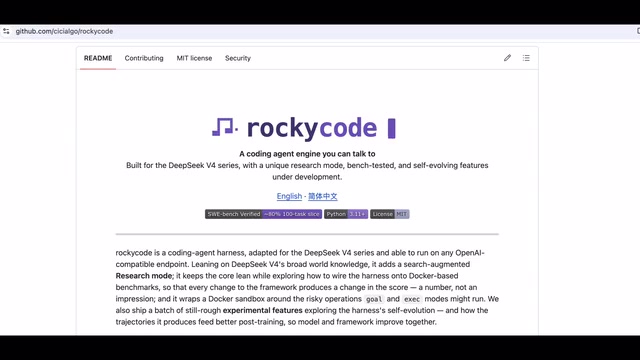
Rocky: An Open-Source Coding Agent with Minimal Architecture and Native DeepSeek Integration
Rocky is a minimal, transparent open-source coding agent with a core loop under a few hundred lines of Python, native DeepSeek search, Research mode, and built-in SWE benchmarking for reproducible agent experiments.
Read more →

·2 min
Can One Skill Transform All Skills? The Boundary Debate Between Dify Workflows and Agents
A recursive technical proposition: Can we build a "meta-Skill" that auto-transforms any Skill into a Dify workflow? This article dissects the boundary between deterministic orchestration and autonomous Agent decisions.
Read more →

·6 min
How the Creator of Redis Squeezed a 284B-Parameter DeepSeek into an Ordinary Laptop
Redis creator antirez built DS4 "Dwarf Star," a pure-C inference engine, using asymmetric quantization to compress DeepSeek V4 Flash from 500GB to 80.8GB for local 128GB unified-memory deployment at 26.7 tokens/sec.
Read more →

·6 min
How the Creator of Redis Squeezed a 284-Billion-Parameter DeepSeek Into an Ordinary Laptop
Redis author antirez built the pure-C inference engine DS4 "Dwarf Star," compressing DeepSeek V4 Flash from 500GB to 80.8GB via asymmetric quantization for local deployment on 128GB unified memory at 26.7 tokens/sec.
Read more →