#election timeout
116 related articles

·3 min
How Beginners Can Start Contributing to Open Source: A Complete Guide from Zero to Your First PR
How can programming beginners contribute to open source? A complete guide covering project selection, finding good first issues, non-code contributions, and submitting your first Pull Request.
Read more →

·5 min
Harness: The Operating System That Takes LLM Agents from Demo to Production
Deep dive into Harness technology: how context engineering, memory management, and multi-agent architecture transform LLM agents from stochastic demos into stable production systems.
Read more →

·3 min
ScrapeOps Proxy Tester: Choose the Right Proxy for Your Scraper with Real-World Data
ScrapeOps Proxy Tester benchmarks 20+ proxy configurations against your specific target URL, measuring success rate, latency, and cost to help scrapers and AI Agents choose the optimal proxy.
Read more →

·3 min
Open-Source vs Closed-Source Models, Reward Hacking & Benchmark Gaming: A Deep Dive into Core AI Model Technical Issues
Deep analysis of six core AI model issues: open-source vs closed-source models, inference throughput vs accuracy tradeoffs, benchmark gaming, distillation vs RL, reward hacking defenses, and dynamic quantization technology.
Read more →

·3 min
Cursor Browser Worker Parallelization: Practical Strategies for Working Within Rate Limits
Learn how to parallelize Cursor browser Workers from serial to parallel execution using distributed Worker pools, proxy pools, token bucket algorithms, and exponential backoff to compress 2000-3000 page scraping tasks from hours to 15-20 minutes.
Read more →

·2 min
HyperProbe: How a Read-Only AI Agent Is Revolutionizing Production Debugging
HyperProbe is a YC S26 AI debugging agent that performs read-only debugging in production, helping engineers quickly identify root causes. Analysis of its design philosophy and market positioning.
Read more →

·3 min
Deep Dive into Raft Leader Election: Building a Distributed Consensus Algorithm from Scratch
A detailed explanation of Raft's leader election mechanism covering terms, randomized timeouts, and majority voting — helping developers truly understand distributed consensus.
Read more →

·3 min
Building a Local AI Agent Architecture: From Scattered Scripts to Your Personal Jarvis
A practical guide to consolidating scattered automation scripts into a local AI Agent hub. Covers Function Calling, Ollama+Qwen2.5 deployment, tool orchestration architecture, and a complete implementation roadmap.
Read more →

·5 min
Have AI Doomers Actually Used AI? A Developer Exposes the Gap Between Hype and Reality
AI Doomers warn AI will destroy humanity, but have they actually built AI apps? A developer's sharp critique reveals the vast gap between AI demos and real engineering practice.
Read more →

·3 min
Supabase in Production: A Deep Dive into Cron and Queue Reliability Issues
Deep analysis of Supabase production reliability issues with pg_cron and pgmq, covering task loss, execution uncertainty, and observability gaps, with practical architecture optimization advice.
Read more →

·4 min
G.I.A.ac: An AI Architect That Generates Working Apps from a Single Sentence
G.I.A.ac (General Intelligence Architect) is an AI architect tool that generates runnable apps from a single sentence. Deep dive into its positioning, competitive landscape, target users, and core challenges.
Read more →

·4 min
Best Practices Guide for Deploying Nextcloud in a 15-Person Small Business
Complete Nextcloud deployment guide for 15-person small businesses covering AIO installation, hardware specs, Redis and PHP tuning, OnlyOffice vs Collabora, backup strategies, and more.
Read more →

·4 min
Best Practices Guide for Deploying Nextcloud in a 15-Person Small Business
Complete Nextcloud deployment guide for 15-person small businesses covering AIO installation, hardware specs, Redis and PHP tuning, OnlyOffice vs Collabora, backup strategies, and key practices for building a stable private cloud office platform.
Read more →

·3 min
Production-Grade LLM Inference Deployment: A Practical K8s Handbook
Complete guide to deploying production-grade LLM inference on Kubernetes, covering GPU scheduling, vLLM engine selection, autoscaling, observability, and cost optimization.
Read more →

·3 min
Gemini Managed Agents API Update: Environment Hooks and Free Tier Fully Explained
Google Gemini Managed Agents API introduces environment hooks, model selection, free tier support, and default model upgrades—empowering AI Agent developers with stronger execution control and lower barriers to entry.
Read more →

·3 min
Inbox Pattern Explained: An Elegant Solution to Duplicate Message Processing
Deep dive into how the Inbox Pattern solves duplicate message processing in distributed systems, covering core principles, MassTransit implementation, alternatives comparison, and practical selection guidance.
Read more →

·3 min
Inbox Pattern Explained: An Elegant Solution for Duplicate Message Processing
Deep dive into the Inbox Pattern for solving duplicate message processing in distributed systems, covering core principles, MassTransit implementation, alternatives comparison, and selection guidance.
Read more →

·3 min
Gemini Batch API Major Upgrade: 80% Latency Reduction, Success Rate Exceeds 99.998%
Google's Gemini Batch API completes major infrastructure upgrade with 80% lower p95 latency, 99.998%+ success rate, 98% fewer expirations, and new partial batch support for large-scale AI inference.
Read more →
·4 min
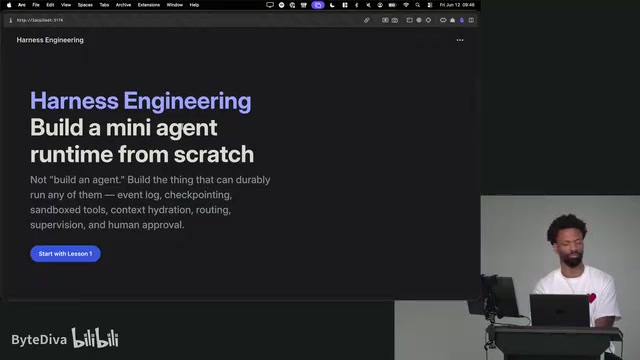
Harness Engineering: The Core Infrastructure for Taking AI Agents from Demo to Production
Deep dive into Harness Engineering: why AI Agents need memory management, durable execution, guardrails & approvals to go from demo to production.
Read more →

·4 min
Harness Engineering: The Core Infrastructure for Taking AI Agents from Demo to Production
Deep dive into Harness Engineering: why AI Agents need memory management, durable execution, guardrails & approvals to reach production. Based on Scott Moss's workshop.
Read more →