#multi-agent research
908 related articles

·2 min
Moving State Out of Framework Memory: A Multi-Agent Architecture Refactoring Guide
Exploring how 70% of multi-agent memory is consumed by non-reasoning state, and a refactoring approach using email threads to replace framework memory for better token efficiency, auditability, and resilience.
Read more →

·2 min
LangChain or LangGraph? Choosing the Right Framework for Production-Grade AI Applications
In-depth analysis of core differences between LangChain and LangGraph, exploring why more teams are migrating to LangGraph for production AI apps, with framework selection guidance.
Read more →

·2 min
LangChain or LangGraph? Framework Choices for Production-Grade AI Applications
In-depth analysis of LangChain vs LangGraph differences, why teams are migrating to LangGraph for production AI apps, and framework selection guidance based on project complexity.
Read more →

·2 min
Task Monki: An Open-Source Multi-Agent Collaborative Programming Workflow Platform
Task Monki is an open-source desktop app that lets coding agents handle the full dev workflow from task planning to Pull Request, with multi-agent parallel execution, code review, and collaborative discussion.
Read more →

·3 min
Medley: A Deep Dive into the Multi-Agent Orchestration Plugin for Claude Code
Medley is a free Claude Code plugin that decomposes complex dev tasks into live task graphs via /mission, orchestrating multiple AI agents with BYOK model support and built-in review cycles.
Read more →

·4 min
FlowTask 2.0: Building a Unified Enterprise Memory Layer for AI Agents
FlowTask 2.0 proposes a "Company Brain" that unifies data from Email, Slack, WhatsApp and more to provide real-time enterprise context for AI Agents, reducing repetitive context-feeding costs.
Read more →

·3 min
Gstack Agents: Open-Source AI Expert Panel Joins Your Google Meet Video Calls
Gstack Agents is an MIT open-source tool that adds 18+ AI personas (CEO, CSO, YC partner, etc.) as voice bots to Google Meet, providing real-time multi-perspective structured feedback on your demos.
Read more →

·3 min
Gstack Agents: Open-Source AI Expert Panel Joins Your Google Meet Video Conferences
Gstack Agents is an MIT open-source tool that adds 18+ AI personas (CEO, CSO, YC Partner, etc.) as voice bots to Google Meet, providing real-time multi-perspective structured feedback on your product demos.
Read more →

·3 min
OpenComputer: Deploy Managed AI Agents with a Single Sentence — A Minimalist Launch Solution for Developers
OpenComputer is an AI agent managed deployment platform that gives you a live agent URL from a single description. This article analyzes its workflow design, market positioning, and security/cost considerations.
Read more →

·3 min
From Linear Pipelines to State Machines: A Practical Guide to Advanced Agent Architecture
Learn how to advance from linear pipeline to state machine Agent architecture through a YouTube script-to-storyboard case study, covering fault tolerance, LLM evaluation frameworks, and LangGraph vs AutoGen selection.
Read more →

·4 min
Infrastructure Architecture for Agent Applications: Four Core Patterns Explained
Deep dive into infrastructure architecture patterns for production-grade Agent applications, covering state persistence, sandbox isolation, LLM observability, and cost control.
Read more →

·3 min
Long Documents Don't Work: Why AI Agents Can't Follow Your Rules
Analysis of why AI Agents can't reliably follow long policy documents, covering context dilution, rule conflicts, and soft constraint limitations, with more reliable governance architectures.
Read more →

·3 min
The ISNAD Framework: Building a Trust Verification Layer for Multi-Agent AI Systems Using a Millennium-Old Scholarly Tradition
The ISNAD framework adapts Islamic chain-of-transmission verification to build a trust layer for multi-agent AI systems, focusing on claim verification over agent authentication to combat hallucinations and silent failures.
Read more →

·3 min
EMNLP 2026 Launches AI Reviewing Experiment: A Transformation in Academic Peer Review
EMNLP 2026 introduces AI-generated reviews in ACL Rolling Review, exploring LLM-assisted academic peer review. Analysis of the experiment's background, core content, controversies, and implications.
Read more →

·3 min
EMNLP 2026 Launches AI Reviewing Experiment: A Turning Point for Academic Peer Review
EMNLP 2026 introduces AI-generated reviews in ACL Rolling Review, exploring LLM-assisted academic peer review. Analysis of the experiment's background, mechanics, controversies, and implications.
Read more →

·3 min
Implementing Zanzibar in Lean4: A Formally Verified Permission Engine for AI Projects
Deep dive into a Datalog permission DSL built on Google Zanzibar using Lean4 theorem prover. How formal verification strengthens AI permission management.
Read more →

·2 min
Agenta: A Detailed Look at the Open-Source Self-Hosted Claude Cowork Alternative
Agenta is an open-source AI Agent collaboration platform supporting self-hosted models and any Agent framework, positioned as an open-source Claude Cowork alternative.
Read more →

·2 min
Training AI to Play Devil May Cry 3 with Reinforcement Learning: Challenges and Practices in Action Game AI
An indie developer trains AI to autonomously play Devil May Cry 3 using reinforcement learning. Explore the core challenges of action game AI including sparse rewards, high-dimensional action spaces, and real-time decision-making.
Read more →

·2 min
Training AI to Play Devil May Cry 3 with Reinforcement Learning: Challenges and Practices for Action Game AI
An indie developer trains AI to autonomously play Devil May Cry 3 using reinforcement learning. This article analyzes the core challenges including sparse rewards, high-dimensional action spaces, and real-time decision-making.
Read more →
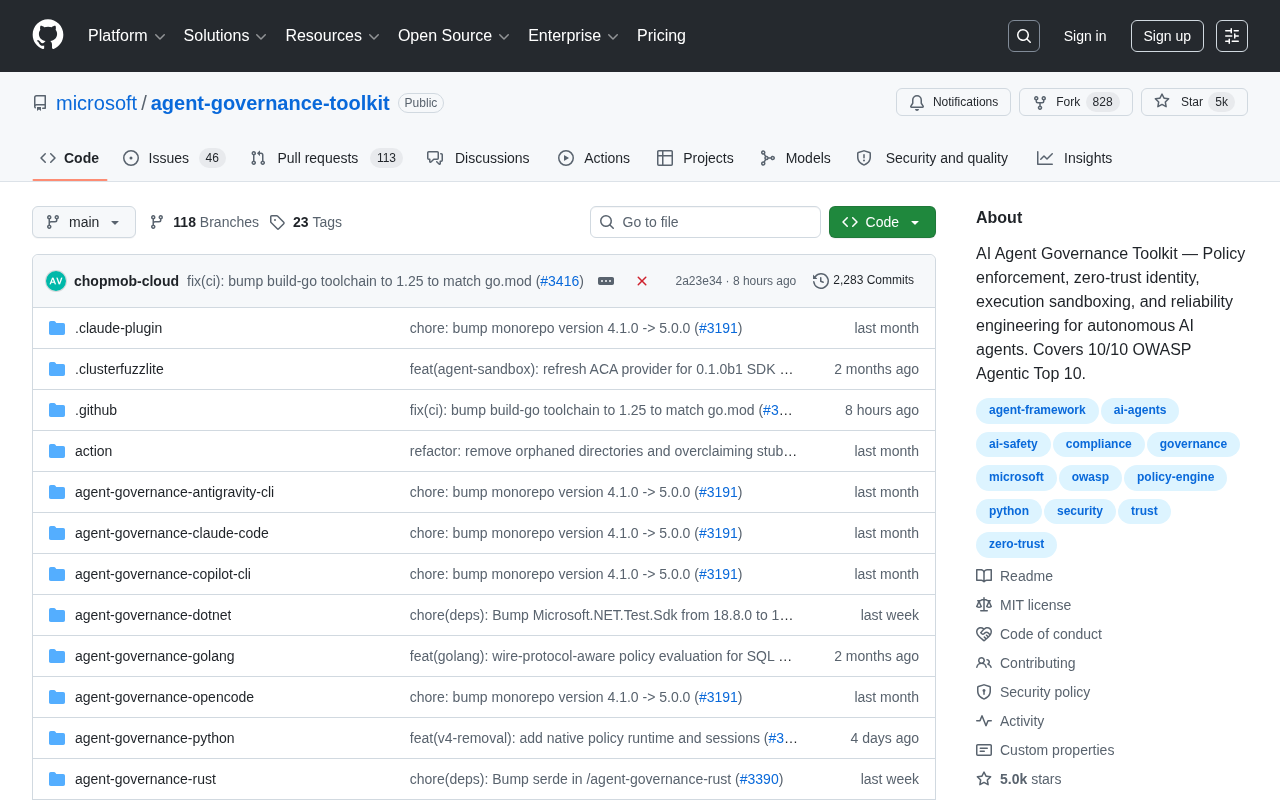
·4 min
Microsoft Open-Sources AI Agent Governance Toolkit: Comprehensive Coverage of OWASP Top 10 Risks
Microsoft open-sources agent-governance-toolkit covering all OWASP Agentic Top 10 risks through policy enforcement, zero-trust identity, execution sandboxing, and reliability engineering for production AI Agent deployment.
Read more →