#open source intelligence
1656 related articles
 Product Reviews
·3 min
Deep Dive into AGGO Framework: A New Go-Based Choice for Enterprise AI Agents
Deep dive into AGGO—an enterprise AI Agent framework built with Go and CloudWeGo Eino, covering conversational AI, RAG, memory systems, and tool calling, with Go's performance advantages.
Read more →
 Tutorials
·2 min
OpenClaw Orange Book: An In-Depth Guide to the Open-Source AI Agent Framework
In-depth look at the OpenClaw Orange Book open-source project covering AI Agent framework components, tech ecosystem, and practical development methodology.
Read more →
 Product Reviews
·2 min
Lingque AI Agent Framework: A Self-Controlled Solution for Private Deployment
Lingque is a Python-based open-source AI Agent framework supporting fully private deployment with data sovereignty. This article analyzes its technical features, use cases, and advantages over LangChain.
Read more →
 Product Reviews
·3 min
Agentica Open-Source Framework Review: A Lightweight Async AI Agent Development Alternative
In-depth review of Agentica, an open-source AI Agent framework featuring async-first architecture, tool calling, RAG, multi-agent collaboration, and MCP protocol support, with comparisons to LangChain and other mainstream frameworks.
Read more →
 Deep Dives
·4 min
Deep Dive into Claude Code Source Code: A Complete Guide to Agent Loops, Context Engineering, and Architecture Design
Deep analysis of Claude Code's source architecture: Agent loop mechanism, context engineering strategies, tool system design, and permission controls. Based on the viral GitHub project how-claude-code-works.
Read more →
 Product Reviews
·3 min
GSD-2 Open Source Project Deep Dive: How Meta-Prompting + Context Engineering Keep AI Agents Working Autonomously Without Drifting
Deep dive into GSD-2's three core technologies: meta-prompting, context engineering, and spec-driven development — solving the problem of AI agents drifting off-target during long tasks.
Read more →
 Tutorials
·3 min
74K Stars on GitHub: The Most Comprehensive Open-Source Learning Guide for Prompt Engineering, RAG & AI Agents
Deep dive into the 74K-star GitHub project Prompt Engineering Guide, covering prompt techniques, context engineering, RAG, AI Agents, and complete learning paths for developers.
Read more →
 Product Reviews
·3 min
PaperOrchestra Open Source Project Explained: Automatically Generating Research Papers with Coding Agents
PaperOrchestra is an open source AI paper writing tool based on Google's research. It uses coding agents like Claude Code and Cursor to automate the full research paper workflow without API keys.
Read more →
 Product Reviews
·2 min
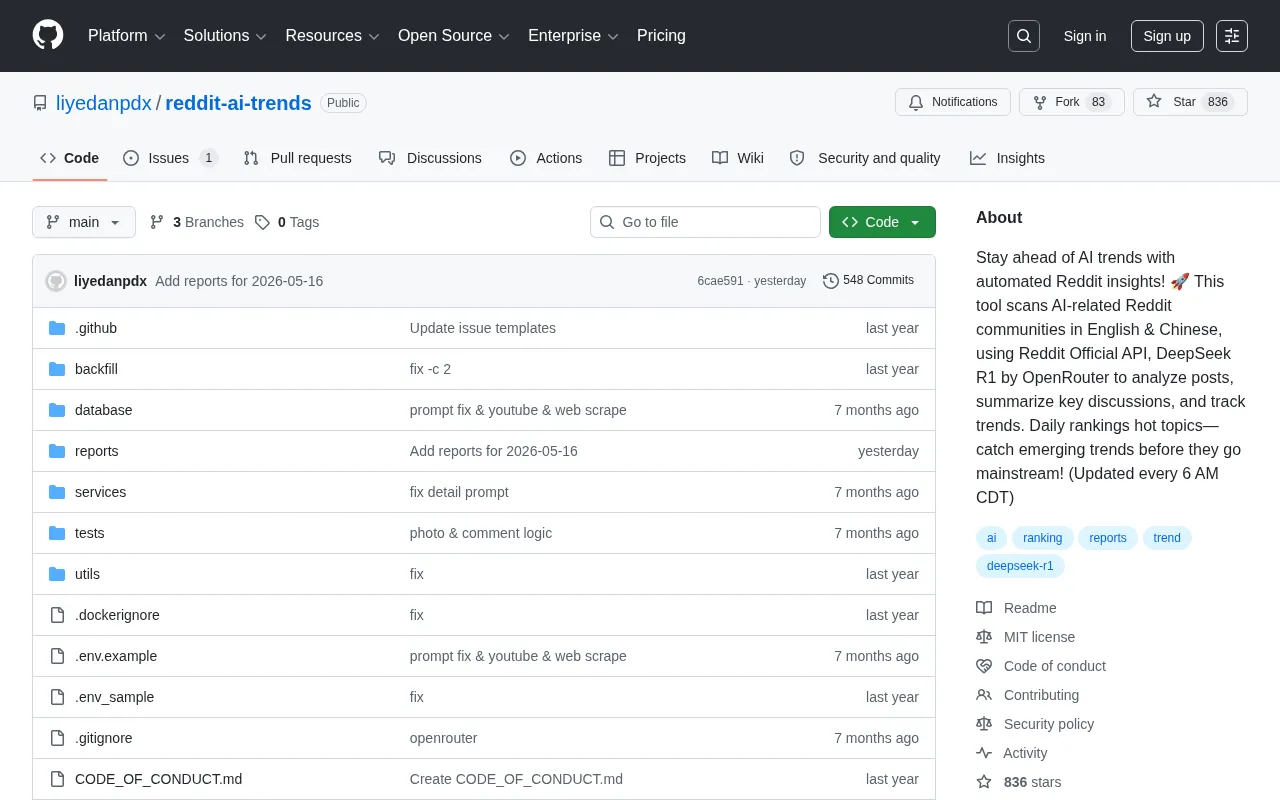
Reddit AI Trend Tracking Tool: Automatically Capture AI Hotspots with DeepSeek
reddit-ai-trends is an open-source Python tool that scans Reddit AI communities via the official API and uses DeepSeek R1 to auto-generate trend summaries and topic rankings for efficient AI industry tracking.
Read more →
 Deep Dives
·3 min
Open-Source Replication of OpenAI Operator: Building a Computer-Controlling AI Agent in 48 Hours
A developer open-source replicated OpenAI's $200/month Operator in 48 hours using Anthropic Computer Use, building a full-stack Dockerized computer-controlling AI Agent with deep analysis of architecture and industry trends.
Read more →
 Deep Dives
·3 min
AI-Assistant Open Source Project Analysis: Building a Local AI Agent with the Anthropic API
Deep analysis of the open-source AI-Assistant project built on Anthropic Claude API for local AI Agents, covering architecture, use cases, security, and agentic AI trends.
Read more →
 Deep Dives
·3 min
Open Computer Use: An Open-Source Framework for AI Agents to Autonomously Control Computers
Open Computer Use is an open-source TypeScript AI agent framework enabling automated computer control via browser, terminal, and desktop. Learn about its features, architecture, and comparison with Claude Computer Use.
Read more →
 Deep Dives
·2 min
best-agent: A Self-Evolving Multi-Agent Framework Built on Claude Code
Deep analysis of best-agent, a self-evolving AI Agent framework built on Claude Code with 94+ skills, 14 specialized agents, and Computer Use capabilities.
Read more →
 Deep Dives
·2 min
Computer Agent: An Open-Source Rust AI Desktop Agent That Automatically Controls Mouse, Keyboard, and Browser
Computer Agent is an open-source AI desktop agent built in Rust that controls terminals, browsers, mice, and keyboards via natural language. Explore its features, architecture, and security.
Read more →
 Deep Dives
·2 min
OS AI Computer Use: A Cross-Platform Open-Source AI Desktop Automation Tool Explained
OS AI Computer Use is an open-source AI desktop automation tool supporting Windows, macOS, and Linux with OpenAI and Anthropic API compatibility. Learn about its features, architecture, and safety tips.
Read more →
 Tech Frontiers
·3 min
Swarm IDE: Open-Source Multi-Agent Collaborative Development Environment with 1500 Stars for Agent Orchestration
Swarm IDE is an open-source IDE for Agent Swarm multi-agent collaboration, supporting Kimi-2.5, GLM-4.7 and more models with visual orchestration, debugging and management capabilities.
Read more →
 Product Reviews
·2 min
Deep Dive into LobeHub: The 75K-Star Open Source Multi-Agent Collaboration Platform
Deep dive into LobeHub, a trending GitHub open-source project with 75,900+ Stars. Explore its multi-agent collaboration mechanisms, low-code team design, and competitive advantages over AutoGen and CrewAI.
Read more →
 Tutorials
·3 min
Programmer Yupi's AI Resource Collection: A Complete Learning Path from Zero to Production
A deep dive into the popular GitHub project liyupi/ai-guide covering Vibe Coding tutorials, LLM usage, AI coding tools (Cursor/Claude Code), Prompts, RAG/MCP/Agent concepts — a 13,000+ Stars Chinese AI learning resource hub.
Read more →
 Product Reviews
·2 min
LobeHub Open Source Project Deep Dive: How a Multi-Agent Collaboration Platform is Reshaping AI Workflows
Deep dive into LobeHub's open-source multi-agent collaboration platform, covering core features, technical architecture, and industry trends. Learn how this 75K+ Star GitHub project redefines human-AI collaboration through Agent team design and multi-agent coordination.
Read more →
 Tech Frontiers
·3 min
UK AISI Assessment Report: GPT-5.5 Cybersecurity Capabilities and Public Availability Raise Governance Concerns
UK AISI releases GPT-5.5 cybersecurity assessment showing vulnerability discovery capabilities on par with Claude Mythos, but its public availability raises urgent AI safety governance challenges.
Read more →