#personal software
1609 related articles
 Tutorials
·2 min
Save to Spotify: The Complete Guide to Publishing AI-Generated Podcasts on Spotify with One Click
Save to Spotify is a CLI tool for AI agents like OpenClaw, Claude Code, and OpenAI Codex to publish AI-generated audio directly to Spotify. Full guide on setup, use cases, and podcast ecosystem impact.
Read more →
 Product Reviews
·2 min
Fitbit Air Review: Can Google's $99 AI Band Replace Whoop?
Google launches the $99 screenless Fitbit Air AI health band, directly challenging Whoop. Full analysis of its screenless design, AI health tracking, pricing advantage, and market competition.
Read more →
 Tutorials
·1 min
Chinese Prompt Collection for AI Coding Tools: An Essential Reference for Developers
A curated GitHub project collecting system prompts from Cursor, Devin, and VSCode Agent with Chinese translations — helping developers master AI coding tools.
Read more →
 Product Reviews
·4 min
RuoYi-AI Open Source Framework: A One-Stop Solution for Java Enterprise AI Application Development
A deep dive into RuoYi-AI, a Java-based enterprise AI development platform supporting multi-vendor LLM integration, RAG knowledge bases, and agent orchestration. 5,200+ Stars on GitHub.
Read more →
 Product Reviews
·2 min
OpenYak: Open-Source Local AI Agent Supporting 100+ Models with Zero Telemetry Privacy
OpenYak is an open-source local AI agent supporting Windows/macOS/Linux. Access 100+ models via OpenRouter, MCP, and Ollama with BYOK zero-telemetry privacy — a strong alternative to Claude Code and OpenAI Codex.
Read more →
 Tutorials
·3 min
Building an iNaturalist Observation Display Tool Over a Weekend with a Phone + Claude Code: Full Workflow
Simon Willison built an iNaturalist observation display tool from scratch using his phone and Claude Code while camping. Full breakdown of the three-layer data pipeline architecture and AI-assisted mobile development workflow.
Read more →
 Tutorials
·2 min
Simon Willison's Full Journey: Building a Wildlife Sightings Feature for His Blog Using Claude Code on His Phone
Simon Willison used Claude Code for web on his phone to add iNaturalist wildlife sightings to his blog, going from prototype to production in one day.
Read more →
 Product Reviews
·2 min
Claude Code Prompt Optimizer: Using AI to Automatically Rewrite Prompts for Better Code Generation
Explore claude-code-prompt-optimizer: an open-source tool using Hook interception and Claude Opus to auto-rewrite simple prompts into structured instructions, boosting Claude Code output quality.
Read more →
 Expert Opinions
·2 min
The Vibe Coding Era: Why We Need RSS to Distribute Personal Apps
As vibe coding makes app development as easy as blogging, personalized micro-tools are proliferating. This article explores why RSS/Atom is the ideal solution for app discovery and distribution in the AI-assisted programming era.
Read more →
 Product Reviews
·3 min
LibreChat: A Complete Guide to the Open-Source Self-Hosted Multi-Model AI Chat Platform
Deep dive into LibreChat, an open-source self-hosted AI chat platform supporting GPT, Claude, Gemini multi-model switching, MCP protocol, Agents, code interpreter, and enterprise deployment.
Read more →
 Tutorials
·3 min
Ollama Tutorial: The Simplest Way to Run DeepSeek and Other LLMs Locally
Complete guide to deploying LLMs locally with Ollama. Supports DeepSeek, Qwen, Kimi-K2.5 and more. Learn how this 170K-Star open-source tool enables one-click setup, offline inference, and ecosystem integration.
Read more →
 Product Reviews
·2 min
The Complete Guide to AnythingLLM: A Privacy-First AI Productivity Tool for Local Deployment
Deep dive into AnythingLLM, a privacy-first open-source AI tool for local deployment. Covers RAG document chat, multi-model support, AI Agents, and more — zero config, nearly 60K GitHub Stars.
Read more →
 Product Reviews
·2 min
OpenMemory: Local Persistent Memory Storage for Shared Context Across AI Tools
OpenMemory is an open-source local memory storage solution providing a unified memory layer for Claude Desktop, GitHub Copilot, and other LLM apps, enabling shared context while ensuring data privacy.
Read more →
 Product Reviews
·2 min
Simon Willison Used Claude Code on His Phone to Add Wildlife Sightings to His Blog
Simon Willison used Claude Code's web version on his phone to integrate a decade of iNaturalist wildlife observations into his blog, showcasing AI-assisted mobile development.
Read more →
 Expert Opinions
·2 min
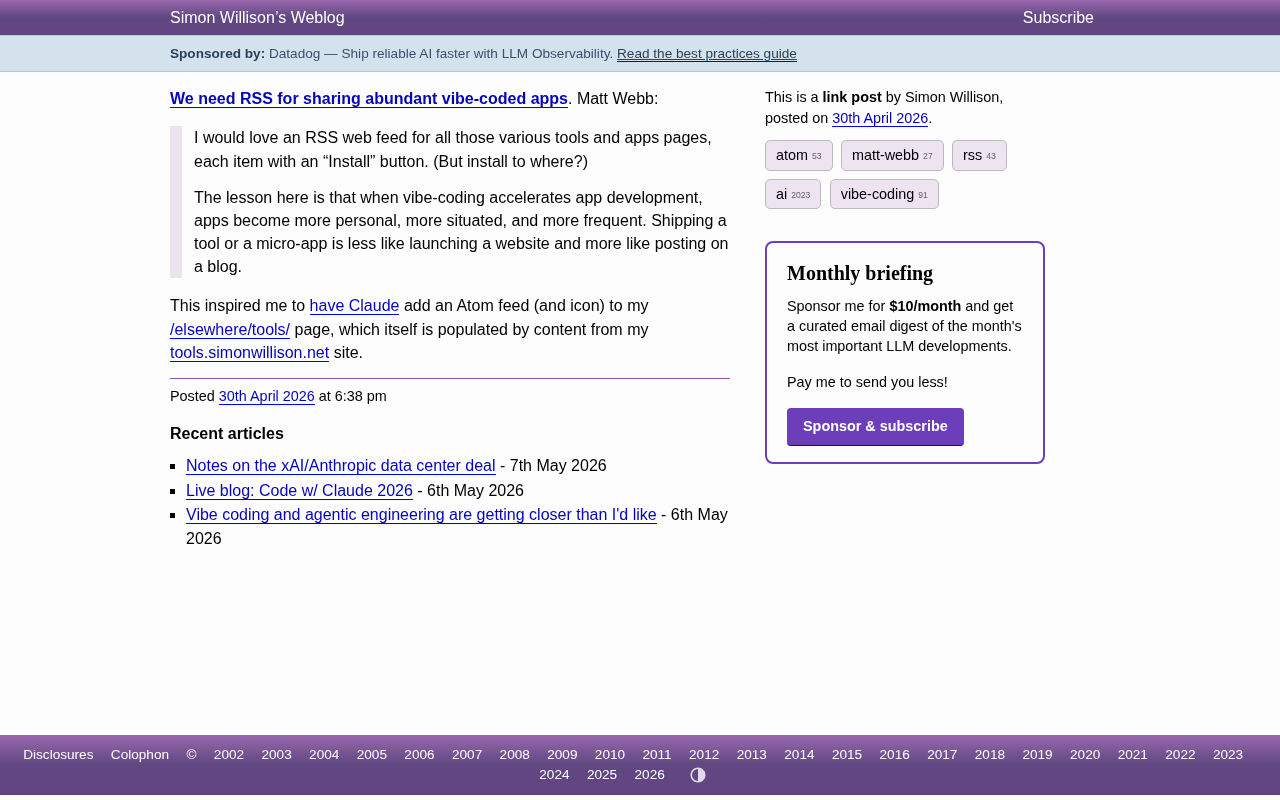
The Vibe Coding Era: Why We Need RSS to Distribute Personal AI Apps
As vibe coding makes app development as frequent as blogging, we need lightweight mechanisms like RSS to discover and share personal AI tools. Exploring the future infrastructure of AI app distribution.
Read more →
 Expert Opinions
·3 min
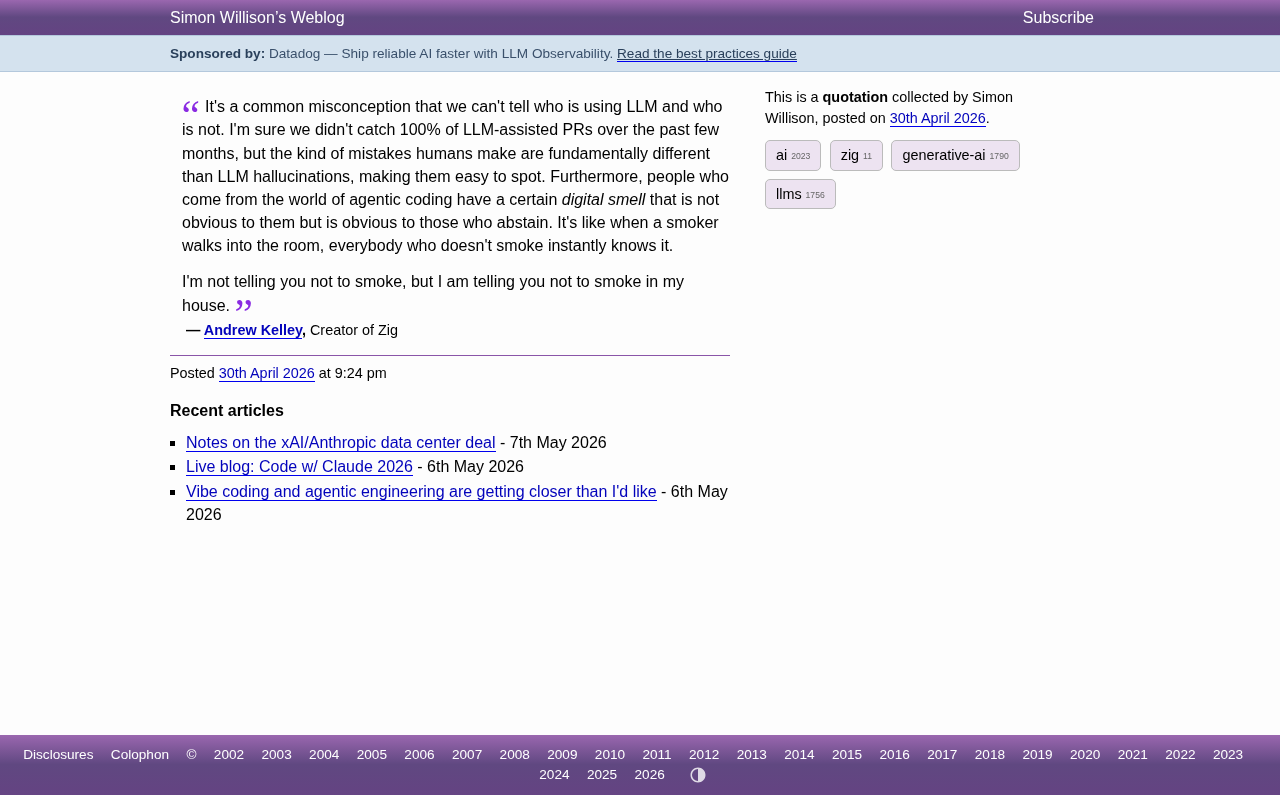
Zig Creator on AI Code Ban: You Can Smoke, But Not in My House
Zig creator Andrew Kelley uses a smoking analogy to address the AI code ban controversy: developers can use AI tools, but Zig's codebase won't accept LLM-assisted contributions.
Read more →
 Product Reviews
·2 min
Building an iNaturalist Observation Tool Entirely on a Phone with Claude Code
Simon Willison built an iNaturalist observation display tool entirely on his phone with Claude Code while camping, using Git Scraping + GitHub Actions for a zero-cost serverless architecture.
Read more →
 Expert Opinions
·2 min
The Vibe Coding Era: Why We Need RSS to Share Personal Micro-Apps
AI coding makes building micro-apps as easy as blogging, but how do we share them? Matt Webb proposes RSS for distributing vibe coding output, and Simon Willison has already put it into practice.
Read more →
 Expert Opinions
·3 min
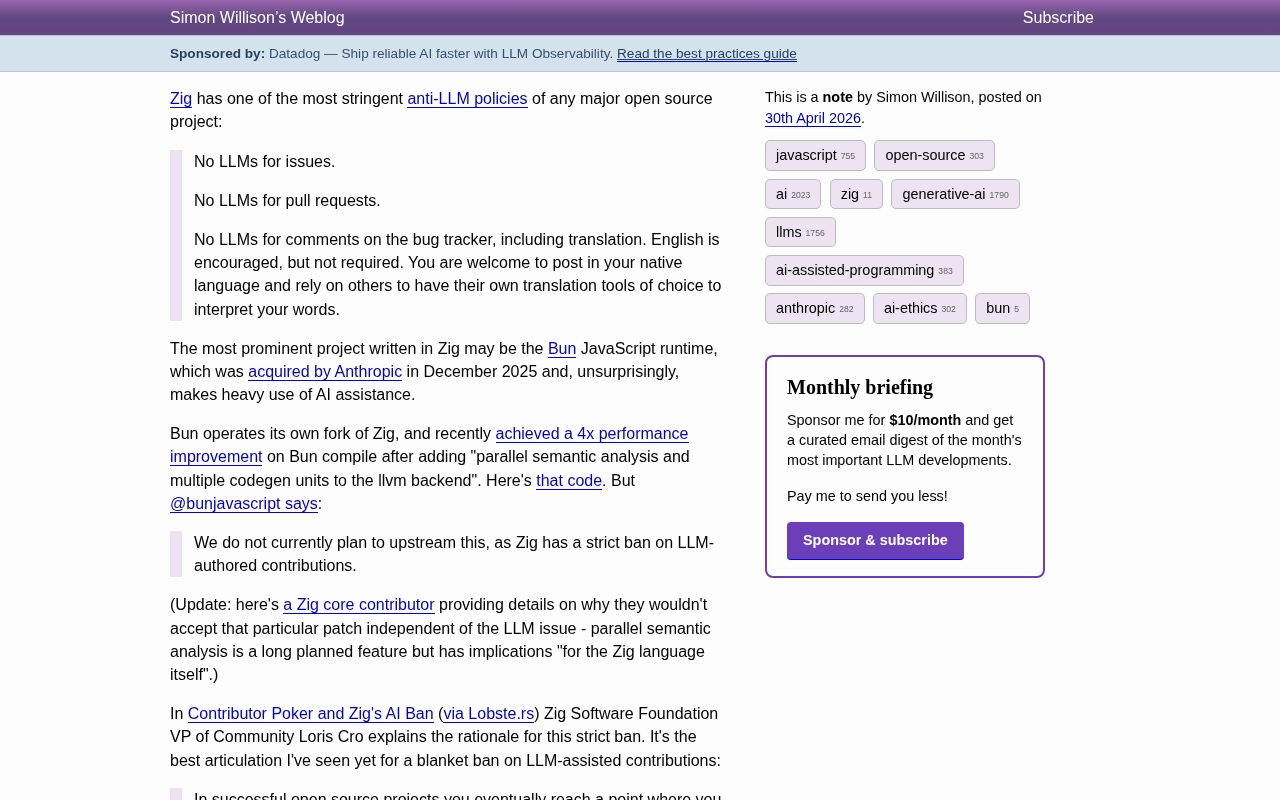
Why Does Zig Completely Ban AI Contributions? A Deep Dive into Contributor Poker Theory
Zig implements open source's strictest anti-LLM policy, banning all AI-generated PRs and Issues. Deep dive into its "Contributor Poker" theory: investing in people over code.
Read more →
 Expert Opinions
·2 min
In the Vibe Coding Era, Why RSS Is the Best Solution for Sharing Personal Apps
Vibe Coding makes building apps as easy as blogging, but how are these personal micro-apps discovered? Matt Webb proposes RSS for distributing vibe-coded apps, and Simon Willison has already implemented it.
Read more →