#task orchestration
1499 related articles

·3 min
Graph Engineering: The Core Paradigm and Design Patterns for AI Agent Orchestration
Explore how graph engineering uses state machines and directed graph structures to constrain AI agent behavior, covering reflection, routing, human-in-the-loop, and parallel execution patterns.
Read more →

·3 min
13 Models, 4 Agents: Who Is the Best Coding AI?
A systematic evaluation of 13 LLMs, 4 agent frameworks, and 5 programming languages reveals the real differences in AI coding capabilities and optimal model-framework pairing strategies.
Read more →

·4 min
Tiling Window Management: A New Interaction Paradigm for Multi-Agent Conversations
Exploring tiling window management for multi-agent AI conversations: how it solves parallel monitoring and observability challenges, real-world limitations, and the evolution from chat boxes to control consoles.
Read more →

·4 min
Cross-Cloud GPU Preemption Migration: How to Slash 40% of Compute Costs
Deep analysis of how cross-cloud GPU preemption migration technology helps MLOps teams cut 40% of compute costs through predictive telemetry, cross-cloud state migration, and compute arbitrage.
Read more →

·2 min
Deep Dive into Chatwoot: The Best Open-Source Alternative to Intercom
Deep dive into Chatwoot, a 34K-star open-source customer service platform on GitHub. Covers omni-channel support, self-hosted deployment, and AI integration as an alternative to Intercom and Zendesk.
Read more →

·3 min
Goodbye ZimaOS: A Guide to Choosing Your Next Home NAS System
Migrating from ZimaOS? This guide compares Debian+Docker, TrueNAS SCALE, and Proxmox VE, analyzing pros and cons for home server users seeking their next step.
Read more →

·3 min
Goodbye ZimaOS: A Guide to Choosing Your Next Home NAS System
Migrating from ZimaOS? This guide compares Debian+Docker, TrueNAS SCALE, and Proxmox VE, analyzing pros and cons for home server users seeking their next step.
Read more →

·3 min
What Kind of GUI Do AI Agents Need? The Evolution from Chat Boxes to Task Consoles
Exploring GUI design for AI Agents: why chat boxes fall short, and how ideal agent interfaces need task visualization, human-in-the-loop intervention, state presentation, and multi-agent orchestration.
Read more →

·3 min
Self-Hosted Ticketing Systems: Turning Family Tech Support into a Streamlined Service
Explore how to manage family IT support with a self-hosted ticketing system. Compares osTicket, Zammad, FreeScout and more, with Docker deployment tips and UX advice.
Read more →

·3 min
Supabase in Production: A Deep Dive into Cron and Queue Reliability Issues
Deep analysis of Supabase pg_cron and pgmq reliability issues in production, including task loss, execution uncertainty, and observability gaps, with practical architecture optimization advice.
Read more →

·3 min
Supabase in Production: A Deep Dive into Cron and Queue Reliability Issues
Deep analysis of Supabase production reliability issues with pg_cron and pgmq, covering task loss, execution uncertainty, and observability gaps, with practical architecture optimization advice.
Read more →

·3 min
Claude Opus 5 Plays Pokémon: A 12-Hour AI Experiment in Multi-Agent Loop Architecture
Deep analysis of Claude Opus 5 playing Pokémon for 12 hours via multi-agent loop architecture, exploring Agent design patterns, long-horizon planning, and AI Agent trends.
Read more →

·3 min
Claude Opus 5 Plays Pokémon: Analyzing a 12-Hour AI Experiment Under Multi-Agent Loop Architecture
In-depth analysis of Claude Opus 5's 12-hour Pokémon gameplay through multi-agent loop architecture, exploring multi-Agent design, long-horizon planning, and AI Agent trends.
Read more →
·2 min
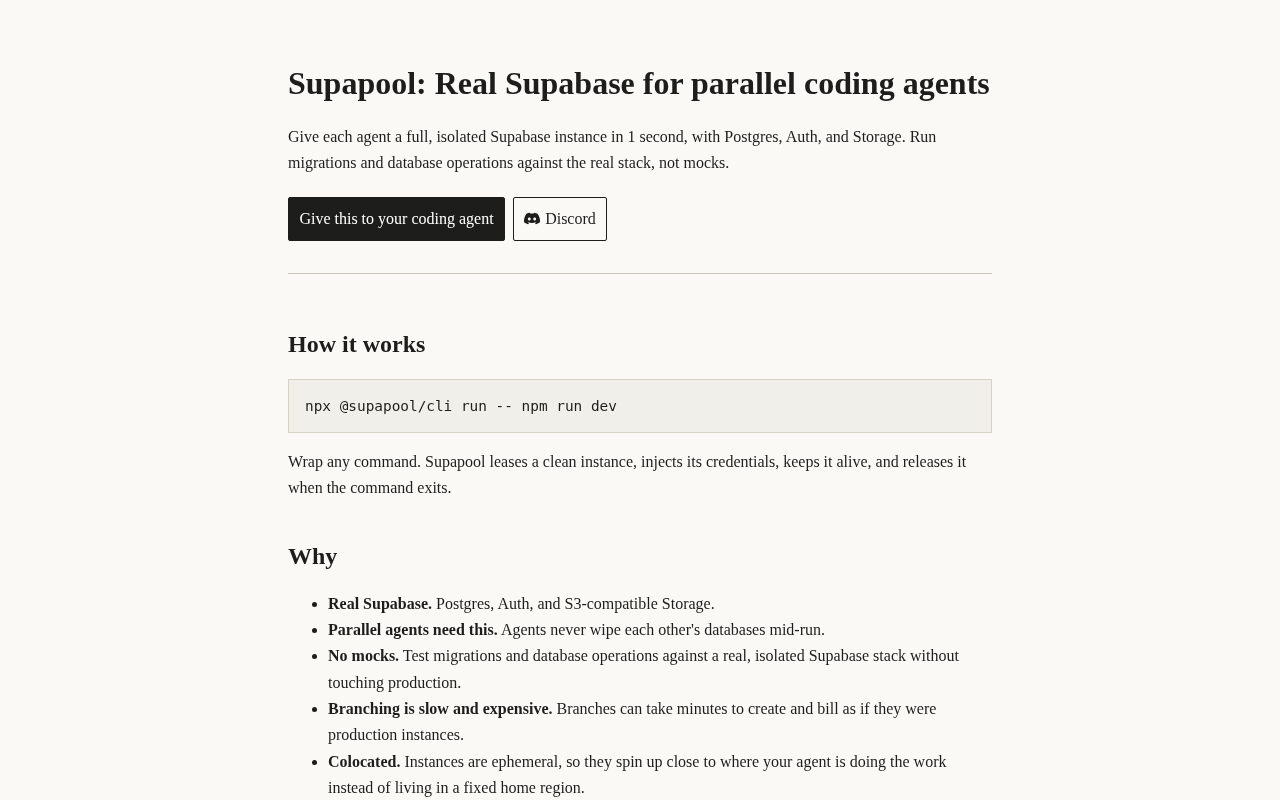
Supapool: Creating Isolated Databases for AI Coding Agents in 400 Milliseconds
Supapool uses pool prewarming to create isolated Supabase database instances in 400ms for AI coding agents like Claude, Cursor, and Devin, solving the database isolation challenge.
Read more →

·2 min
Supapool: Creating Isolated Databases for AI Coding Assistants in 400 Milliseconds
Supapool uses pool prewarming to create isolated Supabase database instances in 400ms for AI coding assistants like Claude, Cursor, and Devin—a prime example of AI-native infrastructure.
Read more →

·3 min
Mistral Deepens Partnership with Microsoft: How Sovereign AI Is Landing in the European Enterprise Market
Mistral expands its strategic partnership with Microsoft, delivering controllable frontier AI to Europe's regulated industries through open-weight models and Azure Local deployment.
Read more →

·3 min
Mistral and Microsoft Deepen Partnership: How Sovereign AI Is Landing in the European Enterprise Market
Mistral and Microsoft expand their strategic partnership, delivering controllable frontier AI to Europe's regulated industries through open-weight models and Azure local deployment.
Read more →

·3 min
Jina v3 Matryoshka Embeddings in Practice: Cut Vector Storage Costs by 75%
Use Jina v3 Matryoshka embeddings to truncate 1024-dim vectors to 256-dim, cutting Pinecone storage costs by 75% while maintaining retrieval quality with task-specific LoRA adapters and circuit breakers.
Read more →

·3 min
Building a Streaming LLM Backend in Go: Deep Dive into the SDK and React Frontend Library
Deep dive into an open-source Go SDK for building streaming LLM backends, covering streaming responses, tool-calling architecture, and companion React library for end-to-end integration.
Read more →

·2 min
Moving State Out of Framework Memory: A Multi-Agent Architecture Refactoring Guide
Exploring how 70% of multi-agent memory is consumed by non-reasoning state, and a refactoring approach using email threads to replace framework memory for better token efficiency, auditability, and resilience.
Read more →