#weight initialization
144 related articles

·3 min
Double Descent Explained: Why Massively Overparameterized Models Don't Overfit
A deep dive into the Double Descent phenomenon in machine learning, explaining why overparameterized models defy the classic bias-variance tradeoff to achieve stronger generalization.
Read more →

·3 min
The ML Paper Reproducibility Crisis: 60% of Code Contains Fatal Bugs — Should Top Conferences Mandate Code Submission?
A top conference reviewer reveals: only 1 of 12 ML papers provided complete reproducible code, and 60% of submitted code contained fatal bugs. Should conferences mandate code submission?
Read more →

·3 min
The Third Exit Code for Training Linters: Inconclusive ≠ Failure
trainproof is an ML training linter using three exit codes (pass/fail/inconclusive) to eliminate the CI blind spot where skipped checks silently appear as passes.
Read more →

·2 min
MicroCodex: A C++ Programming Agent Under 1MB — A Fresh Take on Minimalist AI Tools
MicroCodex re-implements OpenAI's Codex programming agent in C++ with a binary under 1MB. This article analyzes its engineering design, minimalist philosophy, and use cases in CI/CD and embedded systems.
Read more →

·3 min
Reproducing Medical AI Papers: Where Does That 0.78 F1 Score Come From?
A researcher attempts to reproduce MedViT and LungMaxViT on ChestX-ray14, achieving only 0.30-0.35 F1 vs. the reported 0.78. Analysis of data splits, evaluation protocols, and hidden details.
Read more →

·2 min
TabPFN: A Transformer Model for Tabular Classification That Predicts in One Second Without Training
Deep dive into TabPFN's core principles and use cases. Built on Transformer architecture and in-context learning, TabPFN classifies small tabular data in one second without hyperparameter tuning, matching XGBoost accuracy.
Read more →

·2 min
Efficient Few-Shot Learning: Insights from Achieving 100% Accuracy with Just 16 Samples
Exploring the deep significance behind achieving 100% accuracy with just 16 samples, analyzing the critical role of data efficiency and stability in continuous learning systems.
Read more →

·4 min
SELENE Open-Source Project: An Interactive Notebook Library for Systematically Learning AI and Machine Learning from Scratch
SELENE is an open-source AI learning resource built on Jupyter Notebooks, systematically covering ML, deep learning, Transformers, and LLMs with interactive code and math derivations for beginners.
Read more →

·2 min
Cartha: An AI Agent Operations Control Plane Solving Observability and Cost Control Challenges
Cartha is a managed control plane for AI Agents offering full-chain tracing, hard budgets, scoped memory isolation, and tool allow-lists to solve observability, cost overrun, and permission management challenges in production.
Read more →

·3 min
Six Months and 124 Iterations: Conquering Reactive Play in Breakout with PPO
An RL enthusiast spent 6 months and 124 iterations to achieve reactive play in Atari Breakout using PPO. A deep dive into PPO tuning challenges and real-world RL engineering.
Read more →

·3 min
Famegrid Auto Color: A ComfyUI Node for Automatic Color Correction to Fix LoRA Color Cast Issues
Famegrid Auto Color is an open-source ComfyUI node that automatically corrects LoRA color casts through per-image adaptive analysis, with skin-hue protection, batch processing, and Float32 precision.
Read more →

·3 min
Reproducing GPT-2: How a Hidden Bug Affected Weight Training
An in-depth analysis of a hidden bug discovered while reproducing GPT-2 from scratch, revealing how implementation errors silently degrade weight quality and sharing practical debugging methodologies.
Read more →
·2 min
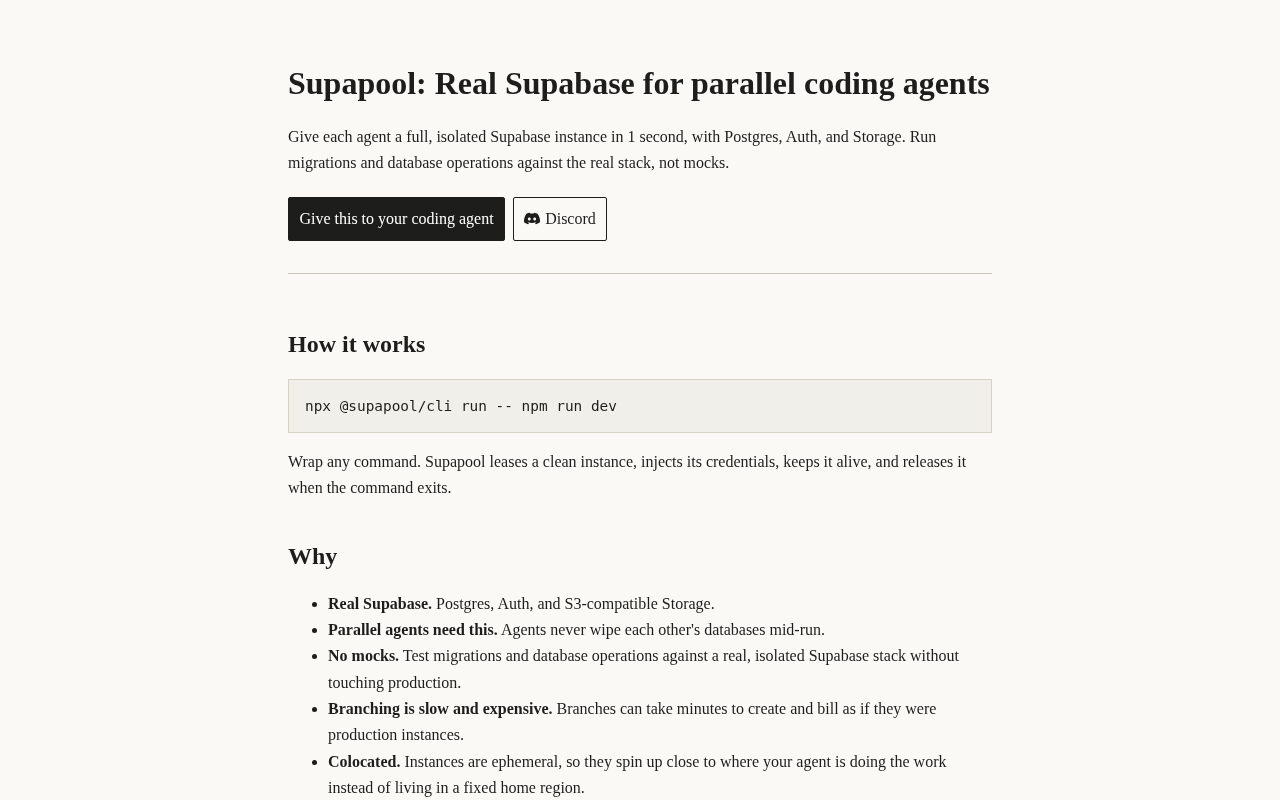
Supapool: Creating Isolated Databases for AI Coding Agents in 400 Milliseconds
Supapool uses pool prewarming to create isolated Supabase database instances in 400ms for AI coding agents like Claude, Cursor, and Devin, solving the database isolation challenge.
Read more →

·2 min
Supapool: Creating Isolated Databases for AI Coding Assistants in 400 Milliseconds
Supapool uses pool prewarming to create isolated Supabase database instances in 400ms for AI coding assistants like Claude, Cursor, and Devin—a prime example of AI-native infrastructure.
Read more →

·2 min
SDL_GPU: Deep Dive into a Single-Header High-Performance 2D Graphics Library
Deep analysis of the SDL_GPU single-header 2D graphics library covering its design philosophy, GPU acceleration principles, use cases, and technical trade-offs.
Read more →

·4 min
How Much Math Do You Need for Machine Learning? Finding the Balance Between Preparation and Practice
How much math do you really need before starting ML projects? This article analyzes the 'bottomless pit' trap, proposes a minimum viable math framework, and offers project-driven learning strategies.
Read more →

·4 min
Transitioning from DevOps to MLOps: A Complete Learning Roadmap
How can DevOps engineers efficiently transition to MLOps? This guide covers MLOps core concepts, standard workflows, essential tools, and Azure practices with a progressive learning roadmap.
Read more →

·2 min
Tutorial: Installing Tailscale on a Jailbroken Kindle to Create a Private Network Node
Learn how to deploy Tailscale on a jailbroken Kindle, turning an idle e-reader into a private network node. Covers cross-compilation, power optimization, and risk considerations.
Read more →
·2 min
Tutorial: Installing Tailscale on a Jailbroken Kindle to Create a Private Network Node
Learn how to deploy Tailscale on a jailbroken Kindle to turn an idle e-reader into a private network node. Covers cross-compilation, power optimization, and risk considerations.
Read more →

·2 min
Running Manim in the Browser: Rebuilding 3Blue1Brown's Animation Engine with WebGPU
Explore how WebGPU brings 3Blue1Brown's Manim math animation engine to the browser, enabling zero-install, real-time mathematical visualization with interactive education potential.
Read more →