AI Agent Beginner's Guide: How Agents Work, What They're Made Of, and Where They're Used

A clear breakdown of what AI agents are, how they work, and the three types you'll encounter.
This guide explains AI agents from the ground up — starting with how they differ from chatbots, defining them as 'AI employees' that can think, use tools, and complete complex tasks independently. It breaks down the three core components (LLM brain, memory, tools), explains how agents fix the key limitations of raw LLMs, and categorizes agents into general-purpose, specialized, and workflow-based types, with an overview of the broader tech stack including RAG, MCP, LangChain, and LangGraph.
What Is an AI Agent? Starting with Chatbots
Many people struggle to tell the difference between a chatbot and an AI agent. Tools like Doubao or DeepSeekAd are essentially "AI advisors" — you ask, they answer. An agent, on the other hand, is more like an "AI employee" that actually gets things done for you.
Here's a concrete example: say you want to create a PowerPoint presentation from some materials you have on hand. With a tool like Doubao, you'd need to upload files one by one, wait for the output to be generated on the server, then manually download the result — a cumbersome process. An agent works differently. It can read files directly from your local machine, identify file types, create the PPT, save it locally, notify you when it's done, and even run a self-check.
The word "agent" literally means "an individual with intelligence and the ability to act." An agent is an application that can proactively reason, invoke tools on your computer, and independently complete complex tasks. This leap from "knowing how to talk" to "knowing how to act" is the fundamental difference between an agent and a conventional LLM chat tool.

The Three Core Components of an Agent: Brain, Memory, and Tools
A complete agent is built from three conceptual components — remove any one of them and the system breaks down.
The brain is the large language model itself. Models like Doubao or DeepSeek serve as the agent's brain, responsible for understanding requirements, breaking tasks into steps, and deciding what to do next. It's the decision-making hub of the entire system.
Memory allows the agent to remember what you said earlier and track how far along a task has progressed. Without memory, the model starts fresh with every conversation and can't handle coherent multi-turn tasks. With memory, an agent can see a job all the way through to completion.
Tools are the most critical piece. An agent can invoke all kinds of tools on your computer — just like a person would — including controlling browsers, managing folders, editing Excel files and PowerPoints, and even writing code. Tools are what allow an agent to actually get work done, rather than staying stuck at the conversation layer.
Understanding how these three components work together is the first step to mastering agent technology. The brain thinks, memory records, and tools execute — each one depends on the others.
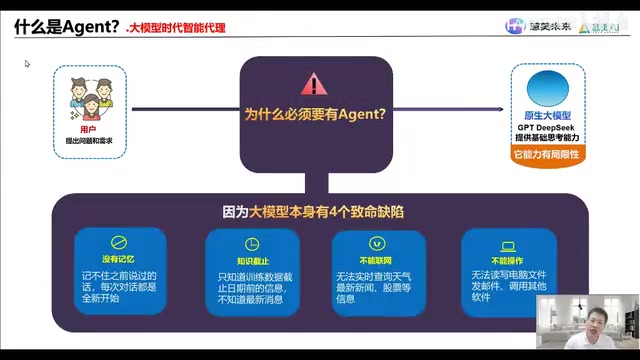
What Critical Shortcomings of LLMs Do Agents Address?
Out-of-the-box large language models (such as GPT or DeepSeek), despite costing large companies tens of millions to develop, have some obvious limitations.
No persistent memory: Native models treat each conversation as independent. By the tenth or fifteenth turn of a conversation, the model may have already "forgotten" what was said earlier.
Knowledge cutoff: Models only learned from data up to a certain point in time. Ask about anything after that date and the model may confidently make things up — and it can't browse the web to fetch real-time data like weather or stock prices.
No tool access: Native models can't directly interact with files or applications on your computer.
Agents exist specifically to address these shortcomings. Within the broader LLM ecosystem, an agent plays four distinct roles:
- Translator: Converts user requests into instructions the LLM can understand, and transforms the model's output into results the user can act on.
- Tool expert: Helps the LLM call external tools and APIs, enabling web access and data queries — turning a model that "knows how to talk" into one that "knows how to act."
- Memory manager: Keeps track of context and user preferences so that multi-turn conversations remain coherent.
- Task manager: Breaks a complex problem down into smaller steps, plans the execution flow, and proactively seeks solutions when things go wrong — much like a real person would.
In essence, an agent is a "proxy for the LLM era" — a bridge between the user and the underlying model.
The Three Categories of Agents on the Market
Agents available today can be roughly grouped into three categories, each with a different positioning and set of use cases.
General-purpose agents are typically products from large companies — such as Claude Code, Codex, and other local desktop agents. Once configured with the right capabilities, these agents can handle almost anything, making them a good fit for everyday users who want to use AI to boost their productivity right away.
Specialized agents focus on doing one thing well — video editing, image processing, e-commerce operations, and so on. Their strength lies in their focus on a single high-frequency use case, with a streamlined interface that anyone can pick up quickly. Today, anyone can build their own specialized agent.
Agent-building platforms produce agents assembled through visual workflow editors. These agents follow a fixed set of steps and nodes, with AI participating in decisions at specific points along the way. They're well-suited for enterprise scenarios that require standardized, repeatable processes.
For individuals looking to quickly boost their productivity with AI, jumping straight into a general-purpose agent is the recommended path — low barrier to entry, fast results.
The concept of "visual workflows" in agent-building platforms deserves a closer look. Platforms like Coze, Dify, and n8n let users chain together LLM calls, database queries, API requests, and conditional logic by dragging and dropping nodes — no code required. Compared to general-purpose agents, workflow-based agents are more predictable and easier to audit. Enterprises can precisely control where AI gets involved and to what degree, which is especially important in compliance-heavy industries like finance and healthcare. The trade-off is flexibility: when something falls outside the designed workflow, the system often can't adapt on its own and requires manual intervention or a redesign of the nodes.
Where Agent Technology Is Heading
Looking at the technical trajectory, agents are undergoing several key transitions: from basic tool calling, to workflow orchestration, to increasingly sophisticated engineering at production scale.
Around agents, a broader technology stack has emerged — including RAG (Retrieval-Augmented Generation), MCP, LangChain, LangGraph, multimodal processing, model fine-tuning, and prompt engineering with system prompts. Together, these technologies power everything from simple demos to enterprise-grade applications.
In real-world enterprise deployments, agent technology has already made its way into a range of practical scenarios — intelligent customer service systems, multi-agent collaboration platforms for e-commerce, and more. These projects typically involve advanced techniques like multimodal RAG retrieval, high-concurrency optimization, and model fine-tuning, representing the full scope of what agents can do.
For anyone studying the AI/LLM space, the goal isn't to memorize specific steps — it's to internalize the underlying logic and principles. Get a solid grasp of the overall architecture and technical concepts, then apply them to real business scenarios. That's how you stay relevant in a field that's evolving this fast.
RAG (Retrieval-Augmented Generation) is one of the most frequently discussed components in the agent technology stack and deserves its own explanation. The core idea: before generating an answer, the system first retrieves relevant document snippets from an external knowledge base, then feeds those snippets as context to the model — allowing it to "borrow from external memory" and produce more accurate, up-to-date responses. This directly addresses the LLM problems of knowledge cutoffs and hallucinations.
MCP (Model Context Protocol) is an open protocol proposed by Anthropic to standardize how models connect to external tools and data sources. Think of it as a "USB port" for AI — once there's a unified standard, any tool can plug into an agent without custom integration work.
LangChain and LangGraph are currently the most widely used agent development frameworks. LangChain provides foundational modules for tool calling and memory management; LangGraph builds on top of that to support directed-graph-style multi-step workflow orchestration, making it well-suited for complex agents that need conditional branching and iterative decision-making.
Closing Thoughts
AI agents represent a pivotal shift in how LLMs are applied — moving from "conversation" to "action." Understanding the three core components (brain, memory, tools) and the four roles agents play (translator, tool expert, memory manager, task manager) is the essential foundation for anyone entering this space.
Whether your goal is to boost personal productivity with a general-purpose agent or to go deep on enterprise-level technical implementation, building a clear conceptual framework first is critical. Technology moves fast, but the underlying logic stays relatively stable — nail the principles, and you'll be equipped to adapt to whatever comes next.
Related articles

WorkBuddy Beginner's Guide: How This Chinese AI Agent Works For You
WorkBuddy is a Chinese AI Agent often called the domestic alternative to Codex. Learn how it moves beyond Q&A to directly operate your computer, with connectors, Skills, and expert agents.

MiniMax Code Open-Sources to Rival ZCode; Claude Code Gains AGENTS.md Compatibility
MiniMax Code open-sources to rival ZCode; Claude Code 2.1.277 adds AGENTS.md compatibility. Daily roundup covering AI coding tools, Ascend chip roadmap, and Rust supply chain security.
The Elias Thorne Phenomenon: Why AI Chatbots Keep Fabricating the Same Fictional Person
Why do AI chatbots keep inventing a fictional person named Elias Thorne? This article unpacks LLM hallucination mechanics, training data bias, and model collapse risks.