AI Agent Beginner's Guide: LLMs vs. Agents, and a Full Breakdown of Development Tools

A beginner's guide to AI Agents: how they differ from LLMs and which tools to use for building them.
AI Agents go beyond large language models by combining an LLM with workflows and a knowledge base to enable real-world action — not just conversation. This guide explains the core differences, breaks down the Agent architecture formula, and compares popular development tools including Dify, Coze, LangChain, and LlamaIndex to help you get started.
What Is an AI Agent?
In recent years, "AI" has become a ubiquitous term — yet most people still have a vague understanding of what an "AI Agent" actually is. The most intuitive way to grasp the concept is to start with ourselves.
AI Agents are not a concept that suddenly emerged in recent years. Their intellectual roots trace back to "Software Agent" research in the 1990s. Early academic definitions described an Agent as "a system that can perceive its environment and take actions to achieve goals" — a definition heavily influenced by cybernetics and behavioral psychology. Research at the time explored multiple approaches including Reactive Agents, Deliberative Agents, and hybrid architectures, yielding rich academic results in robotics and Multi-Agent Systems (MAS). However, constrained by the computing power and algorithms of the era, early Agents consistently fell short in decision quality for open-ended natural language tasks. The turning point that brought Agents from academic concept to real-world engineering was the explosive rise of Large Language Models (LLMs) in late 2022. Their powerful natural language understanding and reasoning capabilities filled the critical gap in "decision quality" that had long plagued Agent systems, making the complete loop of perception, reasoning, and action genuinely viable for the first time.
Artificial intelligence is fundamentally a "bionic" technology — one that mimics us, biological beings. Imagine a complete human: we interact with the world through hearing and vision (speech, images), we use our brains to think, learn, and make decisions, and we act through speaking and writing. In other words, a person simultaneously possesses perceptual ability, decision-making ability, action ability, and memory.
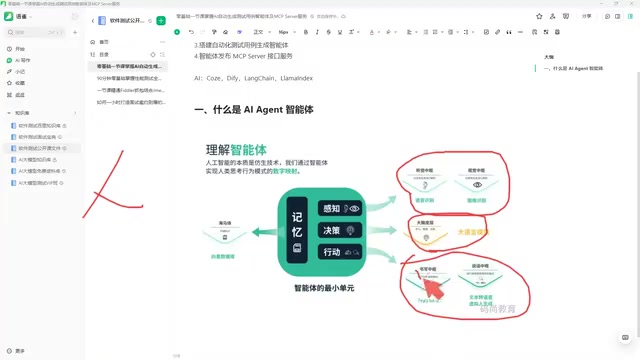
An AI Agent is a digital mapping of this entire human behavioral pattern. It can interact through natural language and possesses a complete loop of perception, decision-making, and action. Simply put, an Agent is the technological recreation of "how humans perceive and act upon the world."
What's the Difference Between an AI Agent and an LLM?
Many people conflate AI large language models (like DeepSeek) with Agents, but the two are fundamentally different.
Today's mainstream LLMs (such as GPT-4, DeepSeek, Claude, etc.) are essentially large-scale language models built on the Transformer architecture. The Transformer was introduced by Google in 2017 in the paper Attention Is All You Need, with its core innovation being the "Self-Attention" mechanism — which dynamically weighs the relationships between every word when processing long text, dramatically improving language understanding and generation quality. Through pre-training on massive text datasets, these models acquire the ability to understand language, reason logically, and generate content. However, they come with several inherent limitations: first, they are "stateless" — they retain no memory after a conversation ends; second, their training data has a cutoff date, so they cannot access real-time information; third, they can only produce text output and cannot actively call external systems or trigger real-world actions. These three limitations are precisely why the Agent architecture exists.
The core of an LLM is interaction. Based on natural language and prompts, it can answer questions, analyze content, and generate text. But its capabilities stop there — it can only "say" things, not "do" them.
Here's a concrete example: if you ask an LLM to order takeout for you, it can tell you how to do it and recommend restaurants — but it can't actually open an app, search for items, and complete a payment.
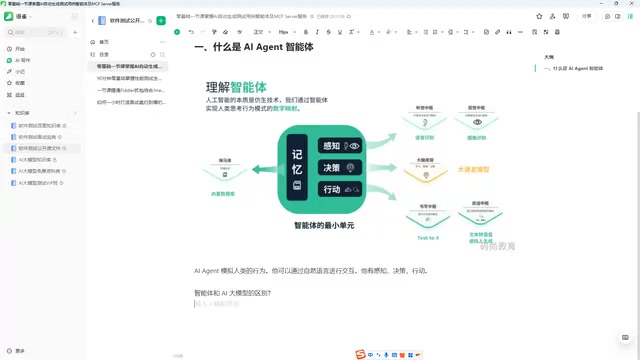
An AI Agent is entirely different. When you give it the instruction "order me some takeout," the Agent can:
- Perceive your request and understand what you've said;
- Decide on the path to complete the task;
- Act — open the app, search for items, place the order, make the payment.
It can carry out an entire sequence of steps from understanding to execution. This is the purpose of the Agent architecture: through Tool Use and workflow orchestration, it transforms an LLM's "language ability" into "action ability." An LLM, therefore, is just one component of an Agent — not the whole thing.
The Formula for an AI Agent
To better understand what an Agent is made of, here's a simple formula:
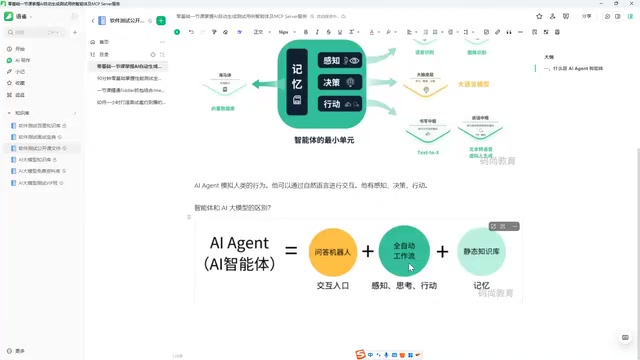
AI Agent = LLM + Workflow + Knowledge Base
LLM: The Brain for Understanding and Communication
The large model (e.g., DeepSeek) plays the role of the "brain" — responsible for understanding and generating natural language, forming the foundation for the Agent to communicate with humans. But as mentioned, a brain alone isn't enough to complete a task.
Workflow: The Execution Path for Perception, Thinking, and Action
The Workflow serves as the "nervous system" of the Agent architecture, responsible for connecting the LLM's reasoning capabilities with external tools, APIs, databases, and other resources. In practice, workflows are typically organized as DAGs (Directed Acyclic Graphs) — meaning task steps have a clear sequential dependency and no circular deadlocks. Each node represents an atomic operation (such as calling a search engine, executing code, or writing to a database), and edges represent the flow of data. This structure ensures deterministic execution and makes it easy to debug and swap out individual nodes independently.
At its core, a workflow is the perception → thinking → action execution chain — it defines "what the Agent does first, and what it does next."
Taking the takeout example, a workflow might look like this:
- Step 1: Open the delivery app
- Step 2: Search for items
- Step 3: Place the order
- Step 4: Complete payment
This ordered sequence of steps is precisely what enables an Agent to truly "get things done." As task complexity grows, a single Agent often can't handle everything on its own — which is where Multi-Agent architectures come in. Multiple specialized Agents collaborate: a planning Agent handles task decomposition, an execution Agent handles specific operations, and a review Agent handles quality verification. This architecture draws inspiration from the "Microservices" design philosophy in software engineering: each Agent focuses on its own responsibilities and communicates through standardized interfaces, significantly improving both efficiency and robustness. Even if one sub-Agent encounters an error, the others can continue running or trigger a retry mechanism.
Knowledge Base: Filling the LLM's Blind Spots
LLMs are trained on historical data, which means their knowledge has a cutoff date and domain limitations — they can't perceive the latest industry developments or access specialized data accumulated by a particular organization.
This is where a Knowledge Base comes in. The core technology behind it is RAG (Retrieval-Augmented Generation): when a user asks a question, the system first retrieves the most relevant text fragments from an external knowledge base, then sends those fragments along with the original question to the LLM, guiding it to generate answers based on real source material. The RAG pipeline typically consists of two phases: offline indexing (chunking documents, vectorizing them, and storing them in a database) and online retrieval (vectorizing the user query, running a similarity search, and returning the Top-K relevant chunks). Compared to direct fine-tuning, RAG's key advantages are: the knowledge base can be updated at any time without retraining the model (at very low cost); it also preserves the original document sources so answers are traceable and auditable — especially valuable in compliance-heavy domains like healthcare, law, and finance. The critical infrastructure behind RAG is the Vector Database (e.g., Milvus, Pinecone, Weaviate), which converts text into high-dimensional vectors and enables fast semantic retrieval. Unlike traditional keyword matching, vector search can identify semantically similar content even when the wording differs, significantly improving recall quality.
Take a medical Agent as an example: by importing years of clinical cases and diagnostic outcomes from a hospital into the model, you can give it specialized capabilities in that specific domain. This approach of enhancing a model with external knowledge is the core strategy behind today's enterprise AI applications.
Which Agent Development Tool Should You Use? A Comparison of Popular Options
Now that you understand how Agents work, the next question is: how do you actually build one? There are two main categories of approaches.
Low-Code / No-Code Tools: Best for Fast Deployment
For most businesses and beginners, tool-based platforms are the most accessible starting point:
- Coze: An Agent development platform built in-house by ByteDance, currently free and easy to get started with. However, since it uses an online-hosted model, it has limited suitability for enterprises with data privacy requirements.
- Dify: The mainstream choice for enterprise-grade Agent development — roughly 80% of companies observed are using Dify to build their Agents. Dify uses an open-source architecture (Apache 2.0 license) and supports private deployment. Its key strengths include integrating prompt orchestration, RAG pipelines, tool invocation, and workflow orchestration into a unified visual interface, along with built-in model switching and A/B testing mechanisms. It's feature-complete, and if you can only choose one tool, Dify is almost always the answer.
Code Development Frameworks: For Flexible, Custom Builds
For scenarios requiring deep customization, code frameworks are the way to go:
- LangChain: Open-sourced in October 2022, LangChain quickly became the most influential framework in Agent development thanks to its comprehensive abstractions for LLM calls, tool integrations, and memory management — amassing over 90,000 GitHub stars at its peak. LangChain's core abstraction is the "Chain" — linking prompt templates, model calls, and output parsing into reusable processing pipelines. The later addition of the LangGraph module introduced a graph-based state machine mechanism, making it more intuitive to orchestrate complex multi-step Agent behaviors and conditional branching. With a mature ecosystem and rich documentation, it remains one of the most widely used Agent frameworks today.
- LlamaIndex: Focused deeply on the data layer, LlamaIndex specializes in efficiently connecting diverse unstructured data sources (PDFs, databases, API responses, etc.) to LLMs. Its core design philosophy is the "Data Framework" — providing a complete toolchain from data ingestion, chunking, and vectorization to index construction, along with multiple advanced retrieval strategies for complex RAG scenarios (such as hybrid search, re-ranking, and query routing). It leads the industry in RAG pipeline engineering. Its update frequency and feature depth have noticeably increased in recent releases, making it particularly strong in knowledge retrieval and RAG use cases. LangChain and LlamaIndex are complementary rather than competing — they're often used together in real projects and are both worth your attention.
In short: use Dify for tools, use LangChain or LlamaIndex for code. The former is ideal for rapid deployment; the latter for flexible extensibility.
Conclusion
From concept to implementation, the logic behind AI Agents isn't complicated: use an LLM as the brain, connect perception, thinking, and action into a complete loop via workflows, and supplement domain expertise through a knowledge base (powered by RAG technology).
Understanding the core distinction — "LLM = communication" vs. "AI Agent = communication + execution" — is the first step to getting started with Agent development. Whether you choose a low-code platform like Dify or a code framework like LangChain or LlamaIndex, there's a clear path for developers with different needs. As these tools continue to evolve and Multi-Agent architectures mature, building an Agent that can genuinely "get things done" is becoming more accessible than ever.
Related articles
Claude Code v2.1.271 Update Deep Dive: Fast Mode, Sandbox Security, and Enterprise Improvements
Claude Code v2.1.271 adds fast mode for remote sessions, per-command sandbox network controls, enterprise policy fixes, MCP protocol improvements, and terminal/IDE enhancements.
AI Giants Collectively Hit the Brakes: Safety Protocol or Industry Cartel?
OpenAI, Anthropic, Google DeepMind, and SpaceX leaders agree to slow AI development. Is this a responsible safety pact — or an oligopolistic cartel in disguise?

Apple Home Gets AI Camera Features with iOS 27: Up to $60/Month
iOS 27 and tvOS 27 bring Apple Intelligence to Apple Home with AI video summaries for HomeKit Secure Video — but unlocking them costs up to $60/month via subscription.