AI Agent Development 101: The Four-Stage Evolution from Raw LLMs to Intelligent Agents

How AI evolved from raw LLMs to Agents — and why Agent is now essential for enterprise AI.
This article traces the four-stage evolution of LLM deployment: raw models generate knowledge but hallucinate and lack memory; prompt engineering improves output but can't access private data; RAG adds knowledge retrieval but only supports passive Q&A; and Agent finally enables autonomous planning, tool calling, and end-to-end task execution — transforming LLMs from Q&A tools into true digital employees capable of handling complex enterprise workflows.
AI Agent Development 101: The Four-Stage Evolution from Raw LLMs to Intelligent Agents
A lot of people who study large language models stop at writing good prompts and building a local knowledge base. Then in an interview, when they're asked "Can you build an automated system for processing orders and following up with customers?" — they freeze. This reveals a common misconception: prompt engineering and RAG solve the problem of getting the model to answer questions well, while Agent solves the problem of getting the model to think proactively and solve problems on its own. This article is based on a beginner-friendly AI/LLM course on Bilibili. It traces the technical evolution from raw large models to Agents, helping you understand why Agent has become the go-to direction for enterprise AI deployment.
The Four Stages of LLM Deployment
To understand the value of Agent, you first need to see how large models have evolved step by step. The whole journey can be broken down into four stages, each adding a new layer of complexity.
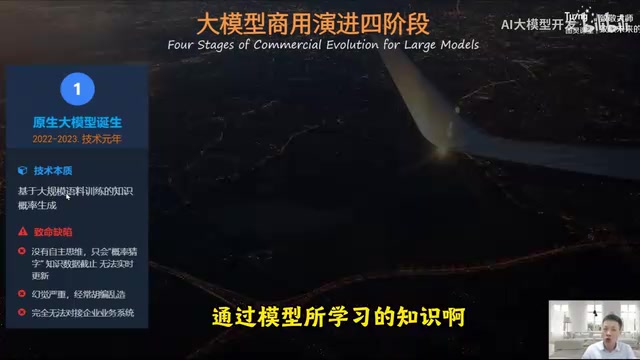
Stage 1: The Birth of Raw Large Models. This is where it all began. The technical principle is actually quite simple — train on massive amounts of publicly available internet data, and generate answers probabilistically based on learned knowledge. When ChatGPT exploded onto the scene, people discovered it could write copy, write code, and seemed to know everything under the sun. But its limitations surfaced quickly: no ability to reason autonomously, only probabilistic generation; knowledge has a cutoff date, so asking about anything after training triggers severe hallucinations; and critically, it couldn't integrate with traditional enterprise business workflows — still a long way from real commercial deployment.
Stage 2: Prompt Engineering. To improve output quality, the industry went all-in on structured instructions, chain-of-thought techniques, and other tricks. There was even a popular saying at the time — "nail the prompt and you can commercialize it." But prompt engineering has three core flaws: it can't access a company's private internal data, it can't handle enterprise business processes, and output quality is heavily dependent on how well a human crafts the prompt. Looking back today, prompt engineering has been downgraded from a "core technology" to a baseline skill for LLM application engineers. Knowing how to type doesn't make you an IT engineer — and knowing how to write prompts doesn't mean you can deploy production-ready AI.
The Value and Inherent Limits of RAG
Stage 3: RAG (Retrieval-Augmented Generation). This is the go-to solution for many traditional enterprises exploring LLM deployment today. The logic isn't complicated: store the company's repetitive domain data — financial, legal, manufacturing, including tables and images — in a knowledge base; before answering, the LLM first retrieves relevant content from the knowledge base, then returns the result to the user. Most of the content distribution systems and Q&A systems you see in enterprises today are built on RAG.

But RAG's inherent limitations are just as apparent. It can only do passive retrieval — look things up when asked, never proactively think. It also can't handle task decomposition for complex business problems, and only supports a simple one-question-one-answer delivery model. Consider an e-commerce company's end-to-end workflow: from customer inquiry, to placing an order, to checking inventory, to changing a shipping address. RAG simply can't handle that. This explains why many traditional enterprises spend significant resources building a Q&A system that answers some questions, but contributes little to the overall business.
It's worth unpacking the technical mechanics of RAG (Retrieval-Augmented Generation) a bit more. The core process has two steps: first, vector storage — enterprise documents are split into text chunks, converted into high-dimensional vectors by an embedding model, and stored in a vector database; second, retrieval augmentation — when a user asks a question, the system converts it into a vector as well, computes cosine similarity against the database, retrieves the most relevant text chunks, and appends them to the prompt before sending everything to the LLM to generate an answer. The advantage of this design is that the LLM can "cite" external knowledge rather than relying purely on training memory, effectively reducing hallucination rates. But the fundamental limitation is this: the retrieval process is entirely passive and linear. It cannot dynamically decide whether to retrieve again based on answer quality, nor can it coordinate across multiple systems to complete a task — and that is exactly what Agent is designed to solve.
Agent: From Q&A Tool to Digital Employee
Stage 4: The Agent Capability Explosion. At this stage, large models gain the ability to plan autonomously and execute deliberate reasoning — upgrading from a Q&A tool to a "digital employee" that can call various tools to complete complex tasks and support multi-agent collaboration across an entire enterprise workflow.
So what exactly is an Agent? Think of it as a "proxy" or intermediary for the large model — a communication bridge. It's like having a translator between a Chinese speaker and an English speaker. The user poses a question, the Agent understands the requirement, calls the right tools, completes complex tasks, and returns the result to the user.
Why is Agent necessary? Because raw large models have several critical shortcomings: no memory — after multiple turns of conversation, they forget what was said earlier; knowledge cutoff — ask them about anything after their training date and they'll confidently make things up; no internet access — they can't look up real-time data; no ability to read local files or call external tools. Real enterprise scenarios, however, demand multi-turn dialogue, multi-step operations, and real-time data — far beyond what a raw large model can handle.

The Four Core Problems Agent Solves
From an industry perspective, Agent primarily addresses four categories of problems:
- Translator: Converts natural language requests into instructions the LLM can understand, then transforms model output into results users can directly act on.
- Tool Expert: Helps the LLM call APIs and other tools, enabling it to browse the web, manipulate files, and integrate with enterprise systems — going from "can only talk" to "can actually do things."
- Memory Manager: Helps the LLM remember context, user preferences, and conversation history, enabling coherent multi-turn dialogue without amnesia.
- Task Planner: Breaks complex problems into multiple smaller steps, plans and executes them; when issues arise, it can try alternative approaches — solving problems proactively, just like a human.
We use Agents every day without realizing it. When you send a message to an AI assistant like Doubao (豆包), your question doesn't go directly to a raw large model — it's first processed by Doubao's Agent layer. The same goes for programming assistants that developers use regularly: they can remember the entire project structure and call a compiler to catch errors in code. That's the Agent's tool-calling and memory management capabilities at work.
On the technical implementation side, the mainstream Agent architecture today is typically based on the ReAct framework (Reasoning + Acting) or a similar "think-act" loop. At each step, the LLM first reasons (Thought), decides which tool to call and with what parameters (Action), receives the tool's return value (Observation), and then continues reasoning — repeating until the task is complete. Tools (Tools) can be search engine APIs, database query interfaces, code executors, email-sending functions, or any other external capability. In multi-agent scenarios, there's also a division of labor between an Orchestrator and Sub-agents: the orchestrator breaks down the task and delegates to specialized sub-agents, then aggregates the results. Open-source frameworks like LangChain, LlamaIndex, and AutoGen — as well as Agent platforms from major cloud providers — are fundamentally all packaging this same core skeleton of "reasoning – tool calling – memory management."
Why You Should Learn Agent Development Now
The course author emphasizes that when traditional enterprises pursue digital transformation, their actual demand is to "cut costs, boost efficiency, replace repetitive labor, and automate entire business workflows" — not just build a simple Q&A chatbot. That's precisely where Agent shines.

From a policy perspective, the author references China's national "AI+" action plan deployments from 2025, covering six major areas including scientific research, industrial development, consumption, and public services. The author draws an analogy: the people who seized the "Internet+" opportunity a decade ago now hold leading positions at major tech companies — and intelligent agents are at a similar inflection point, on the eve of an explosion. According to the cited plan, China's target is to achieve a high level of Agent adoption by 2027 and comprehensive development by 2035. (Note: Policy data is cited from the video; please refer to official sources for accuracy.)
A word of caution: this course has an obvious student recruitment and lead-generation angle, with heavy use of verbal marketing scripts and calls to action like "like and subscribe" or "get resources in the comments." Some policy figures cited may also contain misspoken dates. As a learner, the key takeaway is the technical storyline of the "four-stage evolution" — treat specific promotional figures with appropriate skepticism.
Conclusion
From raw large models to prompt engineering, then RAG, and finally Agent — this evolution clearly answers one fundamental question: why has Agent become the mainstream approach to enterprise AI deployment? Raw large models solved generation. Prompt engineering solved expression. RAG solved knowledge. Agent solves action — giving models the ability to plan autonomously, call tools, and complete complex end-to-end business tasks. For developers looking to enter the AI/LLM space, understanding and mastering Agent development is shifting from a "nice-to-have" to an essential skill.
Related articles

Apple HomeView Hands-On Review: Is the $300 Smart Home Hub Worth It?
Apple HomeView hands-on: a $300 smart home hub with facial recognition for quick account switching, but no App Store or voice recognition. Is the wall-mounted version worth it? Should you buy the first generation?

Meta Muse Wonder Launch: What It Means for Meta's Return to the Frontier AI Race
Meta releases Muse Wonder and WonderFull, benchmarks reach the frontier, community feedback is polarized. An in-depth look at Meta's return to the frontier AI race, its personal agent strategy, and Zuckerberg's different path.

Apple Home Smart Home Lineup Leaked: LG and Schneider Team Up, UWB Door Lock on Board
Apple Home ecosystem gains new LG and Schneider devices: UWB smart lock with proximity unlock, 2.5K dual-camera doorbell, privacy indoor camera, and AirPods-like seamless pairing.