AI Agent in Enterprise: A Deep Dive into the Low-Code + Code Framework Dual-Track Approach
A dual-track AI Agent course turning LLMs into deployable enterprise "digital employees" via low-code and code frameworks.
This article breaks down a widely-shared Bilibili course on enterprise AI Agent development. Its central argument: LLMs alone are brains without limbs — real productivity comes from AI Agents that can call tools and close business loops. The course runs a dual-track approach using low-code platforms (Coze, Dify, n8n) for rapid validation and code frameworks (LangChain, LangGraph) for deep customization. MCP protocol is highlighted as key infrastructure for breaking enterprise data silos. Case studies span nine job functions including marketing, finance, and customer service, and four end-to-end capstone projects round out the curriculum. The article closes with a grounded note: marketing claims aside, real competence still requires hands-on practice.
LLMs Are the Brain — Agents Are the Hands and Feet
Many people share the same frustration: ChatGPT and DeepSeek are everywhere, so why hasn't the workload at the office shrunk at all? You're still copying and pasting generated content, still spending time editing before anything is usable.
A widely-shared AI Agent enterprise application course on Bilibili cuts straight to the heart of the problem: a large language model is nothing more than a brilliant but limbless brain. It can write copy and analyze data, but it can't close the loop on its own — it won't automatically format your WeChat public account posts, look up orders in your CRM, or proactively chase follow-ups in DingTalk.
The value of an AI Agent is giving that brain a body. It's not a chatbot that just answers questions — it's a "super digital employee" that can call tools, execute workflows, and actually get things done. The entire goal of this course is to teach learners how to build those digital employees themselves.
Low-Code and Code Frameworks Running in Parallel
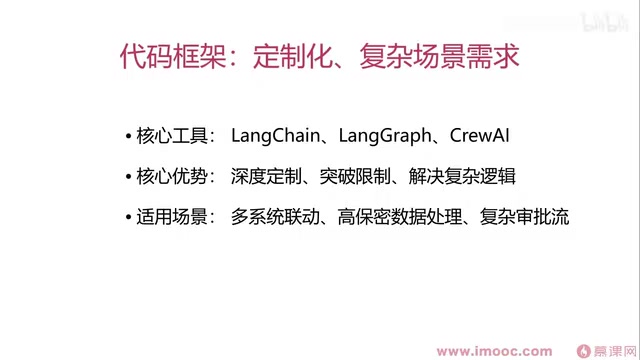
One of the most valuable design decisions in this course is its commitment to a "low-code and code framework dual-track" philosophy. This isn't just a list of technologies thrown together — it's a layered response to how real enterprise needs actually differ.
Low-Code: Rapid Validation and Day-to-Day Efficiency
If the goal is to quickly validate an idea or boost everyday productivity, platforms like Coze, Dify, and n8n are the right tools. The course describes them as "LEGO bricks" — with prompt engineering and drag-and-drop nodes, a business team can stand up a short-video production pipeline within a week. The barrier to entry is low: as long as you can articulate your requirements in plain language, you can build functional workflows without a technical background.
Code Frameworks: Deep Customization and Complex Scenarios
When enterprises need to handle core business logic, sensitive data, or intricate approval processes — think cross-department data integration, custom approval chains, key account data handling, or multi-agent customer service — code-based development becomes the only viable option. That's when you reach for LangChain, LangGraph, and similar frameworks to break through platform limitations and achieve full customization.
The logic is straightforward: low-code handles rapid validation and daily efficiency gains; code frameworks tackle deep customization and high-value complex problems. This layered thinking is exactly where many enterprises stumble when adopting AI — either going all-in on low-code and hitting a ceiling, or jumping straight into heavyweight frameworks and stalling the validation process entirely.
LangChain is one of the most widely adopted AI Agent development frameworks today, providing foundational modules for chained calls, tool integration, and memory management — well-suited for building standard business workflows around a single agent. LangGraph, released by the LangChain team as an advanced extension, introduces the key innovation of a "State Machine" model — representing an agent's execution flow as a directed graph, where each node is a processing step and each edge defines a state transition condition. This enables precise control over complex multi-step workflows with conditional branching, backtracking, or loops (such as multi-round approvals or error retries), rather than leaving things to the model's discretion. By contrast, CrewAI and AutoGen focus more on multi-agent collaboration scenarios: CrewAI emphasizes role-based task orchestration, while AutoGen excels at conversational coordination between agents. Understanding the differences between these frameworks helps you choose the right technical path for any given project.
Three Core Technical Modules
The course covers a broad technical landscape. On the low-code and workflow platform side, it works through Manus, Coze, Dify, n8n, Tencent Yuanqi, Alibaba Cloud Bailian, and other major platforms, with the goal of building deployable enterprise applications from scratch — such as a shopping guide system that bridges the WeChat ecosystem, DingTalk, and Alipay.
The MCP protocol deserves special mention. The course points out that most companies' data is locked away in on-premises databases and internal APIs — completely inaccessible to AI. Mastering MCP is described as obtaining a "master key" that lets agents securely read local files and call internal interfaces, dissolving the data silos that plague enterprise AI adoption. This observation hits a real nerve: data fragmentation is often a bigger bottleneck than model capability.
The code-intensive track goes deep into LangChain, LangGraph, LlamaIndex, AutoGen, CrewAI, MetaGPT, and other frameworks, covering topics like multi-agent communication, state management, and enterprise knowledge base construction.
MCP (Model Context Protocol) is a standardized protocol proposed and open-sourced by Anthropic in late 2024. Its core idea is to establish a unified communication interface between large models and external data sources or tools — similar in concept to the standardization that USB-C brought to hardware. Regardless of where the underlying data lives (local file system, database, internal API), as long as an MCP Server is deployed, an AI Agent can interact with it through a unified MCP Client protocol, without needing to build a custom integration layer for each data source. This eliminates the fragmentation problem of rewriting tool-calling code every time a new enterprise system is connected. For businesses, MCP means agents can securely access sensitive internal data (without uploading it to the cloud) while rapidly expanding their capability boundaries through a standardized interface — making it one of the most closely watched infrastructure directions in enterprise Agent deployment today.
Nine Core Intelligent Job Functions
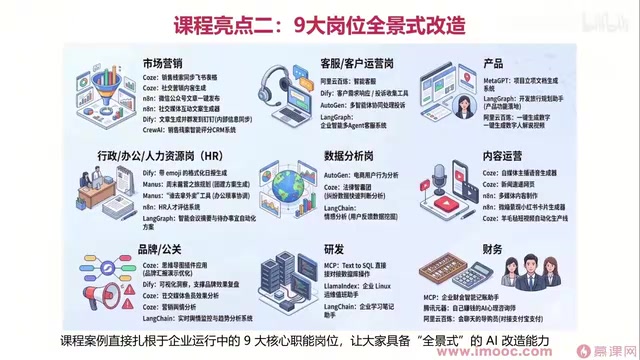
A second standout feature of the course is that its case studies are grounded in nine core intelligent job functions that actually exist in enterprises. The author's perspective is refreshingly direct: many technical courses just teach you to write code, but when you get to a company, the hardest part isn't the code — it's not knowing where the real business pain points are.
The course's principle is "target the pain where it hurts":
- Marketing: Automated lead syncing and data cleansing, so high-value prospects never slip through the cracks
- Finance: An intelligent bookkeeping assistant that compresses account processing from hours to seconds
- R&D: Text to SQL — ask the agent in plain language, and it retrieves the answer from the database itself
- PR & Operations: A real-time sentiment monitoring system that auto-alerts and pushes response plans as soon as an issue begins to surface
The course also covers HR resume screening, multi-turn customer complaint handling, product manager data analysis, and automated content production pipelines. The emphasis is that the value of learning isn't memorizing tool names — it's mastering the underlying logic of AI-enabling business processes. The goal is to develop an "AI eye" that can scan an organization and immediately spot which repetitive tasks are worth automating with an Agent.
Four Enterprise-Grade Capstone Projects
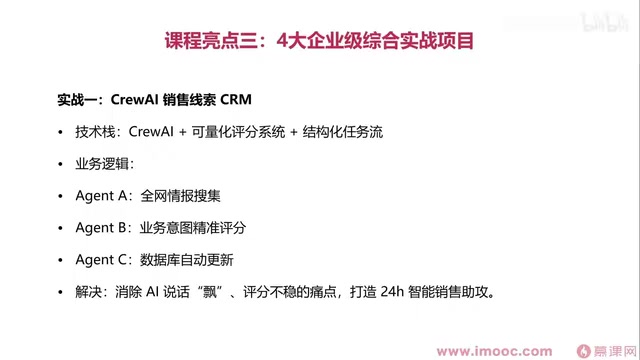
The course ties everything together through four comprehensive projects, each designed to deliver a deployable system — not just scattered code snippets.
Project 1: A CrewAI-based Intelligent Sales Lead Scoring CRM System. This simulates a complete sales team: one Agent gathers intelligence across the web, another scores leads precisely based on business logic. The core challenge is converting unstructured customer leads into quantifiable scores through a rigorous evaluation framework.
Project 2: A LangGraph-based Enterprise Meeting Summary and Action Item Tracking System. Dubbed "the hottest LangGraph state machine project in big tech," this isn't just about summarizing text — it's about completing a task end-to-end. The flow goes from meeting recording ingestion, to identifying owners, to dispatching action items via email — a full business loop. The focus is on Agent memory and state management under complex logic.
Project 3: A Coze-based Short-Video Automated Production Pipeline for Content Creators. Enter a keyword, and the system handles everything — trending topic selection, shot-by-shot scripting, automatic voiceover, and video assembly. One person's output can match an entire team's.
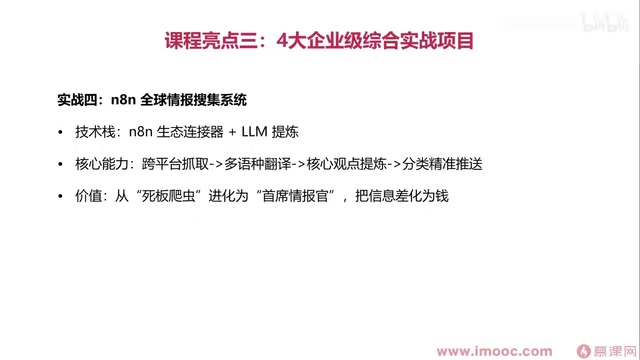
Project 4: An n8n-based Global Industry News Intelligence Gathering System. This project leverages n8n's connectivity capabilities to build an intelligence system with real reasoning ability — one that automatically scans global news sites, structures content, distills key insights, and distributes them logically. It's not a rigid scraper; it's more like a "Chief Intelligence Officer."
A Measured Assessment
Looking at the overall framework, this course's technology choices and business-mapping approach are coherent and grounded in enterprise reality. The layered strategy of "low-code for rapid validation + code frameworks for deep customization," along with bringing cutting-edge concepts like the MCP protocol and multi-agent collaboration down to specific job function scenarios, reflects genuine practical experience.
That said, the marketing language deserves some skepticism. Claims like "job-ready after completion" and "career domination" are clearly promotional, and whether 548 episodes can provide sufficient depth to support real enterprise-level development is something only actual learning outcomes can answer. For those looking to get started with AI Agent development, treating this course as a resource for building a technical map and business perspective is more appropriate than taking the career promises at face value. Real competence still comes from hands-on practice.
The workplace doesn't lack people who can chat with AI. What's genuinely scarce are people who can turn AI into a production tool. That's probably the most memorable takeaway from courses like this one.
Related articles
Automattic Executives Signed Reciprocal Severance Agreements During Mullenweg's Brief Ouster
Automattic's CFO and General Counsel signed reciprocal severance agreements during Matt Mullenweg's brief ouster, covering one year's salary and accelerated equity vesting, raising corporate governance concerns.
H3 Singularity Optimization: 40% Speed Boost With Better Image Quality
A Reddit user's Minimax Singularity workflow tip: insert an RTX upsampler before H3 Latent for 40%+ speed gains and better quality. Covers parameters, 12-bit output, and more.
Glyph: A Multi-Strategy Agent System for Automated Enterprise Data Catalog Annotation
Glyph is a multi-strategy LLM agent system for enterprise data catalogs that automates column description generation and sensitivity ontology tagging, grounding outputs in pipeline source code to improve accuracy.