AI Agent in Practice: A Complete Enterprise Deployment Guide from Low-Code to Hardcore Frameworks

A Bilibili AI Agent course spanning low-code platforms and hardcore frameworks across nine enterprise job roles.
This article reviews a Bilibili AI Agent course built on a core argument: LLMs are powerful but limbless brains, and what truly delivers enterprise value is an AI Agent capable of calling tools and executing workflows. The course runs low-code platforms (Coze/Dify/n8n) and code frameworks (LangChain/LangGraph) on parallel tracks, covers the MCP protocol for breaking down information silos, and grounds every case study in nine real enterprise roles. It concludes with four capstone projects — a CrewAI CRM scoring system, a LangGraph meeting tracker, a Coze video pipeline, and an n8n intelligence system — while reminding readers to look past marketing language and focus on hands-on practice.
LLMs Are Just the Brain — Agents Are the Hands and Feet
Many people share a familiar frustration: ChatGPT and DeepSeekAd are everywhere, yet back at the office, the workload hasn't budged. You're still copy-pasting, tweaking generated content, doing it all manually. This Bilibili AI Agent course cuts straight to the core issue — a large language model is essentially a brilliant but limbless brain. It can write copy and analyze data, but it can't close the loop: it won't auto-format your WeChat public account posts, pull orders from your CRM, or proactively follow up on tasks in DingTalk.
That's exactly the gap AI Agent is designed to bridge. It's not just a chatbot that answers questions — it's a "super digital employee" that calls tools, executes workflows, and actually gets things done. This distinction is the critical dividing line between "AI as a toy" and "AI as a productivity engine."
Dual-Track Design: Low-Code and Code Frameworks, Each in Its Lane
The course's central design philosophy is a dual-track approach running low-code and code frameworks in parallel — a technically sound selection logic with real practical value.
If your goal is rapid prototyping or improving day-to-day office efficiency, low-code platforms like Coze, Dify, and n8n work like LEGO bricks. With prompt engineering and drag-and-drop nodes, you can spin up a short-video production pipeline for a business team within a week. The barrier to entry is minimal — if you can clearly express your needs in plain language, you're ready to go.
But when enterprises need to handle core business processes, highly confidential data, or exceptionally complex approval flows — think multi-department data integration, custom approvals, sensitive customer data processing, or multi-agent customer service — code development becomes the only viable option. That's when you need hardcore frameworks like LangChain and LangGraph to break through platform limitations and achieve full customization.
In short: Low-code handles rapid validation and efficiency gains; code frameworks handle deep customization and high-value complex problems. This layered thinking is a valuable reference for avoiding the classic selection pitfalls of "using a sledgehammer to crack a nut" or "building a core system with toy tools."
LangChain and LangGraph are the most mainstream Agent development frameworks in the Python ecosystem today, though they serve different purposes. LangChain's core abstraction is the "Chain" — linking prompts, model calls, tool usage, and memory modules into reusable pipelines, suited for relatively linear task flows. LangGraph builds on this by introducing directed acyclic graphs (DAG) and state machine concepts, allowing developers to define complex flows with branches, loops, and conditional jumps. Each node can read and write shared state, making it a natural fit for multi-agent collaboration and long-running tasks that require "wait-decide-backtrack" logic. A simple analogy: LangChain is an assembly line; LangGraph is a map where you can retrace your steps. For common enterprise requirements like multi-round approvals, exception retries, and parallel subtasks, LangGraph's state management capabilities are often indispensable infrastructure.
Three Core Technical Modules, Fully Covered
The course's technical roadmap covers the current mainstream Agent development stack, organized into three categories.
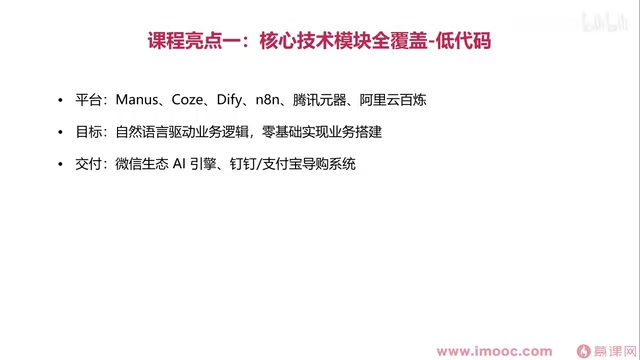
Low-code and workflow platforms: Hands-on work with Manus, Coze, Dify, n8n, Tencent Yuanqi, Alibaba Cloud Bailian, and other leading platforms. You'll build deployable applications from scratch — including a shopping guide system integrated with WeChat, DingTalk, and Alipay.
MCP Protocol: Described as the "universal key" for breaking down enterprise information silos. Many companies have data locked inside local databases and internal APIs that AI simply can't reach. Once you master MCP, agents can securely read local files and call internal interfaces, enabling real data flow between inside and outside the organization. MCP has been gaining enormous traction as a connectivity standard, and dedicating a dedicated module to it squarely addresses a real-world pain point.
Agent development frameworks: This is the hardcore code track, covering LangChain, LangGraph, LlamaIndex, AutoGen, CrewAI, MetaGPT, and more. The focus is on inter-agent communication, state management, and enterprise knowledge base construction. Master these, and unfamiliar technical terms in job descriptions or development requirements won't faze you.
MCP (Model Context Protocol) is an open protocol standard proposed by Anthropic in late 2024, designed to standardize communication between large language models and external data sources and tools. Before MCP, every AI application had to write custom adapter code for each database, API, or file system it needed — costly to integrate and nearly impossible to reuse. MCP's core idea is analogous to the standardization of USB interfaces: as long as a data source implements an MCP Server, any MCP-compatible agent can plug in and read data or invoke functions out of the box, with no redundant development required. This is especially critical for enterprise environments, where internal OA systems, ERP databases, and private knowledge bases typically operate in isolation. MCP provides a standardized "data pipeline" that lets agents cross information silos in a secure, controlled manner without uploading sensitive data to the public cloud. Leading tools like Claude and Cursor already natively support MCP, and the ecosystem is expanding rapidly.
Technology Grounded in Nine Enterprise Job Functions
What sets this course apart is that its case studies are embedded directly in nine core enterprise roles — not isolated code demos.
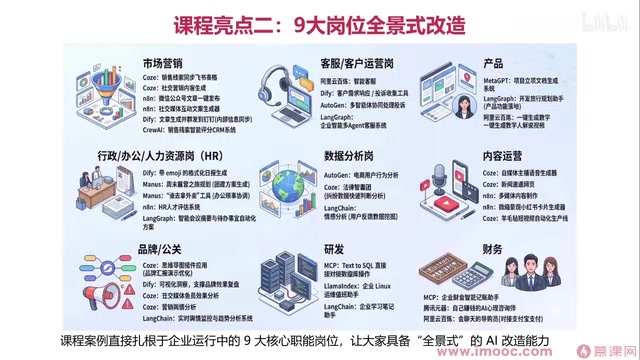
The course makes an important point: once you're in a company, the hardest part isn't writing code — it's not knowing where the business pitfalls and pain points are. That's why the cases cover concrete scenarios:
- Marketing: Automatic lead syncing and cleansing, so valuable customers no longer slip through the cracks;
- Finance: Intelligent bookkeeping assistant that cuts processing time from hours to seconds;
- R&D: Text to SQL — query databases in plain language without writing complex SQL by hand;
- PR & Operations: Real-time public sentiment monitoring that auto-alerts and pushes response plans the moment negative coverage starts brewing.
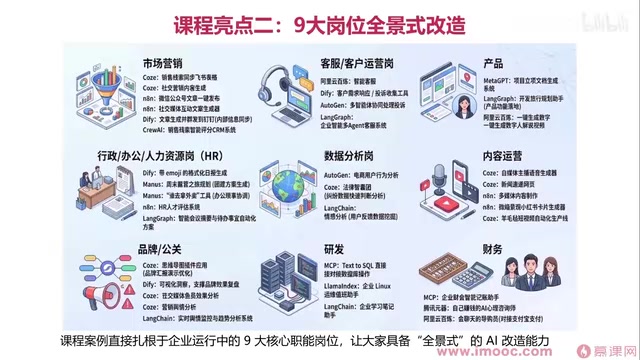
The course also covers HR résumé screening, multi-turn customer complaint handling, product manager data analysis, and automated content production pipelines. The recurring value proposition is this: the goal isn't memorizing a list of tool names — it's mastering the underlying logic of "business AI transformation" and developing an "AI eye" that can spot repetitive labor and strike precisely.
Four Comprehensive Enterprise-Grade Capstone Projects
The course culminates in four deliverable projects that tie the scattered techniques into complete systems.
Project 1: Sales Lead Intelligent Scoring CRM System Based on CrewAI. Simulates a complete sales team — one agent handles intelligence gathering across the web, another applies business logic to score leads precisely. The highlight is a scientific evaluation framework that converts unstructured customer lead data into quantifiable scores.
Project 2: Enterprise Meeting Summary and Action Tracking System Based on LangGraph. Described as one of the hottest LangGraph state machine projects at major tech firms right now, this solves not "summarize a paragraph" but "get a task done": from meeting recording input, to automatic identification of responsible parties, to dispatching tasks to email to-do lists, forming a full business loop. The focus is on agent memory and state management under complex logic.
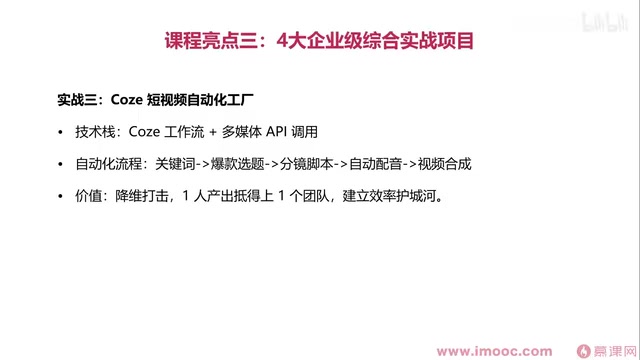
Project 3: Self-Media Short Video Automated Production Pipeline Based on Coze. Enter a keyword and the system handles everything — topic selection, shot-by-shot script, automatic voiceover, and video synthesis — with a single person's output rivaling that of an entire team.
Project 4: Global Industry News Intelligence Gathering System Based on n8n. Leverages n8n's powerful connectivity to build an intelligent system capable of reasoning — automatically traversing global news sites, structuring content, extracting key insights, and distributing them logically. It's an upgrade from a rigid web scraper to a "Chief Intelligence Officer."
Who Is This Course For
The course follows a clear progression: from agile development for quick deployment to deep customization for complex systems, covering both tool usage and the architectural thinking and design logic behind Agent development. For professionals and developers looking to advance from "using AI to chat" to "turning AI into a genuine productivity tool," this full-stack curriculum spanning LangChain, Coze, Manus, Dify, n8n, and MCP offers a reasonably complete learning path.
One caveat worth noting: phrases like "dimensional reduction strike" and "digital employee" in the course's promotional materials carry obvious marketing flair. Real learning outcomes still depend on hands-on practice and depth of business understanding. No matter how comprehensive the toolkit, whether it translates into career value ultimately comes down to actually grinding through the projects one by one.
Related articles

Random Pruning of the DPO Computation Graph: 1.4x Training Speedup and Lower Peak Memory
DPO training too slow and memory-hungry? This paper proposes a random pruning framework for the DPO computation graph, sampling independently across position, sequence, and branch dimensions; branch pruning achieves a 1.426x step-time speedup and cuts training time by about 30%, with in-depth attribution of memory and time gains.

Why Does JEPA Underperform MLM in Longitudinal EHR Representation Learning?
New study compares JEPA and MLM for longitudinal EHR representation learning on MIMIC-IV: three JEPA variants train stably without collapse but underperform MLM; target size, not heterogeneity, drives prediction error.

Transfer Learning + Visible Light Communication: A New Approach to Energy-Efficient Indoor Positioning
A study proposes a transfer learning-based visible light communication indoor positioning method, achieving 47% accuracy improvement on the BOSCH factory dataset, 67.5% model efficiency under high noise, and introducing the ME composite metric for energy-efficient positioning in energy-constrained industrial IoT scenarios.