AI Agent Learning Path from Zero: A Complete Guide from Principles to Practice

A complete zero-to-hero learning roadmap for AI Agent development, from principles to practice.
This article provides a systematic learning path for AI Agent development, covering core architecture principles like ReAct and Plan-and-Execute, essential skills including prompt engineering and tool calling, advanced topics such as memory management and multi-agent collaboration frameworks (AutoGen, CrewAI, LangGraph), and hands-on projects from personal assistants to automated research agents.
With the rapid advancement of large model technology, AI Agents have become one of the hottest technical directions today. From intelligent assistants that can autonomously think and execute tasks, to multi-role collaborative agent teams, to RAG assistants integrated with knowledge bases, the application scenarios for Agents are experiencing explosive growth. A Bilibili content creator named "Afu" spent three months systematically organizing a complete AI Agent learning framework. This article breaks down the core learning path and key concepts based on his course structure.
Why Learn AI Agent Now?
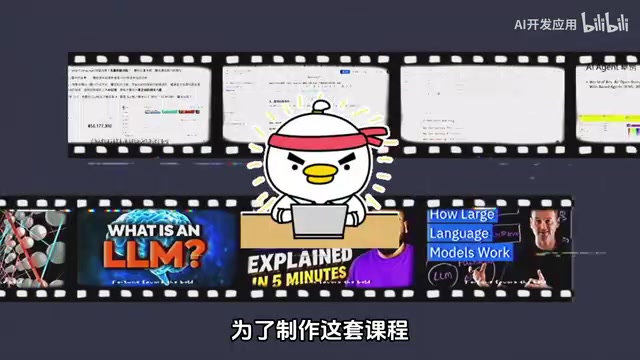
The quality of Agent tutorials currently available on the market varies wildly. According to the creator's research, after reviewing nearly all related courses on Bilibili and even watching international tutorials on YouTube, he found that over 85% of the content suffers from quality inconsistency — either too fragmented, lacking systematic structure, or rarely offering step-by-step guidance to help learners deeply understand a specific framework or core mechanism.
The core reason AI Agent is worth studying systematically is that it represents the next paradigm shift in AI applications. The concept of paradigm shift originates from philosopher of science Thomas Kuhn, referring to a fundamental change in the basic assumptions and methodologies within a field. In AI, we've experienced multiple paradigm shifts — from rule-based systems to machine learning, from discriminative models to generative models. The current transition from "large model conversations" to "Agent autonomous execution" is widely regarded as the next major paradigm leap following ChatGPT's explosion of generative AI. Traditional large model interaction follows a "question-and-answer" pattern, while Agents can autonomously plan, invoke tools, and continuously execute complex tasks. The core difference is that traditional large models are passively responsive, whereas Agents possess initiative — they can decompose a complex goal into multiple subtasks, autonomously determine execution order, and dynamically adjust strategies based on feedback during execution. This means mastering Agent development is equivalent to mastering the key skill of truly deploying AI into real business scenarios.
Fundamentals: Building an Agent Cognitive Framework
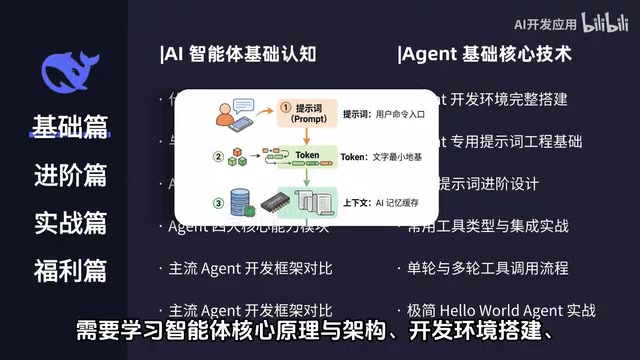
The first step in systematically learning about Agents is establishing a complete understanding of their core principles and architecture. The fundamentals section covers the following modules.
Core Principles and Architecture of Intelligent Agents
At its essence, an Agent is a perception-thinking-action loop system. It uses a Large Language Model (LLM) as its "brain," completing tasks by receiving environmental information, performing reasoning and planning, and invoking external tools. Understanding this basic architecture is the foundation for all subsequent learning.
Mainstream Agent architectures currently include ReAct (Reasoning + Acting), Plan-and-Execute (separated planning and execution), and state machine-based workflow architectures. Among these, the ReAct architecture was jointly proposed by Google and Princeton University in 2022. Its core idea is to have the large model alternate between "reasoning" and "acting" steps when generating responses. Specifically, the model first performs reasoning analysis through Chain-of-Thought, then decides to call an external tool to obtain information, continues reasoning based on the tool's returned results, and repeats this cycle until reaching a final answer. The advantage of this architecture is that the reasoning process is transparent and traceable, and it effectively reduces the "hallucination" problem of large models, since key facts are obtained in real-time through tools rather than relying on model memory. The Plan-and-Execute architecture decouples planning from execution — a planning module first generates a complete task plan, then an execution module carries it out step by step, making it suitable for structured tasks with clear steps. Beginners need to understand the design philosophy and applicable scenarios of these architectures before they can make sound technical choices in actual development.
Development Environment Setup
Good tools are a prerequisite for good work. Agent development typically requires configuring a Python environment, installing mainstream frameworks like LangChain/AutoGen, connecting to large model APIs (such as OpenAI, Claude, or domestic models), and preparing infrastructure like vector databases.
Vector databases are one of the core infrastructure components for Agent and RAG systems. Unlike traditional relational databases that query through exact matching, vector databases convert unstructured data like text and images into high-dimensional vectors through embedding models, then perform semantic-level approximate searches using metrics like cosine similarity and Euclidean distance. Popular vector databases include Pinecone, Weaviate, Milvus, Chroma, and FAISS. In an Agent's memory system, vector databases serve as long-term memory storage and retrieval — when an Agent needs to recall historical information, it vectorizes the current query and finds the most semantically relevant historical records in the vector database. While this step may seem simple, environment issues are often the biggest stumbling block for beginners.
Prompt Engineering and Tool Calling
Prompt Engineering is the most fundamental and important skill in Agent development. The quality of an Agent's behavior largely depends on system prompt design — how to define roles, how to describe tools, and how to standardize output formats all directly affect Agent performance.
Tool calling (Function Calling / Tool Use) is the key capability that distinguishes Agents from ordinary chatbots. Function Calling was first introduced by OpenAI in June 2023 and was subsequently widely adopted by major model providers. The technical principle is: developers describe available functions to the model in JSON Schema format (including function names, parameter types, and functional descriptions). If the model determines during reasoning that it needs to call a function, it generates a structured function call request (containing the function name and parameter values) rather than directly generating a natural language response. The application receives this request, executes the actual function call, and returns the result to the model, which then generates the final answer based on the result. It's worth noting that the model itself doesn't execute functions — it only decides "which function to call and what parameters to pass," with actual execution happening at the application layer. Through this mechanism, Agents can search the web, query databases, manipulate files, and call APIs, truly "getting things done."
Advanced: Mastering the Agent Core Tech Stack
After understanding the fundamentals, the advanced section dives into several core technical challenges of Agent development.
Memory Management: Giving Agents Continuous Learning Capability
Memory is the key to enabling Agents to maintain long-term interactions and deliver personalized services. It's mainly divided into three categories:
- Short-term memory: Current conversation context, typically maintained through message lists
- Long-term memory: Cross-session user preferences and historical information, usually stored in vector databases
- Working memory: Intermediate states and temporary information during task execution
How to design efficient memory retrieval strategies and how to reasonably allocate memory space within a limited context window are core challenges in Agent development. The context window refers to the maximum number of tokens a large model can process in a single inference. GPT-4 Turbo supports 128K tokens, Claude 3 supports 200K tokens, and Gemini 1.5 Pro reaches up to 1 million tokens. However, even as windows continue to expand, during an Agent's long-term operation, the accumulation of conversation history, tool return results, and memory retrieval content can easily exceed limits. More importantly, research has shown that large models exhibit a "Lost in the Middle" phenomenon — the model pays more attention to information at the beginning and end of the context while tending to overlook information in the middle. Therefore, Agent memory management must solve not only the "can't store it all" problem but also the "can't remember it" problem, requiring carefully designed strategies for memory compression, summarization, and priority ranking.

Multi-Agent Collaboration: Unlocking Complex Task Processing
A single Agent's capabilities are ultimately limited. Multi-Agent collaboration is an important direction for solving complex tasks. Common collaboration patterns include:
- Hierarchical: A "manager" Agent assigns tasks to multiple "executor" Agents
- Debate-style: Multiple Agents analyze the same problem from different perspectives, reaching consensus through discussion
- Pipeline: Tasks are passed sequentially to Agents with different specializations
The three major mainstream multi-agent frameworks each have their own strengths: AutoGen, developed by Microsoft Research, centers on the concept of "conversable Agents" for flexible multi-agent interaction, supports human-in-the-loop collaboration, and is well-suited for research and prototyping. CrewAI adopts a "role-playing" design philosophy where developers define a clear Role, Goal, and Backstory for each Agent, organizing collaboration through Tasks and Processes. Its API design is clean and intuitive, making it ideal for quickly building multi-Agent applications. LangGraph, released by the LangChain team, is a graph orchestration framework that models Agent workflows as directed graphs, where nodes represent processing steps and edges represent state transition conditions. It supports loops, branching, and parallel execution, making it suitable for building complex, production-grade Agent systems that require fine-grained process control. Developers should choose the appropriate framework based on project complexity, team tech stack, and production requirements.
Model Fine-tuning and Safety Alignment
When general-purpose large models can't meet the needs of specific scenarios, model fine-tuning becomes necessary. In Agent scenarios, fine-tuning has two main application directions: first, using Supervised Fine-Tuning (SFT) to help the model better understand domain-specific tool calling formats and business logic; second, using alignment techniques like RLHF (Reinforcement Learning from Human Feedback) or DPO (Direct Preference Optimization) to make the model's behavior more compliant with safety standards.
At the same time, safety alignment for Agents is a topic that cannot be overlooked. Core security risks the industry focuses on include: Prompt Injection — malicious users hijacking Agent behavior through carefully crafted inputs; Privilege Escalation — Agents acquiring system permissions beyond expectations during execution; and Cascading Failures — erroneous decisions by one Agent in a multi-agent system triggering chain reactions. Countermeasures include implementing the principle of least privilege, setting up operation sandboxes, adding human approval checkpoints, and deploying independent safety monitoring Agents. How to prevent Agents from executing dangerous operations, how to set permission boundaries, and how to handle adversarial inputs are all problems that must be solved before production deployment.
Hands-On: Learning by Doing Through Projects
Theory must ultimately be put into practice. The following projects, arranged from simple to complex, can help developers quickly accumulate Agent development experience.
Personal AI Assistant
This is the most basic Agent project, covering features like schedule management, information retrieval, and file processing. Through this project, you can practice tool definition, prompt design, and basic conversation management.
Multi-Agent Team Collaborative Writing
This project involves multiple Agent roles — such as planner, writer, editor, and proofreader — collaborating to create an article. The focus is on practicing multi-agent communication, task decomposition, and quality control workflows.
Automated Web Research Agent
This is the most challenging project, where the Agent needs to autonomously search for web information, filter reliable sources, extract key data, and generate research reports. It integrates multiple core technologies including tool calling, memory management, and information retrieval, making it the ultimate litmus test for validating your learning outcomes.
Learning Recommendations and Resource Suggestions

For developers who want to systematically learn AI Agent development, the following recommendations are worth considering:
- Understand principles before jumping into frameworks: Don't start by copying LangChain templates — first understand the Agent's reasoning loop and architecture design
- Start with simple projects and iterate gradually: Begin with a simple Agent that can call a single tool, then progressively increase complexity
- Stay updated on mainstream framework developments: Frameworks like LangGraph, AutoGen, and CrewAI update rapidly — keep up with the latest versions
- Prioritize prompt engineering: Often, poor Agent performance isn't a code problem but a prompt design problem
- Read open-source project source code: GitHub hosts numerous excellent open-source Agent projects — reading source code is the fastest way to level up
The AI Agent field is in a period of rapid development, and now is the perfect time to start learning. Whether you're looking to transition into AI development or hoping to boost work efficiency with Agents, a systematic learning path is far more effective than fragmented information gathering.
Related articles

Older Google Home Gets Gemini Live Upgrade: Conditions and Experience Fully Explained
Google is rolling out Gemini Live conversational AI to older Google Home speakers, but subscription or plan requirements may apply. Here's what you need to know.

Older Google Home Gets Gemini Live Upgrade: Complete Breakdown of Requirements and Experience
Google is rolling out Gemini Live conversational AI to older Google Home speakers, but subscription or plan restrictions may apply. Full breakdown of the upgrade details and impact.

GPT-5.6 Hands-On Review: Analyzing the Agent Capabilities Behind Its #1 Ranking on the Frontend Development Leaderboard
GPT-5.6 SoulX High tops the frontend dev leaderboard at 1636 points with Agent Arena rank #2. Hands-on tests of portfolio pages and mystery games reveal its task decomposition and self-correction capabilities.