AI Agent Learning Roadmap: A Complete 4-Stage Guide from Zero to Employment

A 4-stage AI Agent roadmap from Prompt basics to RAG and real-world projects for career changers.
This article outlines a four-stage roadmap for breaking into AI Agent development, based on a structured beginner-level tutorial. It traces AI's evolution from Q&A tools to autonomous agents and the resulting surge in enterprise demand. The four stages cover: understanding model boundaries and Prompt Engineering; mastering RAG, tool calling, and workflow orchestration; building a real project complete with evaluation and fallback handling; and translating that work into resume-ready content and interview readiness. The key insight: what separates tutorial completers from job-ready developers is the hands-on engineering work most people skip.
From ChatGPT opening the doors of AI to everyday people, to intelligent agents (AI Agents) that can take over devices 24/7, autonomously break down tasks, and complete them independently — AI has evolved far faster than anyone expected. Models that once could only "answer your questions" are now steadily approaching the Jarvis-style assistant we once thought only existed in sci-fi films. Behind this shift lies a hard reality: the way businesses operate is being rewritten, and demand for AI Agent developers is surging. This article draws from a systematic, beginner-friendly AI Agent tutorial on Bilibili to map out a practical learning path.
From Q&A Tool to Autonomous Agent: What Has Really Changed
On November 30, 2022, ChatGPT gave ordinary people their first real taste of AI's capabilities. But AI was still trapped in a "question-and-answer box" — it could write poems and hold conversations, but it couldn't think for itself or independently get things done. Between "answering questions" and "autonomous execution," there was a clear and significant gap.
As technology has iterated, AI agents can now take over computers and smartphones around the clock — autonomously learning skills, breaking down tasks, executing them to completion, and even remembering user habits, getting smarter the more you use them. The explosion of these tools marks AI's shift from "passive response" to "active agency."

The more critical changes are happening on the enterprise side. Automated workflows are reshaping productivity, AI-driven data analysis is being incorporated into strategic planning, and 24/7 AI-powered customer service is gradually replacing human agents. Intelligent agents have gone from a "nice-to-have" to an outright necessity — and that shift has directly driven up demand and salaries for Agent developers.
Breaking In Is About Roadmap, Not Raw Talent
With such a clear wave of opportunity, the most common question from newcomers is: the job market looks hot, but where do I even start?
The course author's answer is direct — breaking into Agent development isn't about natural talent, it's about following the right roadmap. Watching a pile of scattered tutorials online is no substitute for walking one solid path all the way through. Rather than bouncing between fragmented information, the better approach is to advance systematically, stage by stage.

This path is broken into four stages: Foundation, Intermediate, Hands-On Practice, and Job Readiness. Each stage has a clear goal, and they build on each other — making this roadmap ideal for people who've been laid off and are looking for a new direction, professionals considering a career pivot, and complete beginners who want to add a marketable skill.
Breaking Down the Four-Stage Learning Path
Stage 1: Understand the Boundaries and Prompt Engineering
The core of getting started isn't rushing to write code — it's first understanding what large language models and AI agents can do, can't do, and where their limits lie. From there, you learn Prompt Engineering to get the model to produce reliable, rule-following outputs.
The course author specifically points out that 90% of people don't even understand why models "make things up" (hallucinations) — meaning everything they learn afterward is built on sand. Understanding the capability boundaries of models is the first step to avoiding wasted effort.
What is Prompt Engineering? Prompt Engineering refers to the practice of designing and optimizing the text instructions fed to a large language model, so that the model produces stable, accurate outputs that match your expectations. Because large language models are fundamentally generating text based on statistical probabilities, the same question phrased differently can yield wildly different results. Core Prompt Engineering techniques include: clearly defining a role (e.g., "You are a professional legal advisor"), providing few-shot examples, using Chain-of-Thought prompting to guide the model through step-by-step reasoning, and setting output format constraints. As for "hallucinations" — this refers to the model generating content that sounds plausible but is completely fabricated, with high confidence, when it lacks genuine underlying knowledge — for example, inventing paper citations or fictional biographical details about real people. Understanding why hallucinations occur (insufficient training data coverage, over-generalization) is a prerequisite for learning techniques like RAG. Without this foundation, developers can't judge when to trust the model's output and when external knowledge needs to step in.
Stage 2: Three Core Hard Skills
The intermediate stage is about acquiring three essential capabilities at once:
- RAG (Retrieval-Augmented Generation): Enabling the agent to answer based on your data, reducing fabricated responses;
- Tool Calling: Giving the agent the ability to query data and get things done — real interaction with external systems;
- Workflow Orchestration: Chaining multi-step tasks together to enable automated execution.
These three capabilities are what companies look for most when hiring, and they're standard topics in interviews. Mastering them essentially means crossing the threshold from "knowing how to use AI" to "knowing how to build with AI."

What are RAG, Tool Calling, and Workflow Orchestration? RAG (Retrieval-Augmented Generation) is currently one of the most widely adopted technical approaches for deploying large models in enterprise settings. The core idea: before the model generates an answer, relevant passages are first retrieved from an external knowledge base (company documents, databases, web pages, etc.), and those passages are fed into the model along with the question — so the model generates answers grounded in real material rather than guessing. The typical architecture involves four steps: document chunking, vector embedding, vector database storage, and similarity-based retrieval. Tool Calling (also known as Function Calling) allows a model to actively trigger external APIs during a conversation — for example, checking the weather, reading or writing to a database, sending an email — breaking beyond the limits of pure text generation to give the agent genuine "action" capabilities. Workflow Orchestration chains multiple model calls and tool calls together in logical sequence to form a repeatable, automated pipeline. Common frameworks include LangChain and LlamaIndex.
Stage 3: Pick One Real Scenario and Go Deep
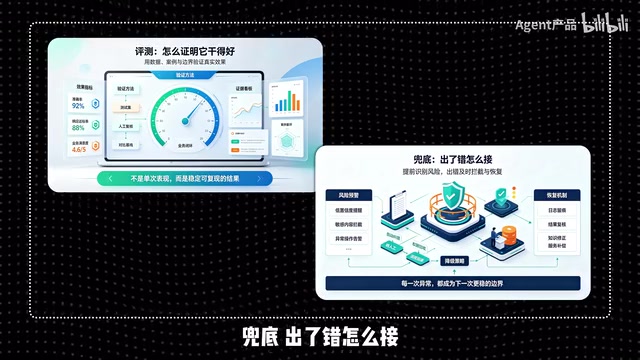
The hands-on stage is about picking one real-world scenario and executing it thoroughly — AI customer service, knowledge base Q&A, and data analysis assistants are all solid options. The author emphasizes doing two things that most people skip:
- Evaluation: How do you prove the agent is actually performing well? Use quantitative metrics to validate results;
- Fallback Handling: What happens when it fails? Ensure system robustness and reliability.
Completing both of these gives you a real project you can actually put on your resume — not just a demo that falls apart under scrutiny.
Stage 4: From Project to Offer
The job readiness stage focuses on converting your work into real competitive advantage: how to frame your Agent projects on a resume, how to answer high-frequency interview questions, and which types of roles best match your background. The goal of this stage is to complete the full loop — from preparation to landing an offer.
Who Is This Roadmap For?
The value of this four-stage roadmap lies in transforming scattered learning resources into a clear, coherent growth curve. For complete beginners, it lowers the barrier to entry. For career switchers, it provides a concrete skill checklist and clear employment direction.
One important caveat: the tutorial itself is a learning path framework — actual skill development depends on hands-on practice. The evaluation and fallback handling work emphasized in Stage 3 is typically what separates "someone who finished the tutorial" from "someone actually ready to work." In a hot market, having a roadmap is just the starting point. Consistent, real-world project work is what ultimately gets you the offer.
Related articles

OpenAI Cracks Math Problems, Why Are Mathematicians Losing Sleep?
OpenAI claims to solve math problems — why are mathematicians anxious? Vergecast reveals the Eye of Sauron dilemma and the tension between AI answers and human understanding.

CSS Conditional Border-Radius Trick: Auto-Square Corners When Elements Touch the Edge
Pure CSS conditional border-radius: auto-square corners when elements touch the edge, rounded while floating. Use calc(100vw-100%) with clamp() to kill the transition band, and container query units cqi for non-fullscreen containers, plus a scrollbar offset workaround.

Google TimesFM 3.0 Hands-On: Is Zero-Shot Forecasting Good Enough?
Hands-on test of Google TimesFM 3.0: zero-shot error cut by ~25% with second-level results, but the two versions give opposite answers in business what-if planning. A deep dive into model internals, version differences, and four key production limitations.