Bilibili's 748-Episode AI Agent Course: A Complete Hands-On Path from Beginner to Expert in Agent Development
Bilibili's 748-episode AI Agent course uses a three-part cognition-advanced-hands-on structure to systematically bridge the gap between concepts and practice.
This article outlines the design logic and practical points of Bilibili's "Complete AI Agent Course." The author notes that over 90% of Agent content falls into two extremes—concept piling or premature code—leaving learners "understanding while watching, blanking when doing." The 748-episode course is divided into three parts: cognition (everyday analogies for ReAct, planning, reasoning, and memory plus a first demo), advanced (LangChain and AutoGen frameworks, Function Calling, multi-Agent collaboration, and evaluation/debugging/security boundaries), and hands-on (intelligent customer service, automated data analysis, and a multi-Agent production line). Source code, materials, and a roadmap are included, but the author cautions that "mastery in seven days" is marketing language—true mastery depends on hands-on reproduction and debugging.
In today's fast-evolving AI landscape, AI Agents have become a focal point for everyone from individual developers to enterprise teams. The "Complete AI Agent Course" launched on Bilibili, with its massive 748-episode scope and a three-part structure spanning cognition to hands-on practice, attempts to address a common pain point: most tutorials on the market either pile up concepts or jump straight into code, leaving learners unable to build a complete capability chain. This article, based on the course's publicly available content, outlines its design logic and the practical points worth noting.
Why do most Agent tutorials leave you unable to apply what you've learned?
The course author states upfront that after scouring nearly all Agent-related content on Bilibili and YouTube—from technical blogs to open-source GitHub projects—they found that over 90% of tutorials fall into two extremes: one talks at length about terms like autonomous planning and tool calling without ever getting hands-on; the other jumps straight into API calls before learners even understand what problems Agents solve. This combination of "hollow concepts" and "premature code" traps many beginners in a state of "understanding while watching, blanking when doing."
The course's strategy is to abandon flashy packaging—first explaining how Agents think through everyday analogies, then gradually building things hands-on. The author spent four months breaking the core knowledge into three parts: cognition, advanced, and hands-on practice. This "build understanding first, then ramp up intensity" arrangement stands in clear contrast to most crash courses.
Cognition Part: Deconstructing the Agent's Underlying Logic Through Analogies
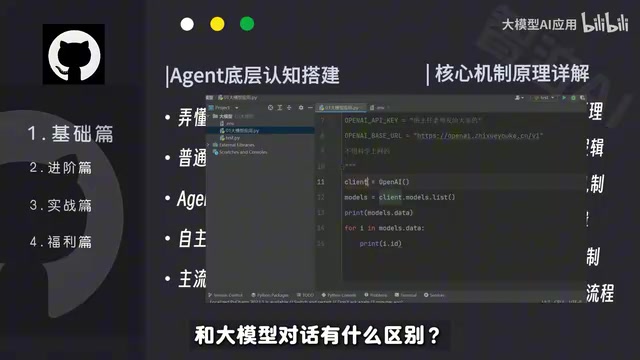
The first part focuses on foundational understanding, answering two core questions: What is an Agent? How does it fundamentally differ from a large model conversation? The course uses everyday analogies to explain concepts like the ReAct framework, planning, reasoning, and memory mechanisms—terms that sound intimidating but can quickly build intuition through analogy. For example, it compares an Agent's planning ability to how a person breaks down steps when handling a complex task, and maps memory mechanisms to a layered structure of short-term context and long-term knowledge bases.
The cognition part doesn't stop at theory—it has learners run their first Agent demo immediately after understanding the concepts, experiencing firsthand what it feels like when an agent "gets things done." This "concept + immediate feedback" design helps establish a positive cycle early on, preventing learners from giving up due to an accumulation of abstract concepts.
The ReAct framework is one of the most frequently mentioned paradigms in Agent development, short for "Reasoning + Acting," proposed by Shunyu Yao et al. in 2022. Its core idea is to have the large model output a "Thought" before each action, then decide which tool to call (Action), and continue reasoning based on the tool's returned result (Observation), looping until the task is complete. This "think while doing" mechanism enables Agents to dynamically adjust strategies rather than generating a final answer in one shot. Understanding ReAct helps grasp the key distinction between Agents and ordinary conversational models: the latter generate in a single or limited number of rounds, while the former possess multi-step reasoning and environment interaction capabilities.
Advanced Part: Framework Practice and Engineering Capabilities
The second part goes into technical depth, covering LangChain and AutoGen framework practice, multi-Agent collaboration, Function Calling tool invocation, hybrid ReAct and Agent architectures, as well as evaluation, debugging, and security boundaries. Each section comes with accompanying code and course materials, lowering the barrier to following along.
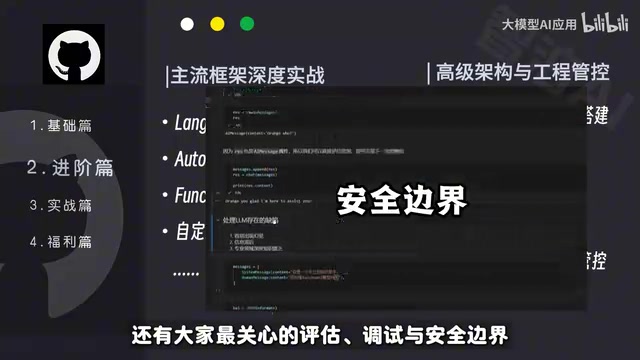
Notably, the course dedicates a separate section to "evaluation, debugging, and security boundaries." In Agent development, the uncontrollability of tool calls, the accumulation of deviations in multi-round reasoning, and the security risks of external APIs are often the most thorny issues in real-world deployment—yet most introductory tutorials gloss over them. The course including this in the advanced curriculum shows its content design intentionally stays close to engineering reality rather than remaining at the demo level.
Function Calling is the standardized capability for connecting large models with external tools. Developers describe available functions and their parameters using JSON Schema; the model determines during conversation whether to call, which function to call, and generates parameters in the correct format; actual execution is done by external code, and results are passed back to the model. It decouples "model decision" from "tool execution," improving reliability while making permission control and error handling easier. Without Function Calling, tool invocation often relies on prompt splicing and text parsing, which is unstable and hard to maintain—which is why it has become foundational infrastructure for Agent engineering.
LangChain and AutoGen represent two different framework orientations. LangChain centers on "chain orchestration," providing modular components like model wrappers, tools, memory, and retrieval, suitable for building complex single-Agent workflows; its ecosystem's LangGraph further supports stateful multi-step loops. AutoGen, released by Microsoft, is designed around "multi-agent conversation," enabling multiple configurable Agents to collaborate on tasks through message passing, suitable for scenarios requiring role division. The two are not mutually exclusive—real projects often use LangChain to build single-Agent capabilities and then AutoGen to organize multi-Agent collaboration. Selection requires weighing learning cost against business complexity.
Hands-On Part: Enterprise-Level Projects and Multi-Agent Collaboration
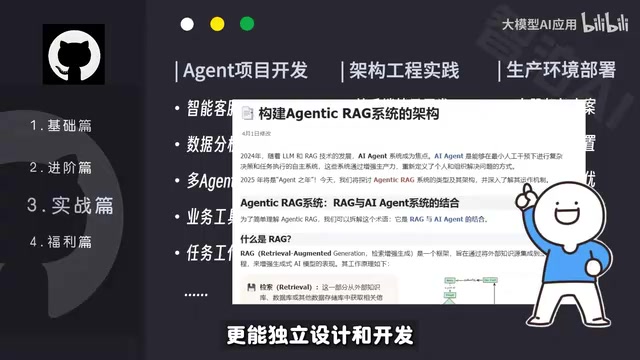
The third part concludes with three enterprise-level projects: an intelligent customer service Agent system (from intent recognition to automatic ticket routing), an automated data analysis Agent (upload an Excel file to automatically generate reports and charts), and a multi-Agent collaborative production line (multiple agents dividing work like a team). These three projects correspond to three high-frequency business scenarios—customer service, data analysis, and process automation—covering both typical single-Agent tool calling and multi-Agent coordination architectures.
From a learning path perspective, the value of the hands-on part lies in integrating the cognition and framework capabilities from the first two parts into real business problems. The author emphasizes that after completing the course, learners will not only understand the underlying principles but also be able to independently design and develop agent applications that solve real business problems. Whether this goal is achieved depends on the learner's hands-on investment, but the project selection itself is highly representative.
Supporting Resources and Learning Suggestions
The course provides all source code, course materials, prompt templates, and an AI Agent developer learning roadmap compiled by the author. For beginners, it's recommended to progress in the order of cognition → advanced → hands-on, and after each demo, modify parameters or swap scenarios yourself to test your understanding. For learners with development experience, you can skip some of the analogy content in the cognition part and go directly to the framework practice in the advanced part, but it's advisable to still quickly browse the ReAct and memory mechanism chapters to ensure conceptual alignment.
It's worth noting that the 748-episode scope means completing the full course requires considerable time investment. The phrase "from novice to master in seven days" is better understood as marketing language than an actual learning timeline. Truly mastering Agent development still depends on hands-on reproduction and debugging of each project.
Conclusion
The value of this course lies in its systematic structure addressing the common problem of "concepts disconnected from practice" in Agent learning: the cognition part builds intuition, the advanced part fills in engineering capabilities, and the hands-on part connects to business scenarios. For readers hoping to systematically get started with AI Agent development, it offers a complete path to follow; but learning outcomes ultimately depend on the amount of hands-on practice, not the number of video episodes.
One-line Summary
Bilibili's 748-episode AI Agent course uses a three-part structure—cognition, advanced, and hands-on—to systematically solve the disconnect between concepts and practice.
Paragraph Summary
This article outlines the design logic and practical points of Bilibili's "Complete AI Agent Course." The author notes that over 90% of Agent content falls into two extremes—concept piling or premature code—leaving learners "understanding while watching, blanking when doing." To address this, the 748-episode course is divided into three parts: the cognition part uses everyday analogies to deconstruct ReAct, planning, reasoning, and memory mechanisms while having learners run their first demo; the advanced part covers LangChain and AutoGen frameworks, Function Calling, multi-Agent collaboration, and evaluation, debugging, and security boundaries; the hands-on part concludes with three enterprise-level projects—intelligent customer service, automated data analysis, and a multi-Agent collaborative production line. The course includes source code, materials, and a learning roadmap, but the author also cautions that given the 748-episode scope, "mastery in seven days" is closer to marketing language—true mastery still depends on the amount of hands-on reproduction and debugging.
Related articles

9 AI Subscription Plans Compared: The Real Cost Per 100M Tokens Revealed
Bilibili creator tests 9 AI subscription plans from Volcano, Alibaba, Tencent, Baidu, Zhipu, Xiaomi, MiniMax and more, converting them all to real cost per 100M tokens, breaking down fixed-quota vs. three-tier coefficient billing and how caching, time-of-day discounts, and window limits affect actual quota.

Vibe Coding for Beginners: Expressing Intent Instead of Handwriting Code
What is Vibe Coding? A 137-episode Bilibili course defines it: the core is expressing intent, not writing code. This article analyzes Vibe Coding's productivity logic, target audience, and entry expectations to help beginners decide if it's worth learning.

LangChain Beginner's Guide: An Agent Development Roadmap from LangGraph to Deep Agents
Clarify the encapsulation relationship among LangChain, LangGraph, and Deep Agents, and master the learning path and selection logic for agent development frameworks—suitable for beginners in large model development.