Building Production-Grade AI Systems from Scratch: A Complete Guide to LLMs, RAG, and Multi-Agent Workflows

A full-stack guide connecting LLMs, embeddings, RAG, LangGraph, and MCP through one enterprise AI project.
Using a fictional company's 500GB internal document assistant as the throughline, this article systematically covers the core stack for production AI: context window limits leading to embeddings and vector databases, LangChain for multi-model integration, RAG for private knowledge injection without fine-tuning, LangGraph for complex multi-step workflow orchestration, and MCP for unified external system integration. Every concept is introduced by the problem it solves, forming a complete mental model from theory to implementation.
Over the past few years, terms like prompt engineering, context windows, tokens, embeddings, Retrieval-Augmented Generation (RAG), vector databases, MCP, agents, LangChain, and LangGraph have flooded the developer landscape, leaving many struggling to keep up. This article, based on a systematic tutorial series, ties all these scattered concepts together through a single project thread — building an AI assistant for a fictional company called TechOp that can understand 500GB of internal documents — forming a complete engineering framework.
It All Starts with Large Language Models and Context Windows
Models like OpenAI's GPT, Anthropic's Claude, and Google's Gemini are all Transformer models trained on massive datasets — trillions of tokens covering medicine, law, programming, science, and more. But here's the problem: TechOp's 500GB of internal documents were never part of that training data. To make a model answer questions about proprietary company information, you need a way to "feed" that data to the model.
The most direct approach is to stuff content into the conversation history. This "short-term memory" is the context window, measured in tokens (roughly 0.75 words per token in English). Different models have vastly different limits: xAI's Grok supports 256K tokens, Claude Opus 200K, and Gemini 2.5 Pro up to 1 million. But a bigger window doesn't automatically mean better comprehension — the tutorial uses two examples, "reciting digits of pi" and "an apple orchard," to illustrate how models can both forget details and get distracted by irrelevant information in long contexts. Choosing the right model for the task — whether you prioritize a large context window or low-latency Flash/Nano variants — is therefore critical.
The core tension becomes clear: even a 1-million-token window can only hold about 50 typical business documents at once, yet TechOp needs the model to understand all 500GB of content. This is exactly where embeddings come in.
Embeddings: Turning Words into Meaning
Embeddings change how information is stored — instead of treating text as words, they convert meaning into numerical vectors (typically 1,536 dimensions). "Employee vacation policy" and "staff leave guidelines" use different words, but they're semantically similar, so their generated vectors will be close to each other in mathematical space.
This means when an employee asks "Can I wear jeans to work?", even if the word "jeans" never appears in the policy document, the system can still find the dress code through semantic matching. The core problem embeddings solve is upgrading retrieval from literal matching to semantic matching.
Generating embedding vectors requires dedicated embedding models (such as OpenAI's text-embedding-3-small/large or Google's text-embedding-004) — these are separate models from the LLM handling conversation. An embedding model takes a piece of text and outputs a fixed-length array of floating-point numbers: a vector. 1,536 dimensions means each piece of text is mapped to a point in 1,536-dimensional space, where semantically similar text sits closer together. The most common way to measure similarity between two vectors is cosine similarity: computing the cosine of the angle between two vectors, yielding a result between -1 and 1, where values closer to 1 indicate greater semantic similarity. This mathematical mechanism is the foundation of the entire semantic search and RAG system — at retrieval time, the user's question is also converted into a vector, then compared against all document chunk vectors in the database, with the top-ranked chunks treated as the most relevant context.
LangChain: Connecting Scattered Components into a System
With LLMs and embeddings in place, you still need a system to wire them together. If you hand-code a chat interface directly with the OpenAI SDK, you'll quickly discover a long list of missing pieces: storing chat messages, maintaining conversational context, connecting to internal knowledge bases, and the flexibility to switch from OpenAI to Anthropic or Google down the road.
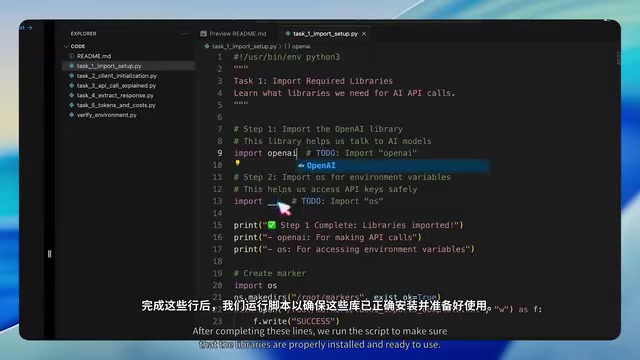
LangChain solves these pain points as an abstraction layer. Its core difference from calling LLMs directly lies in the Agent concept: using a model directly treats it as a static brain, whereas an agent has autonomy, memory, and tools, and can decide for itself what steps are needed to complete a task. The tutorial demonstrates a hands-on comparison — making a single call with the native SDK requires ten-plus lines of boilerplate, and switching providers means rewriting everything; with LangChain, the same logic compresses to three lines, changing models requires only a model name swap, and code volume drops by roughly 70%.
LangChain also provides pre-built components for memory management, standardized vector database interfaces (works with both Pinecone and ChromaDB), embedding calls, and tool integration. It supports prompt templates, output parsers, and pipeline-style chaining with the pipe operator, making AI pipelines cleaner and more scalable.
Prompt Engineering: Techniques for Controlling Agent Behavior
Prompt quality directly determines response quality. A vague "what's the policy?" will surface a flood of irrelevant details, while "what is the company's remote work policy for international employees?" yields a precise answer. The tutorial covers four mainstream techniques:
- Zero-shot: No examples provided — relies entirely on the model's existing knowledge. Fastest approach.
- One-shot / Few-shot: Provide one or several examples in the prompt to ensure consistency in format, tone, and style.
- Chain-of-Thought: Give the model a sequence of reasoning steps — for example: first review GDPR requirements, then analyze policy gaps, then research industry best practices, then draft recommendations. Especially effective for complex reasoning tasks.
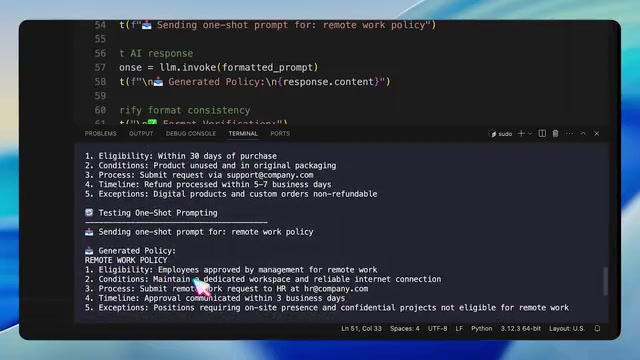
The key takeaway: choosing the right technique can dramatically improve prompt performance — zero-shot is fast, one-shot enforces format, few-shot strengthens tone, and chain-of-thought excels at reasoning.
Vector Databases and Semantic Search
With traditional structured databases like SQL, the burden of search falls on the user — they must construct correct query statements (sometimes with wildcard fuzzy matching). Vector databases shift that burden to the builder, in exchange for allowing end users to query with plain natural language.
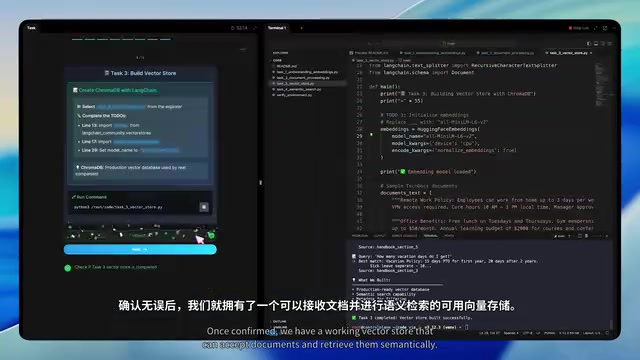
Building one requires understanding a few core concepts:
- Dimensions: Typically 1,536 — striking a balance between expressive richness and storage overhead.
- Score threshold: Defines how similar a result must be to count as a match, used to filter low-similarity results (e.g., "bring your laptop to Florida" vs. "vacation in Florida" are semantically unrelated).
- Chunk overlap: When splitting long documents into chunks, adjacent chunks retain overlapping context to avoid semantic truncation at boundaries.
The tutorial shares benchmark data: a chunk size of 500 characters with 100-character overlap can improve retrieval accuracy by nearly 40%. A complete semantic search engine ultimately drops the search failure rate from 60% to a 95% success rate. Common implementations include Pinecone and ChromaDB.
RAG: Retrieval-Augmented Generation
RAG (Retrieval-Augmented Generation) breaks the process into three steps: Retrieve (embed the user's question and semantically compare it against document vectors), Augment (inject the retrieved data into the prompt at runtime), and Generate (answer based on real, up-to-date, private data). Its greatest value is that it enables AI to access knowledge beyond its training data without any fine-tuning.
In practice, a key anti-hallucination technique is constraining the system prompt: answers must come only from retrieved documents, and if the information isn't in the context, the AI must respond with "I don't have that information in the documents provided." Adding source attribution to every answer rounds out a production-ready Q&A engine. The tutorial also emphasizes that different datasets need different chunking strategies — legal documents should preserve long paragraphs intact, while chat logs call for sentence-level, high-overlap chunking.
RAG is often compared to fine-tuning, the other main approach for giving models access to private knowledge. Fine-tuning continues training an existing model on private data, effectively "burning" knowledge into model weights. The upside is no extra retrieval step at inference time — but the cost is steep: every data update requires retraining, which can run into thousands of dollars, and fine-tuned models are more prone to capability degradation outside their specialized domain. RAG, by contrast, dynamically injects data at runtime — updating knowledge only requires re-embedding new documents, without touching the model itself, making it ideal for enterprise knowledge bases with frequently changing content. The two approaches aren't mutually exclusive — a "fine-tuning + RAG" combination is also used in practice, where fine-tuning shapes the model's response style and domain vocabulary while RAG keeps knowledge current. For most enterprise scenarios, RAG is the lower-cost, easier-to-maintain starting point.
LangGraph: Orchestration for Complex Workflows
When business requirements escalate to multi-step workflows, conditional branching, or iterative processes, LangChain starts to show its limitations — and that's where LangGraph shines. It models processes as a graph: each node is an independent compute unit (e.g., search documents, extract content, evaluate GDPR compliance, cross-reference regulations, generate recommendations), nodes are connected by edges, and a shared state carries information throughout the entire workflow.
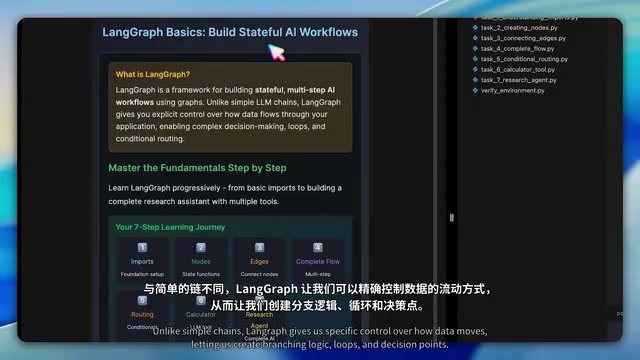
Conditional edges give the system looping and branching capabilities. For example, when a compliance score falls below 75%, an edge routes the flow back to a node that collects more documents; above 75%, it proceeds to generate the final report. This design enables iterative analysis loops, conditional branching based on intermediate results, and persistent state across the entire workflow.
MCP: A Universal Protocol for Connecting External Systems
When agents need to access customer databases, ticketing systems, inventory software, and other external systems, writing custom integrations for every API is expensive. MCP (Model Context Protocol) is similar to an API, but provides a "self-describing interface" that agents can autonomously understand and invoke, shifting the integration burden from developers to the AI itself.
The tutorial illustrates this with a CustomerDB server built using FastMCP: MCP server code only needs to be written once — and you may not even need to write it yourself. The community may have already built ready-to-use MCP servers for popular tools like GitHub, GitLab, and SQL databases, which you can plug in directly. A useful analogy: the MCP protocol is like a USB port, the server is the device, tools are the features, and LangGraph is the computer using those features. Multiple MCP servers can work together under a single agent — math problems go to the calculator, weather questions go to the weather service, with LangGraph intelligently routing between them.
MCP (Model Context Protocol) was proposed and open-sourced by Anthropic in November 2024, with the goal of becoming the industry-standard protocol for AI agents to interact with external tools and data sources. The traditional Function Calling approach requires developers to define tool JSON schemas separately for each LLM platform, and switching platforms means rewriting everything. MCP instead defines a model-agnostic universal interface specification: servers expose tools according to the spec, and any MCP-compatible client (Claude Desktop, LangGraph, Cursor, etc.) can call them directly — write once, run anywhere. MCP servers can run locally (communicating via stdio) or be deployed remotely (via HTTP/SSE), allowing enterprises to wrap sensitive internal resources like databases and ERP systems into local MCP servers, giving agents access while keeping data within the corporate network.
From Static Documents to a Dynamic Intelligent System
When context windows, vector databases, LangChain, LangGraph, MCP, and prompt engineering are integrated together, TechOp's document search drops from a 30-minute manual process to under 30 seconds, with accuracy significantly improved through semantic retrieval. Add a 24/7 chat interface, predictive analytics, and a proactive compliance agent, and the system can even surface solutions before employees ask.
The leap from static documents to a dynamic intelligent system isn't just a turning point for TechOp — it's the path any organization faces when trying to unlock the value of its own knowledge. This technical stack, spanning from LLM fundamentals to multi-agent workflows, is the universal skeleton of production-grade AI applications today.
Related articles

Free Unlimited Claude Code Solution: Agnes AI + CC Switch Setup Guide
No paid subscription needed — pair the free AI platform Agnes AI with the open-source tool CC Switch to provide a backend for Claude Code, enabling unlimited free calls to text, image, and video models. This guide covers the full setup, test results, and usage boundaries.

A Complete Zero-Cost Guide to Getting Started with Claude Code for Beginners in China
A beginner's guide to Claude Code for users in China: two installation methods (command line and IDE plugin), full configuration steps for replacing the official API with the free domestic LongCat model, and a hands-on demo of building a small tool with natural language, plus tips.

When the NSA Gets Involved: The AI Supply Chain Crisis Behind Open-Source CVEs and API Key Hijacking
Multiple open-source projects disclosed severe CVEs in one day, PHP flaws alarmed the FBI, and Railway and OpenCode were breached with API keys stolen. This article breaks down the vulnerability window, AI-accelerated exploitation, and the AI supply chain crisis behind the API key black market, with a developer defense checklist.