Claude vs GPT for AI Agents: The Gap Is Smaller Than You Think (2026 Field Test)
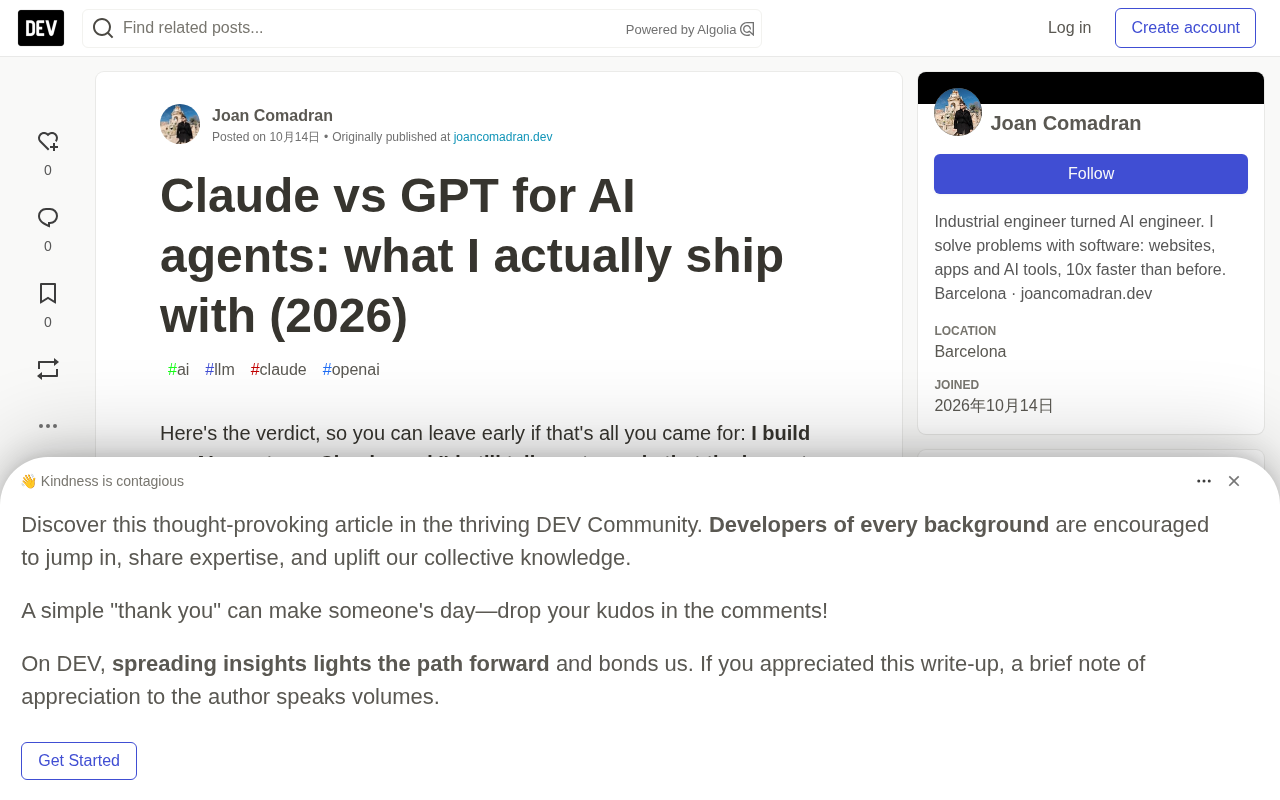
A frontline developer's retrospective: Claude and GPT are nearly indistinguishable for Agents in 2026, and cache control is the key selection factor.
This article is AI engineer Joan Comadran's production-based Agent selection retrospective, concluding that Claude and GPT differ far less than expected in real Agent work. As of October 2026, their pricing tiers line up almost exactly, both offering 1M-token context and strict tool schemas, with the only notable difference in long-context billing. The article identifies three dimensions that truly separate them: API shape (roughly a week of migration work), cache control granularity (the author's decisive reason for choosing Claude), and hosted tool ecosystem (OpenAI strong on voice and file search, Anthropic on web tooling and MCP). It also shares two production Agent designs and a selection checklist.
Claude or GPT for AI Agents? This hands-on retrospective from a frontline developer gives a counterintuitive answer: in most scenarios, the gap between the two is far smaller than you'd expect.
The author, Joan Comadran, is an AI engineer based in Barcelona whose every production Agent runs on Claude. But he readily admits this article isn't about picking sides—as of October 2026, the two vendors' pricing tiers line up almost exactly, both offer 1M-token context windows, both strictly enforce tool schemas, and both host web search server-side. The only real remaining choice dimensions are a few: API shape, cache control granularity, hosted tool ecosystem, and which model scores better on evals using your own tool schema.
The Pricing Table Has Become a Mirror Image
Start with a comparison table—all figures come from the two vendors' official pricing pages. For top-tier models, Claude Fable 5.1 and GPT-6 Astra are both $10 / $50 per million tokens. In the main workhorse tier, Claude Sonnet 5.5 and GPT-6.1 Sol are identical at $2 / $10. In the cheap high-concurrency tier, Haiku 5.5 and GPT-6 Luna both start at $0.10 / $0.50. Claude's exclusive Opus 5.5 fills the middle $4 / $20 slot.
The only pricing difference is in long-context billing: Anthropic charges standard rates for the full 1M-token window on current models (except Haiku 5.5 above 100K tokens), while OpenAI sets a separate, higher long-context rate for Astra, Sol, and Luna. If your Agent needs to stuff an entire codebase, contract, or long conversation into context, this difference needs to be accounted for upfront; if your prompts are only a few thousand tokens, it barely matters.
Both offer 50% batch discounts and discounted cached input. In other words, there's no real difference left on the rate card—your actual cost gap depends on how much context you re-send and how well you cache, not on unit price.
The Three Technical Dimensions That Actually Separate Them
API Shape: A Week of Migration Cost, Not a One-Line Config Change
On Claude, an Agent turn is a single Messages API call. If the model wants to call a tool, the response carries stop_reason: "tool_use" and one or more tool_use blocks; you execute the tool, then send back a user turn full of tool_result blocks.
On GPT, the latest models require the Responses API for tool calling: the output is a list of items, tool calls come back as function_call items, you send back function_call_output items, and you can optionally chain them via previous_response_id.
Neither is inherently better, but the difference is big enough that once you've built retries, caching, cost logging, and error handling around one of them, "just switch models later" actually means a week of engineering work, not a config tweak.
Messages API is Anthropic's conversational interface. It models input as a list of role-based messages (user / assistant alternating), and content blocks in the response can be text, tool calls, or images, with a stop_reason field that uniformly expresses "why the model stopped." This shape maps intuitively onto multi-turn conversation, and both tool calls and tool results are sent back as ordinary message blocks.
Responses API is OpenAI's interface for newer models, replacing the earlier Chat Completions. It models an interaction as a list of items, where tool calls and tool results are each their own item type, and it supports chaining turns via previous_response_id, with the server holding context for you. This "stateful" design simplifies the client, but it also means conversation state is partly hosted on the vendor side.
The core divide between the two is where state lives and what shape the data takes: the Messages API is stateless and sends the full history every time; the Responses API can be stateful with the server holding the chain. This directly affects retry logic, caching strategy, how cost logs are recorded, and whether you can do request-level canary rollouts across vendors. As a result, the infrastructure you build around one—retries, error classification, cache-hit stats, and so on—can't be ported to the other. That's also the root cause of "migration equals a week of engineering work."
Cache Control: The Decisive Difference
This is the key reason the author ultimately chose Claude. Claude lets you use cache_control breakpoints to precisely mark where a cacheable prefix ends (or you can let the API place them automatically). In a conversational Agent, where the system prompt is static and the history grows every turn, being able to explicitly say "cache up to here" means costs go from growing quadratically with conversation turns down to roughly linear growth.
OpenAI also offers substantial discounts on cached input, so this isn't a matter of "Claude has caching, GPT doesn't." The difference is how much control you have over the caching strategy.
Prompt Caching is the core mechanism for cost optimization in today's large model APIs. The principle: the server caches static content serving as a prefix in the request (system prompt, tool definitions, few-shot examples, etc.) keyed by content hash. On the next request, as long as the prefix is exactly identical, the already-computed KV Cache is reused directly instead of recomputing input tokens. The reason "exactly identical prefix" matters so much is that caching matches on a contiguous token-sequence prefix—any single-byte change invalidates everything after it.
cache_control breakpoints hand the developer control over "which segment can be cached." Claude lets you insert up to several breakpoint markers anywhere in the message array, explicitly telling the server "everything up to this point is a stable prefix." By contrast, OpenAI's caching is automatic (automatic prompt caching)—developers just need to ensure a consistent prefix to get a hit, and can't explicitly specify boundaries. The former offers greater control and is easier to slice precisely in complex Agents; the latter is more hands-off, but harder to tune when multiple dynamic segments are interleaved.
Cost going from quadratic to linear growth is caching's direct impact on conversational Agents: without caching, the Nth turn request must reprocess all history from the previous N turns, so cumulative input grows quadratically with turns; with prefix caching, each turn only processes the new portion, so cumulative input grows linearly with turns. This is also the key to whether a long-conversation Agent can keep per-session costs under control.
Hosted Tool Ecosystem: Deciding Scenario Fit
Both run web search server-side and support MCP. OpenAI offers hosted file search (with managed storage) and a full real-time voice model line—if you're building phone or voice Agents, this alone may be enough to decide it. Anthropic has server-side web search, web fetch, code execution, a tool-search tool for large tool sets, and a connector that can connect directly to remote MCP servers from the Messages API.
MCP (Model Context Protocol) is an open protocol defining how models discover and call external tools and data sources. It decouples "tool providers" (MCP Servers) from "model clients" (MCP Clients), so the same tool server can be plugged into models from different vendors, avoiding each vendor rewriting its own tool adaptation layer. Anthropic provides a connector in the Messages API to connect directly to remote MCP servers, and OpenAI also supports MCP on its platform side.
Server-hosted tools go one step further: tool execution happens entirely on the vendor's servers, and your app just receives results—no need to host your own index, deploy a vector database, or worry about tool execution sandboxes. For example, OpenAI's hosted file search handles file storage, chunking, indexing, and retrieval for you; the same goes for Anthropic's web search, web fetch, and code execution.
The trade-off with these hosted tools is: you save the cost of building infrastructure yourself, but you hand data and execution pipelines to the vendor. For teams without strict compliance constraints, it's a shortcut to shorter time-to-launch; for teams with data residency or audit requirements, you need to assess whether the data agreement covers them. This is also why the article lists "your company already has an OpenAI or Azure contract, data agreement, and monitoring" as one reason to pick GPT.
What Actually Runs in Production
Not one of the author's production Agents uses LangChain or the Vercel AI SDK—they all call @anthropic-ai/sdk directly, because those vendor-specific features are exactly what he relies on.
Claient is a multi-tenant WhatsApp lead Agent that tiers models by who's paying: when the platform pays, it uses only Haiku; when the tenant brings their own Key (BYOK), Sonnet or Opus becomes available. Replies run in a tool loop with three booking tools (check availability, book, reschedule). The author stresses that more important than model choice are two guardrails: a hard limit of 5 loop iterations, and a time budget—because a Serverless function getting killed mid-loop means the user receives the message but the webhook never completes, and Meta's retry sends it twice.
Lead extraction is a separate call that forces invocation of the registrar_lead tool, with nullable fields and lead temperature as an enum (cold, warm, hot). The author considers forced tool calling the most reliable way to get structured data out of a conversation; GPT can do the same thing with tool_choice plus strict mode.
Pollitics is deliberately split into two Claude calls: Sonnet 5.5 does research (server-side web search; most of the cost comes from input tokens reading pages, so let the cheap model read), and Opus 5.5 does drafting (structured output via JSON schema, where editorial nuance matters and input is small). The reason for two calls instead of one is that structured output doesn't carry search citations, so research comes back as text with URLs, and the drafter works from that.
The author's reasons for choosing Claude are specific and even a bit "boring": cache breakpoints match the architecture (static script plus growing history is exactly what explicit cache_control excels at), tiered routing within a single vendor, BYOK stays simple, and infrastructure like timing/retries/error classification/cost logging is written once on one SDK and reused. He calls this lock-in "my own, not the vendor's."
Forced tool use (tool_choice: required) is a common technique for reliably extracting structured data from free-text conversation. The approach: define a tool with an explicit schema, then force the model in the request to call it, rather than emitting natural language first and parsing it afterward. Since modern APIs support strict JSON Schema validation on tool arguments, the parameters the model returns naturally conform to field types and enum constraints, eliminating the fragile "regex extraction + retry patching" flow.
An SVM-style reliable substitute—more precisely, constraining the model's output space with enums and nullable fields: limit "lead temperature" to the three values cold / warm / hot, mark non-required fields as nullable, and the model can only choose from a finite set, making downstream branching deterministic. This pattern corresponds to tool_choice plus strict mode (strict schema) on GPT, and forced tool calling on Claude, with comparable results.
The Agent loop risk in Serverless environments deserves a separate warning: functions have execution time limits, and a tool loop terminated midway can produce an inconsistent state where "external side effects have already occurred (message sent, booking created) but the function didn't return normally." That's why the article's emphasis on "a hard limit of 5 loop iterations + a time budget" isn't just cost control—it's idempotency and consistency protection: limiting iterations makes the worst case predictable, and the time budget ensures a graceful exit before timeout.
Selection Checklist
Choose Claude: conversational or long-running Agents where context grows every turn; you need ultra-long context and don't want to pay long-context surcharges at the middle and top tiers; you want a clear cheap/workhorse/heavy ladder within one vendor to route tasks.
Choose GPT: you're building voice or phone Agents and need a first-party real-time model; you want hosted file search without running your own vector store; your company already has an OpenAI or Azure contract, data agreement, and monitoring.
Either way: build a small eval set from real conversations (20 examples is enough to start), run both sides on your actual tool schema before deciding; put model calls behind a single module of your own so future switches touch one file; limit loop iterations and spend from day one—no vendor is going to do that for you.
The point the author repeatedly stresses is worth remembering: "cheaper and newer" is just a hypothesis until your own conversation data says otherwise.
One-line Summary
A frontline developer's retrospective: Claude and GPT are nearly indistinguishable for Agents in 2026, and cache control is the key selection factor.
Paragraph Summary
This article is AI engineer Joan Comadran's selection retrospective based on production Agents, with the core conclusion that Claude and GPT differ far less than expected in real-world Agent work. As of October 2026, the two vendors' pricing tiers line up almost exactly, both offer 1M-token context and strict tool schemas, with the only significant difference in long-context billing. The article points out that what truly separates them comes down to three dimensions: API shape (migration cost between the Messages API and Responses API is roughly a week of engineering work), cache control granularity (the decisive factor in the author's choice of Claude, where explicit cache_control breakpoints bring conversation costs from quadratic growth down to linear growth), and hosted tool ecosystem (OpenAI is strong on voice and hosted file search, Anthropic on web tooling and MCP connections). The author also shares the tiered routing and two-stage call design of two production Agents, Claient and Pollitics, along with a selection checklist and engineering advice.
Related articles

M&M's Spent Millions Replacing Artificial Blue Dye — Why Is It So Hard?
Mars spent millions trying to replace artificial blue dye in M&M's with spirulina, but thick material clogs pipes and residue risks mold, forcing a full production-line rebuild. Here's the engineering behind the reformulation.
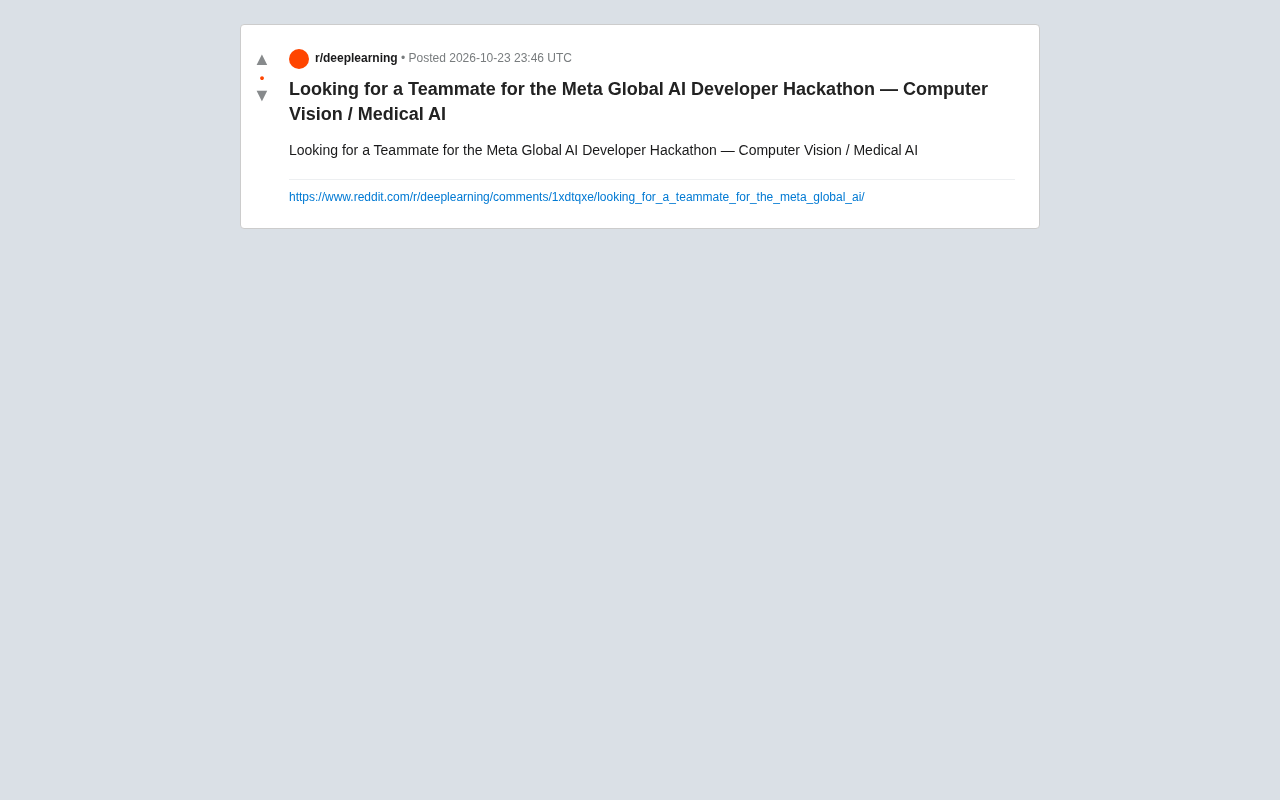
Teammate Wanted for Meta Global AI Developer Hackathon: Computer Vision & Medical AI
A Reddit developer seeks teammates for the Meta Global AI Developer Hackathon, focusing on computer vision and medical AI. This article analyzes the track logic, skills-complementarity needs, and topic selection strategy behind this teaming signal.
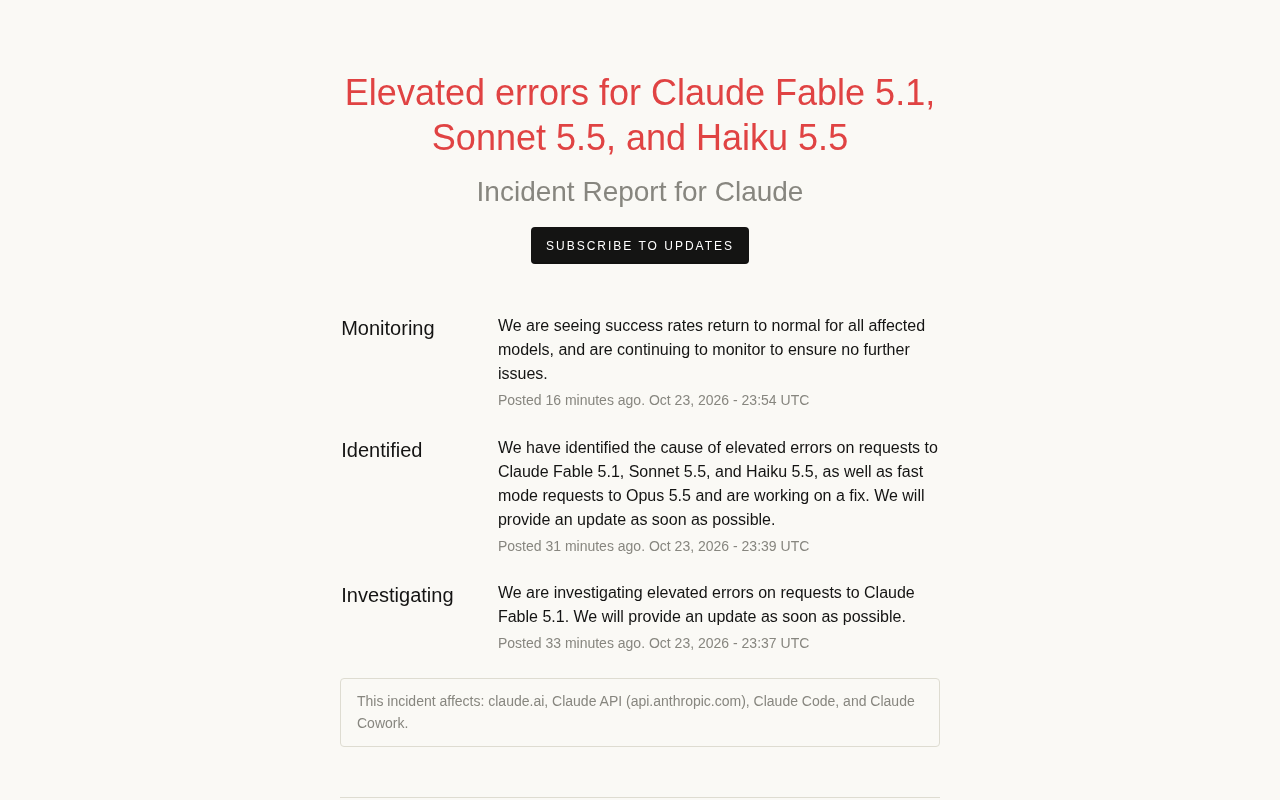
Multiple Claude Models Hit by Errors: A Postmortem of Fable 5.1, Sonnet 5.5, and Haiku 5.5
Claude Fable 5.1, Sonnet 5.5, Haiku 5.5, and Opus 5.5 fast mode saw elevated errors; Anthropic identified and resolved the issue in 17 minutes. This postmortem covers the timeline, the technical reasons for the multi-model cascading failure, and practical lessons for retry and degradation strategies.