Deconstructing a Real AI Agent: Architecture Practices for a LangGraph-Based Learning Assistant
A real-world AI learning assistant decoded: LangGraph, GraphRAG with Neo4j, and career insights for AI developers.
This article uses the Mashibing Education Learning Assistant as a case study to break down a production AI agent that has gone through four iterations. Built on Python and LangChain/LangGraph, it combines MinIO, Redis, and Neo4j to implement a GraphRAG architecture that overcomes the relational blind spots of pure vector search, alongside multi-role style simulation. The article also highlights how technical interviews have shifted toward deep dives into real projects, and introduces the FDE role as an emerging high-compensation path for developers who can bridge engineering and business deployment.
A Real, Production-Ready AI Learning Assistant
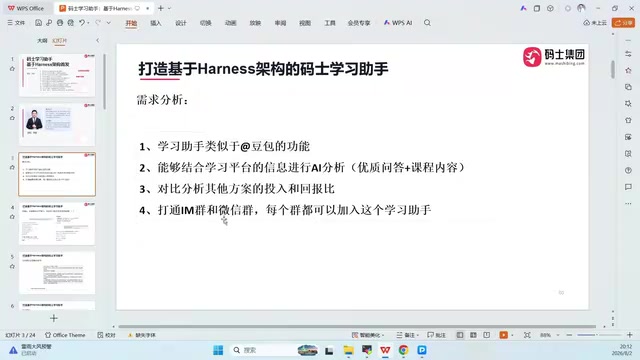
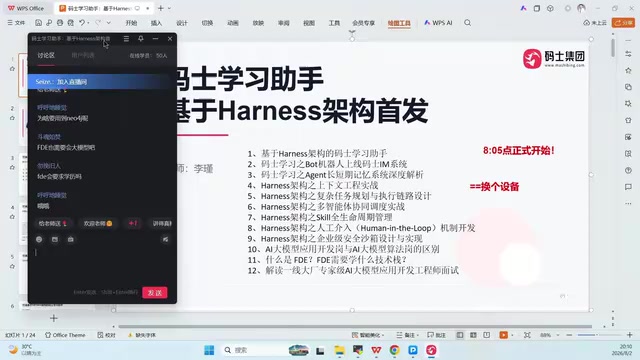
Many developers learning AI agent development get stuck building demos that can only answer simple questions, never crossing the threshold into real-world projects. This article uses the Mashibing Education Learning Assistant — shared by Bilibili creator Li Jin (known as "Lao Li") — as a case study to break down a live, continuously iterated AI agent and examine what an intelligent agent actually looks like in a real business context.
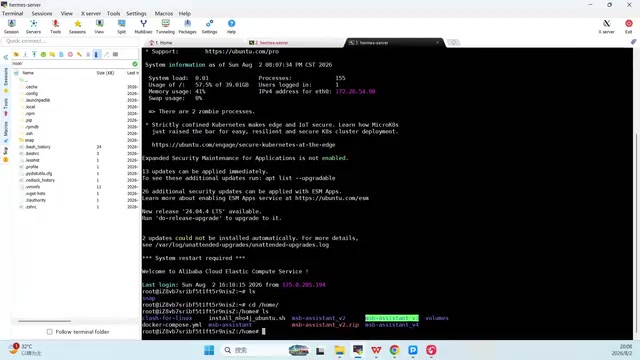
According to the creator, this learning assistant is deployed on a production server and has gone through multiple upgrade cycles from version one to version four. It's not an isolated chatbot — it's deeply integrated with the entire learning platform. Users on the platform have clearly defined roles (teacher, student, VIP, non-VIP), and the learning assistant is added as a system participant to various study groups, acting as an intelligent Q&A and analysis assistant similar to Doubao.
What's particularly notable is its capability evolution: starting from answering only basic questions, to structurally breaking down multi-turn user queries (handling questions one by one in sequence), and eventually learning to replicate different teachers' response styles. This kind of "multi-stage upgrade" reflects a key pattern in real AI agent development — features accumulate incrementally, growing more complex over time.
Tech Stack Breakdown: LangGraph + Multi-Component Orchestration
The project's core stack is built on Python with the latest versions of LangChain/LangGraph, layered with multiple middleware and storage components to form a complete AI agent backend.
Several key components can be identified from the shared content:
Storage and Retrieval Layer
- MinIO: Serves as object storage for unstructured data such as files and documents.
- Redis: Provides caching and session management for the learning assistant, supporting high-frequency read/write operations and context management.
- Neo4j: The most significant component in the entire architecture — worth unpacking in detail.
Why Introduce Neo4j for a Knowledge Graph
Lao Li placed particular emphasis on Neo4j's role in RAG (Retrieval-Augmented Generation). He pointed out that using only text chunking combined with vector retrieval tends to lose critical relationships when dealing with highly relational information.
For example, knowledge concepts often have hierarchical, causal, or subordinate relationships that pure vector similarity search struggles to reconstruct. By building a knowledge graph with Neo4j — explicitly modeling entities and relationships — retrieval accuracy improves significantly. This is a classic implementation of the "GraphRAG" approach seen in advanced RAG architectures: vector retrieval handles semantic recall, while the graph handles relational reasoning, with the two complementing each other.
GraphRAG is a structured enhancement to the traditional RAG pipeline. Traditional RAG splits documents into chunks, generates vector embeddings for each chunk, retrieves the most semantically similar chunks via cosine similarity, and feeds them into a prompt for the LLM to generate an answer. This works well for isolated factual Q&A, but once you encounter relational knowledge like "A depends on B, and B is a subset of C," pure vector retrieval often misses critical intermediate nodes, leading to incomplete or logically flawed answers.
GraphRAG's core idea is to maintain a knowledge graph alongside the vector index: extract entities and relations from documents and store them as nodes and edges in a graph database (Neo4j in this project). During retrieval, vector search first identifies candidate nodes, then multi-hop graph traversal brings in related entities for context. This preserves the advantages of semantic similarity while restoring the structural dependencies between concepts — especially valuable for course knowledge systems and technical concept hierarchies.
Multi-Role Style Simulation
The project also features an interesting design: when users @ different teachers in a group, the learning assistant identifies the intent, retrieves knowledge from the corresponding teacher's backend data, and responds in that teacher's style. For instance, if a user tags two teachers simultaneously, the assistant detects that the user wants a response combining one teacher's knowledge domain with another's communication style. This is essentially a combination of role-based agents and personalized knowledge bases.

Why Interviewers Favor "Complex, Real-World Projects"
A recurring observation in the presentation concerns the job market: the direction of technical interviews has shifted away from rote memorization toward deep dives into real projects.
Based on Lao Li's experience, aside from top-tier internet companies that still test foundational knowledge, most companies prefer candidates who can present one or two complex, genuine projects. If a resume features a compelling project with a clear architecture, interviewers will often spend most of the session drilling into it, asking relatively little about everything else.
The reasoning is straightforward: a candidate who can articulate multi-component orchestration and explain "why Neo4j instead of pure vector search" demonstrates real engineering judgment — not just memorization ability. As a result, clearly documenting the architectural decisions, technology selection rationale, and iteration history of an AI agent project is far more valuable than grinding LeetCode.
FDE: A High-Paying Career Direction Worth Watching
The presentation also introduced the FDE (Forward Deployed Engineer) role. According to the speaker, this position has some educational requirements, but doesn't necessarily require a master's degree, PhD, or elite university background. Compensation is strong: management-track roles can reach ¥2M+, while base-level development positions start around ¥600K, with very few falling below ¥500K.
It's worth noting that these salary figures come from a single anecdotal source and have not been independently verified — readers should treat them as directional reference only. The core value of an FDE lies in combining technical development skills with the ability to deeply engage with customer business scenarios and drive implementation — a capability requirement that aligns closely with the ability to build real, complex projects.
The FDE (Forward Deployed Engineer) role was first popularized by Palantir and has since spread across AI infrastructure and enterprise software companies. Unlike traditional backend or algorithm engineers, FDEs focus on working on-site or in deep collaboration with customers, adapting general-purpose products and platforms into solutions tailored to specific industries or internal workflows. This requires both solid engineering execution (writing deliverable code quickly) and strong business analysis and communication skills (distilling actionable technical specifications from ambiguous customer requirements).
In the era of AI agents, demand for FDEs is rising rapidly — enterprises that purchase LLM APIs or agent platforms often need someone to embed those capabilities into their ERP, CRM, or internal knowledge bases, and that's precisely where FDEs deliver value. For developers with hands-on AI deployment experience, this path carries significant earning potential.
Closing Thoughts: Real Projects Are the True Currency
The biggest takeaway from this case study isn't any specific framework — it's the path it illustrates from demo to production: multi-version iteration, multi-component orchestration, graph-enhanced retrieval, role-based style simulation, and deep integration with a business platform.
For anyone looking to enter or advance in AI development, the more valuable approach is to go deep on a single real project rather than chasing every new framework. Be able to clearly explain the "why" behind every technical decision. That's the real foundation for both interviews and long-term career growth.
Related articles

LynnReal-Omni: 32B Unified Video Diffusion Model Goes Open Source with Multi-Task Coverage in Four Steps
LynnReal-Omni is a 32B unified video diffusion model on MiniMax H3, covering text-to-video, pose guidance, style transfer, restoration in 4 steps. Flash version generates 540p video in 377ms on one H100.

Anthropic Co-Founder: AI 'Kill Switch' May Need to Be Mandatory by Law
Anthropic's co-founder tells the BBC that AI 'kill switches' may need to be legally mandated. We analyze the industry logic, technical challenges, and the tension between regulation and innovation.

The AI Data Center Boom Is Colliding With Cities Scarred by Heavy Industry
The AI data center boom is clashing with post-industrial communities. Philadelphia's case reveals structural conflicts between AI growth, energy use, water, and environmental justice.