Deploying Enterprise AI Agents to Production: The Five Pillars from Demo to Launch

The five pillars for taking enterprise AI Agents from demo to production, with a real banking chatbot POC case.
A Databricks expert systematically breaks down the methodology for deploying enterprise AI Agents to production, revealing the three fatal gaps of observability, evaluation, and governance, and detailing five pillars—the evaluation system, observability tracing, data foundation, multi-Agent orchestration, and AI governance—illustrated with a real eight-week banking chatbot POC.
Over the past two years, nearly every enterprise has wanted to do something with AI. Pressure from the top pushes teams to quickly build demos, but once these demos actually go live, they often fall into a predicament no one can explain—why isn't the AI answering as expected? Why does its live performance fall so far short of the demo?
In a talk, Sandy, Data and AI Technical Lead at Databricks, systematically broke down a complete methodology for taking enterprise-grade Agents from demo to production. He previously served as Principal Architect for Data and AI at AWS for five years, and over the past two years has focused on helping customers in heavily regulated industries such as B2B software and finance deploy AI systems. Based on his frontline hands-on experience, this article distills the five pillars enterprises must consider when building reliable AI Agents.
From Demo to Production: Three Fatal Gaps
Sandy observed that two years ago, nearly every customer conversation opened with "which model should we choose"—GPT or Claude? That wasn't wrong in itself, because models were brand-new technology at the time. Once teams picked a model, they built features in a controlled environment (predictable datasets, limited scenarios), the demo looked great, leadership signed off, and it was pushed to production. But a few weeks later, the doubts followed: "What is the AI actually doing?" The result was not only zero ROI, but a loss of money and effort.
From countless project retrospectives, he distilled three key gaps:
- The Observability Gap: If you can't see what the AI is actually doing, and can't trace every one of its decisions, then it's worthless in production.
- The Evaluation Gap: Teams talk about accuracy, latency, and reliability, yet never define "what metrics truly matter to the business," nor build a system to continuously measure them.
- The Governance Gap: No one thinks about who is accountable when the AI fails in production—who to call when something breaks at 3 a.m., or how to respond when the AI gives customers incorrect information.
Background: Why is observability especially critical for AI systems? Observability originated in cybernetics and was later widely adopted in software engineering, typically consisting of three pillars: Logs, Metrics, and Traces. However, observability for AI Agent systems is far more complex than for traditional software: an Agent's decisions are probabilistic and non-deterministic, and the same input may produce different outputs. Its reasoning chain involves multi-step tool calls, context window management, and vector retrieval—dynamic processes that traditional logging systems struggle to fully capture. This is precisely why LLM tracing tools (such as MLflow Tracing, LangSmith, Langfuse, etc.) rose rapidly after 2023—enterprises urgently need dedicated observability infrastructure capable of "reading" the AI's decision-making process.
These three insights ultimately gave rise to the framework below, which has been deployed across multiple enterprises.
Pillar One: The Evaluation System—Define Success First
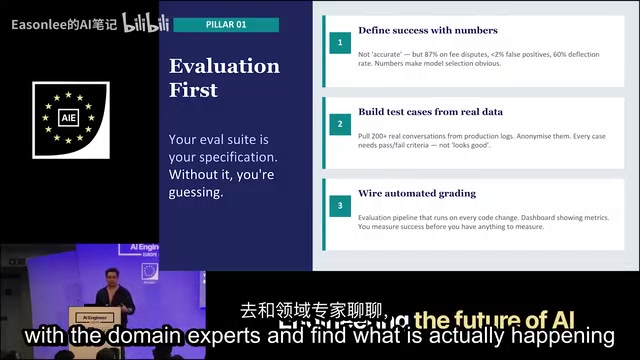
Sandy emphasizes that before touching any code or discussing any model, you must first figure out: how do you measure success? Evaluation is essentially the "specification document" for an AI system.
The key is to define success with concrete numbers, not vague talk of accuracy. Take a banking chatbot as an example: the core goal is "deflection"—handing simple queries to the Agent to free up human agents. So you need to clearly track: what percentage of simple queries can be successfully deflected.
The second step is building a "Golden Dataset": work with domain experts to collect standard human-agent responses in real-world scenarios, focusing on edge cases, then set up an automated testing pipeline so that live responses can be scored in real time against the test set.
The Three Layers of Evaluation
When building an evaluation system, Sandy divides it into a three-layer architecture:
- Deterministic Layer: Format validation, regular expression checks, plus traditional ML for named entity recognition, intent classification, and PII detection. These methods are cheap and mature, and should be tackled first.
- Semantic Layer: Introduce "LLM as a Judge"—use an independent judge model to evaluate the main model's output, assessing safety, reliability, and relevance. Databricks' MLflow already supports automatically running custom LLM judges on trace data.
- Behavioral Layer: Check whether tool calls are correct and whether loops exist. Sandy gives an example: a user queries their account balance, the Agent answers correctly, and on the surface all is well—but the behavioral layer reveals the Agent actually made three duplicate calls to the database. This doesn't matter in a demo environment, but in production with thousands of queries a day, duplicate calls are real, wasted cost. He specifically notes that this layer is often the most overlooked.
Background: The technical principles and limitations of "LLM as a Judge" "LLM as a Judge" is an evaluation paradigm that emerged in the second half of 2023, with its theoretical foundation laid by research such as MT-Bench and Chatbot Arena published by Stanford University. The core idea: since human annotation is extremely costly and hard to scale, while traditional string-matching metrics like BLEU/ROUGE cannot measure semantic quality, a separate powerful LLM (usually GPT-4 or Claude) is used to score the output of the model being evaluated. Studies show that agreement between LLM judges and human experts can exceed 80% on many tasks. But this method has known limitations: judge models exhibit "position bias" (tending to give higher scores to answers listed first), "verbosity bias" (tending to give higher scores to longer responses), and self-preference issues. Therefore, real-world deployment requires carefully designed evaluation prompts and systematic calibration.
Pillar Two: Observability—Trace Every Decision
The core of observability is tracing—completely recording the entire decision chain the Agent makes. Sandy illustrates with a real retail banking chatbot case:
After a user submits the request "I was charged an overdraft fee, can I get it waived?", the Agent's processing chain proceeds as follows: intent classification (recording latency and confidence) → calling the customer database API to fetch account details → retrieving overdraft policy documents from a RAG vector database → reasoning to generate a response → guardrail checks → replying to the customer.
Without a visualized tracing system, when a customer raises a dispute, there is no way to reconstruct the AI's decision-making process, and you're ultimately left with no choice but to offer compensation. This is also why regulators mandate tracing capabilities—in Europe and many heavily regulated industries, an AI system simply cannot go live in compliance without a complete observability framework.

The value of tracing goes beyond post-incident investigation; it also supports real-time online monitoring. When duplicate calls or call failures occur in production, fallback strategies can be triggered immediately: retry failures up to three times, and if exceeded, automatically escalate or hand off to a human.
Pillar Three: The Data Foundation—A Severely Underestimated Core Engineering Task
Sandy admits that in a typical project, he spends 60% of his time on the data foundation. The reason is straightforward: data has long been designed for humans, and humans have tolerance for errors—if a report has incorrect data, you just find someone to fix it. But an Agent has no such tolerance; it will confidently output wrong answers, and you'll be none the wiser. This makes data quality and data governance strategy more critical than ever.
He categorizes the data AI needs into two types:
- Question Data: The data that supports the AI answering questions, including pre-training data, post-training data, and real-time business data accessed via APIs.
- Tracking Data: Observability data, which requires dedicated planning for how it is collected, how it will be provided to auditing and regulatory bodies, and how it supports online monitoring and the operation of LLM judges.
Databricks' Data Foundation Architecture
Databricks is built on open-source technologies such as Apache Spark, MLflow, and Delta Lake, using a layered architecture: the underlying cloud storage (supporting AWS, Azure, GCP) → the Delta Lake layer, which gives raw data database-like properties → Unity Catalog, a unified data catalog that centrally manages permissions, data sharing, and metadata tags. Once tables and columns are tagged with descriptive labels and PII labels, AI queries can obtain more accurate context, effectively reducing hallucinations.
Background: How Delta Lake and Unity Catalog serve AI systems Delta Lake is an open-source storage layer format from Databricks, built on top of Parquet files, that endows the otherwise static data lake with database-grade features such as ACID transactions, version rollback (Time Travel), and schema evolution—solving the pain points of traditional data lakes being "easy to write but hard to read, with no data quality guarantees." Unity Catalog is Databricks' unified data governance layer, capable of uniformly managing permission controls, lineage tracking, and metadata tags for data assets across workspaces and cloud platforms. For AI systems, column-level descriptive tags (such as "this field is customer net worth, denominated in USD") and PII tags (such as "this field contains ID numbers") can be injected into prompts as context, helping the model understand data semantics more accurately and fundamentally reducing hallucinated outputs caused by ambiguous field meanings.
For tracking data strategy, enterprises often run multiple frameworks (such as LangChain) and multiple cloud platforms simultaneously, so they need a centralized aggregation layer that collects all trace data uniformly, then distributes it to different scenarios such as operations dashboards, frontline support, and health monitoring.
Pillar Four: Multi-Agent Orchestration
When a single Agent works well, orchestration isn't a concern—but once you introduce five Agents into a system, complexity climbs exponentially, as they need to coordinate with one another and wait for each other's responses. Sandy introduces three core orchestration patterns:
- Orchestrator-Worker Pattern: A central orchestrator coordinates and distributes tasks to specialized Agents, with all requests flowing through it. The advantage is centralized control—when problems arise, you can directly consult the orchestrator's logs to pinpoint them.
- Choreographic Pattern: Each Agent is autonomous and independent, all connected to a message bus, listening for the events they care about. They can run in parallel without blocking each other, thereby reducing overall latency. For example, in a mortgage approval scenario, one Agent handles customer information verification while another processes approval details in parallel.
- Human-in-the-Loop: When an Agent's confidence falls below a preset threshold, a human decision-maker is brought into the workflow for review.
Background: The architectural origins of the orchestration and choreography patterns The distinction between the Orchestrator-Worker pattern and the Choreography pattern originally comes from the classic classification of service coordination approaches in the microservices architecture field. In microservices design, Orchestration emphasizes active scheduling by a central controller, similar to a symphony conductor; Choreography emphasizes services responding autonomously via an event bus, similar to dancers each moving to the music. When introduced into multi-Agent systems, both patterns have pros and cons: the orchestrator pattern is easier to debug (logs are centralized), but the central orchestrator can become a performance bottleneck and single point of failure; the choreography pattern natively supports parallelism and lower latency, but tracing distributed event chains becomes far more complex. The Saga pattern and the circuit breaker pattern, meanwhile, come from the fault-tolerance design of distributed systems, specifically addressing compensation and degradation when cross-service transactions fail.
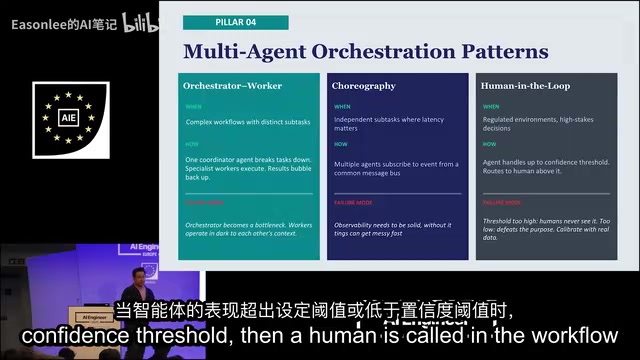
Sandy also recorded in-depth content specifically on multi-Agent orchestration, covering state management, fault-tolerance mechanisms (Saga pattern, compensation pattern, circuit breaker pattern), and enterprise-grade scaling strategies.
Pillar Five: AI Governance—Who Is Accountable When It Fails
AI governance (distinct from data governance) centers on several dimensions:
- Regulatory and Audit Trails: Have you completely recorded every action, every user connection, every request?
- PII Pre-Screening: Intercept sensitive personal information on the input side via named entity recognition. Sandy revealed that during the testing phase of the aforementioned banking project, this layer alone detected 47 PII leaks.
- Prompt Version Management: Prompts must be treated as formal code, brought into a complete change management process, rather than casually modified and simply committed to Git.
- Model Change Management: Model vendors continuously iterate and upgrade, and enterprises need a mechanism to determine whether a new model is suitable for their own business. The benchmark scores published by vendors are often of little reference value in a specific enterprise scenario—only by testing different models with your own evaluation dataset can you select the one truly suited to your business data. From a risk-control perspective, you must never form a strong dependency on a single model.
Background: The engineering practice of Prompt version management Prompt engineering underwent an evolution from "personal skill" to "engineering discipline" between 2022 and 2023. Early practitioners treated prompts as freely adjustable text snippets, but as enterprise production systems advanced, this loose management approach exposed serious problems: a single unrecorded prompt modification could significantly degrade a previously well-functioning feature, and because of the probabilistic nature of LLM outputs, the problem often doesn't surface immediately but is only discovered through user feedback after accumulating over time. The industry has now established relatively mature practices: use dedicated prompt management tools (such as PromptLayer, LangSmith Prompt Hub) for versioned storage; every change must record the reason for modification, the associated failed test case ID, and the expected improvement; in the CI/CD pipeline, prompt changes should automatically trigger regression tests against the golden dataset, and only pass the threshold before merging—this essentially operationalizes the "Prompts as Code" philosophy into executable engineering standards.
Case Study: An Eight-Week POC for a Banking Chatbot
This case best demonstrates the practical value of the framework above. The customer had previously invested about $85,000 over six months to complete a POC that ultimately failed—no one knew why it failed in production, results couldn't be quantified, and no one was accountable.
The bank handles about 20,000 chat inquiries per month, of which 60% are simple queries like "check balance" and "what to do about an overdraft." The goal this time was to have an AI Agent handle those 60% of simple queries with 85% accuracy, while meeting operational metrics such as latency.
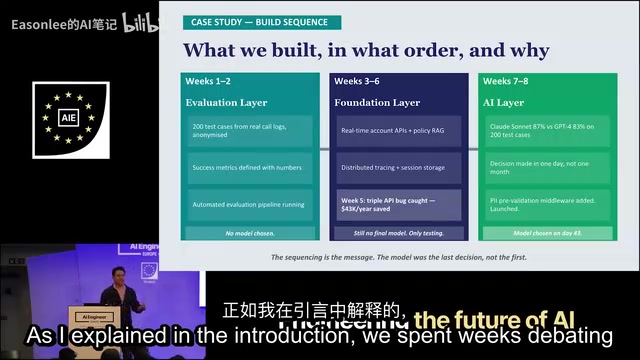
The most critical shift in this eight-week POC was: the model wasn't selected until week seven.
- Weeks One and Two: Build the evaluation layer. Collect 200 samples of real human-agent responses, establish an evaluation dataset, define business success metrics, and set up an automated evaluation pipeline.
- Concurrent with Week Two: Build the data foundation layer, confirming that API connections, tracing capabilities, and secure storage are all in place. It was at this stage that the team discovered and captured the duplicate API call problem.
- Weeks Seven and Eight: Only then did model selection begin. With the evaluation dataset in hand, comparing different models' outputs against expected answers and computing accuracy made the selection decision quick.
Six weeks after going live, the team not only tracked metrics like accuracy, deflection rate, response time, and CSAT, but also validated the value of the observability framework: after the bank adjusted its interest rate policy, customer inquiries began receiving wrong answers, and users flooded in with negative reviews. With the tracing system, the team quickly pinpointed the root cause—the vector embeddings for the new policy documents hadn't been updated to the database in time, causing the Agent to continuously cite outdated content. The problem was then precisely fixed.
Background: The importance of vector embedding freshness in RAG systems Retrieval-Augmented Generation (RAG) is currently the most mainstream knowledge-access architecture in enterprise AI applications, formally proposed by Meta AI in a 2020 paper of the same name. Its core mechanism: enterprise documents are chunked, converted into high-dimensional vectors via an embedding model, and stored in a vector database. When a user queries, the system vectorizes the question as well, uses approximate nearest neighbor (ANN) search to find the most semantically relevant document chunks, then splices these chunks into the prompt for the LLM to generate an answer. RAG can effectively reduce hallucinations and lower the cost of fine-tuning on private-domain knowledge, but its quality depends heavily on the freshness of content in the vector database—as this case shows, when business policy updates but the vector store isn't synced, the Agent will continuously cite outdated information, and output it with high confidence, making the problem hard to detect quickly. Therefore, the "vector store update and synchronization strategy" is a critical, non-negligible aspect of RAG system operations.
Sandy emphasizes one key concept: the evaluation dataset is a living system. Starting from 200 cases, it continuously expands as production runs—the larger the dataset, the more accurate the evaluation.
The Production Incident Playbook and Three Practical Lessons
Sandy shared a "Production Incident Playbook," a step many AI projects tend to overlook: Detect (monitoring dashboards) → Diagnose (trace back to source) → Contain (prompt version rollback, hand off to human, fault-tolerant recovery) → Fix (based on the LLM judge report and evaluation dataset) → incorporate the new test case into the dataset. The entire workflow also needs to integrate with the enterprise's existing ITSM alerting system.
He concluded with three often-overlooked practical lessons:
- The test case library needs governance: As it continuously grows in scale, you need clearly assigned owners and proper categorization (such as security-related and login-related issues) to quickly locate relevant changes during a failure.
- Prompt changes must be fully documented: Git commit messages can't be perfunctory; they must record what was changed, why it was changed, which failed case it fixed, and what the next version plans to correct.
- Behavioral-layer evaluation costs need to be controlled: As the dataset grows, running the full test suite for every tool-call modification becomes expensive. It's recommended to run only a subset of tests in the CI pipeline, and execute the full evaluation only when merging into the main branch.
As for immediately actionable next steps, Sandy's advice is concise and powerful: define success from a business perspective, collect a few "good answer" samples to build an evaluation dataset, then use simple Python code to build an automated comparison pipeline. Make AI visible, measurable, and accountable—this is the true prerequisite for enterprise-grade Agents to genuinely reach production.
Key Takeaways
Related articles
What Is Vibe Coding? The AI Programming Skill Every Developer Needs
What is Vibe Coding? Learn how AI programming is reshaping dev teams, why traditional programmers face displacement, and why Cursor & Claude Code matter.
Making Rocks Think: A Philosophical Exploration of Generative AI and Information Compression
From a viral Reddit post to deep AI theory: why compression equals understanding, the Library of Babel thought experiment, semantic compression, and the Hutter Prize.
Irregular Warns: Four AI Lab Security Breaches Traced to the Same Root Cause
Irregular reveals four AI lab security breaches share a single root cause, exposing systemic risks from technology stack homogeneity across the AI industry.