From RAG to Multi-Agent: How Developers Can Actually Ship Enterprise-Grade AI Agents

From prompt engineering to multi-Agent: a clear progression path for enterprise LLM development.
This article, drawing on insights from a Bilibili creator, maps out the capability ladder in LLM application development. Prompt Engineering and RAG stay within a question-and-answer paradigm; Agents leap into active execution — enabling autonomous planning, tool calling, and decision-making that enterprises actually need. The piece also calls out two common flaws in Agent tutorials: opening with jargon before establishing a framework, and teaching learners to copy code without understanding principles or business adaptation. The correct learning path runs from design logic through to full-cycle deployment.
Why AI Agents Deserve Your Full Attention Right Now
LLM application development is undergoing a capability stratification. In the early days, knowing Prompt Engineering and basic RAG (Retrieval-Augmented Generation) was enough to give developers the impression that they could "build LLM projects." But when it comes to job hunting and real-world deployment, the ceiling on that skill set reveals itself quickly.
According to a Chinese Bilibili content creator, a large number of learners have shared the same frustrating experience: they memorize prompt templates, get a simple RAG system running, and assume they're ready to build enterprise-grade applications. Then a company asks whether they can build something that automatically processes orders, follows up with customers, or generates quotes — and they draw a complete blank.
The root cause is a misalignment of technical boundaries. Prompt Engineering and RAG both address the core question of "can we get the LLM to answer questions well?" — whereas Agent development addresses an entirely different level of problem: "can we get the LLM to think proactively and solve problems autonomously?" The former is passive response; the latter is active execution. As companies push hard on efficiency and cost reduction, the ability to automatically run end-to-end business workflows is precisely what real projects demand.
Two Fatal Shortcomings in Most Agent Tutorials
The creator puts it bluntly: 99% of Agent tutorials on the market fail to teach genuine practical skills. He calls out two pervasive pitfalls.
Getting It Backwards: Piling on Jargon Before Building a Framework
The first shortcoming is opening with a barrage of technical terms. Tool calling, task planning, memory mechanisms, ReAct framework — beginners get buried under these concepts before anyone has laid out the overall architecture. The result: learners are dizzy with jargon before they've even gotten started, and they give up.
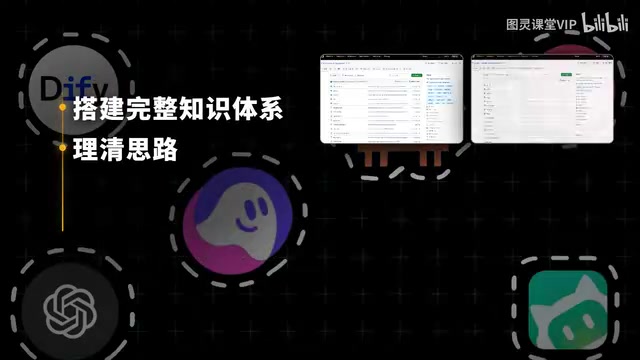
The right sequence is understand the logic first, then build the project. Before you grasp why an Agent is designed the way it is, any framework name is just an empty shell. Constructing a complete mental model and clarifying your thinking is the prerequisite for tackling real projects.
RAG (Retrieval-Augmented Generation) works like this: when a user asks a question, the system first retrieves relevant document chunks from an external knowledge base (such as a vector database), injects those chunks into the prompt, and then has the LLM generate an answer. It addresses the LLM's knowledge cutoff and hallucination problems, enabling the model to reference private or up-to-date domain knowledge. However, RAG is fundamentally still a passive, single-turn question-and-answer pattern — it extends the model's knowledge boundary but does not give the model the ability to proactively plan or execute multi-step tasks in sequence. Understanding this dividing line between RAG and Agent is the core benchmark for assessing whether your skill level has truly reached enterprise project requirements.
Chasing Quick Wins: Running Code Without Understanding It
The second shortcoming is the "learn Agents in 10 minutes" or "build an Agent with a single code snippet" style of tutorial. The creator's verdict is blunt: this is completely unrealistic and purely misleads beginners.
Following a tutorial to get code running is, in essence, just replicating a finished product. You don't understand the underlying principles, you can't tune it, and you don't know how to adapt it to a business context — change the scenario and it falls apart entirely. This style of learning leaves you at zero after you're done, unable to independently ship anything. Real capability means owning the complete loop: from requirements analysis and solution design all the way through to deployment.

The Capability Progression: From RAG to Multi-Agent
To appreciate the value of Agents, you need to see where they sit in the overall technology stack.
Prompt Engineering is the first layer — it optimizes output quality for individual interactions. RAG is the second layer — by connecting an external knowledge base, it makes the model's answers more accurate and domain-appropriate. Both of these layers remain within the "question-and-answer" paradigm: the user asks, the model answers.
Agents leap into the "execution" paradigm. They give an LLM the ability to plan tasks, call tools, maintain memory, and make autonomous decisions. A mature Agent can decompose "automatically process an order" into multiple steps, execute them sequentially, and adjust based on feedback.
Multi-Agent systems take this even further. Multiple agents, each with distinct responsibilities, collaborate — covering perception, planning, execution, and validation — to run complex enterprise business workflows end to end. This is precisely what companies mean when they talk about "cutting costs and improving efficiency": not a simple RAG system, but an automated system capable of replacing or augmenting an entire business pipeline.
The ReAct framework (short for Reasoning + Acting) is one of the most widely adopted reasoning paradigms in current Agent implementations. Its core idea is to have the LLM alternate between "Thought" and "Action" steps while executing a task, observing environmental feedback (Observation) after each action before deciding on the next thought and action. This cyclical mechanism enables Agents to handle complex tasks that require multi-step reasoning, rather than producing a one-shot answer. Compared to pure prompt engineering, the ReAct framework gives the model the ability to dynamically adjust its strategy — and it's the key entry point for understanding what "active execution" in an Agent really means.
Common role patterns in multi-Agent systems include: an Orchestrator (responsible for task decomposition and scheduling), Worker Agents (responsible for specific tool calls), and a Critic Agent (responsible for result evaluation and error correction). These roles collaborate via message passing or shared state, forming an automated pipeline akin to an assembly line. Frameworks such as LangGraph, AutoGen, and CrewAI are the leading choices for implementing multi-Agent systems today — each with its own strengths, and the right pick depends on your business complexity and team's existing technology stack.
A Few Practical Reminders for Learners
With this hands-on perspective in mind, here are four criteria worth keeping in mind when evaluating tutorial quality:
- Does it explain the logic before introducing frameworks, rather than opening with jargon?
- Does it walk you through the complete workflow, from requirements analysis to production deployment?
- Does it emphasize tuning and business adaptation, rather than stopping once the code runs?
- Is it transferable to different scenarios, rather than being locked to a single case study?
One caveat worth noting: the source material for this article comes from a single course promotional video, and the core arguments are primarily methodological — they don't cover specific code implementations, framework selection trade-offs, or detailed project case studies. For developers who want a systematic introduction, the "understand principles first, then build hands-on" learning path advocated here is fundamentally sound. But real capability can only be forged through repeated iteration on complete, end-to-end projects.
Related articles

Free Unlimited Claude Code Solution: Agnes AI + CC Switch Setup Guide
No paid subscription needed — pair the free AI platform Agnes AI with the open-source tool CC Switch to provide a backend for Claude Code, enabling unlimited free calls to text, image, and video models. This guide covers the full setup, test results, and usage boundaries.

A Complete Zero-Cost Guide to Getting Started with Claude Code for Beginners in China
A beginner's guide to Claude Code for users in China: two installation methods (command line and IDE plugin), full configuration steps for replacing the official API with the free domestic LongCat model, and a hands-on demo of building a small tool with natural language, plus tips.

When the NSA Gets Involved: The AI Supply Chain Crisis Behind Open-Source CVEs and API Key Hijacking
Multiple open-source projects disclosed severe CVEs in one day, PHP flaws alarmed the FBI, and Railway and OpenCode were breached with API keys stolen. This article breaks down the vulnerability window, AI-accelerated exploitation, and the AI supply chain crisis behind the API key black market, with a developer defense checklist.