From Single Agent to Multi-Agent: A Complete Guide to Enterprise AI Agent Development

A practical course for building enterprise AI Agents, from low-code tools to LangChain and LangGraph.
This Bilibili course tackles the core problem that LLMs can generate but can't execute, proposing AI Agents as the solution. It runs two parallel tracks — low-code platforms (Coze, Dify, n8n) for rapid prototyping and code frameworks (LangChain, LangGraph) for deep enterprise customization — covering MCP protocol, nine real enterprise job functions, and four capstone projects including a CrewAI lead scoring system, LangGraph meeting tracker, Coze video pipeline, and n8n global intelligence system.
Why Large Language Models Haven't Actually Reduced Your Workload
Here's a very real problem many professionals face: ChatGPT and DeepSeekAd are all the rage, but back at the office, your workload hasn't actually gone down. You're still copy-pasting generated content repeatedly, and half the time it needs heavy editing before it's even usable.
A highly recommended course on Bilibili — AI Agent Enterprise Application Full-Stack Practical Course — offers a pointed diagnosis: a large language model is essentially a brilliant brain with no hands or feet. It can write copy and analyze data, but it can't close the loop on actual tasks. It won't automatically format your WeChat public account post, pull an order from your CRM, or follow up on a pending task in DingTalk.
That's exactly what AI Agents are designed to fix. An Agent isn't a chatbot that just answers questions — it's a "digital employee" that can call tools, execute workflows, and actually get things done. The core goal of this course is to teach learners how to build these digital employees from scratch.
Two Parallel Tracks: Low-Code Platforms and Code Frameworks
The course is built around a clear structural philosophy: low-code platforms and code frameworks run in parallel, each serving a distinct purpose. This reflects a pragmatic, scenario-driven way of thinking.
If the goal is rapid prototyping or improving day-to-day office efficiency, low-code platforms like Coze, Dify, and n8n are the right tools. They work like LEGO bricks — using prompt engineering and drag-and-drop node configuration, you can spin up a short-video content pipeline for a business team within a week. The barrier to entry is extremely low: even without a technical background, as long as you can articulate your requirements in plain language, you can build functional business applications.
But when enterprises need to handle core business processes, sensitive data, or highly complex approval workflows — such as cross-department data integration, custom approval flows, core customer data processing, or multi-agent collaborative customer service — code-based development becomes the only viable option. That's when frameworks like LangChain and LangGraph are needed to break through platform limitations and meet the demands of fully customized enterprise scenarios.
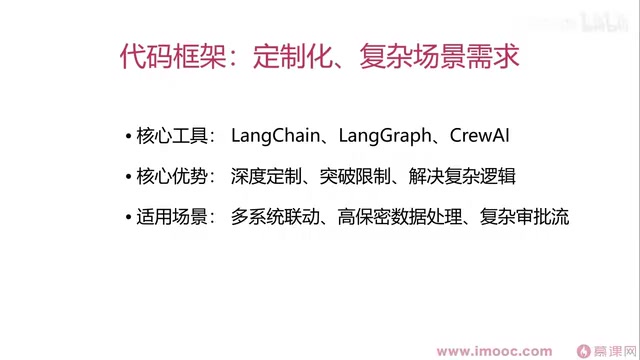
To put it simply: low-code handles rapid validation and daily efficiency gains; code frameworks handle deep customization and high-value complex enterprise problems. This is a division of labor forged through real enterprise practice — not a matter of picking sides in a technology debate.
Three Core Technology Modules: Full Coverage
The course breaks the technology stack into three categories, covering the complete learning journey from beginner to advanced.
Low-Code and Workflow Platforms
The first category covers low-code and workflow platforms, including Manus, Coze, Dify, n8n, Tencent Yuanqi, Alibaba Cloud Bailian, and other mainstream tools. The course walks learners step by step through building deployable enterprise applications from scratch — such as a guided-selling system integrated with the WeChat ecosystem, DingTalk, and Alipay. The emphasis here is on the ability to "express requirements in natural language," not programming skills.
MCP Protocol: Breaking Down Enterprise Data Silos
The second category is the MCP protocol. In many companies, data is locked away in local databases and internal APIs that AI simply can't reach. The course describes MCP as a "master key" — once you have it, Agents can securely read local files and call internal interfaces, completely dissolving the information silos within an enterprise. This is the critical step that transforms an Agent from a "chat toy" into a genuine productivity tool.
MCP (Model Context Protocol) is an open communication protocol proposed and open-sourced by Anthropic in late 2024. Its purpose is to establish a standardized interaction interface between large models and external tools and data sources. Before MCP, every company and every AI application had to develop custom connectors for each system they wanted to integrate (databases, file systems, third-party APIs) — a costly and non-reusable process. MCP's design philosophy is analogous to the standardization of USB interfaces: regardless of what the external system is, as long as it implements an MCP server, an Agent can access and operate on its data in a unified, secure way. The protocol itself has a three-layer architecture: MCP Host (the application running the Agent), MCP Client (the protocol client), and MCP Server (the server-side component interfacing with specific data sources). For enterprise developers, the key value proposition is that locally sensitive data never needs to be uploaded to the cloud — the MCP Server can be deployed within the enterprise's internal network, striking a balance between data security and AI capability integration. Major Agent frameworks (such as LangChain and Claude) have already begun supporting MCP, and it is emerging as an important infrastructure standard for enterprise-grade AI integration.
Agent Development Frameworks: The Hardcore Code Layer
The third category covers various Agent development frameworks — the most technically demanding part of the course. This includes LangChain, LangGraph, LlamaIndex, AutoGen, CrewAI, MetaGPT, and others. The learning focus falls on inter-agent communication and collaboration, state management, enterprise knowledge base integration, and tool construction. Once you've mastered these, unfamiliar technical terms in job descriptions or development requirements will no longer cause anxiety.
LangChain is the most widely used Agent development framework today, offering modular capabilities including model invocation, tool integration, memory management, and RAG (Retrieval-Augmented Generation). LangGraph is a state machine framework built on top of LangChain, specifically designed to handle complex Agent workflow orchestration involving multi-step processes and branching logic — ideal for scenarios requiring loops, conditional jumps, and persistent state. LlamaIndex focuses on structured access and retrieval from enterprise knowledge bases, specializing in transforming unstructured documents (PDFs, databases, API data) into queryable knowledge sources for Agents. AutoGen (from Microsoft) and CrewAI both focus on multi-agent collaboration: the former emphasizes a conversational negotiation mechanism between Agents, while the latter organizes multiple Agents in a "role assignment + task delegation" team model to collaboratively complete complex tasks. MetaGPT goes even further, abstracting roles like product manager, developer, and QA engineer into distinct Agent personas in an attempt to simulate the workflow of an entire software development team. The choice of framework ultimately depends on the complexity of the business process and the team's coding capability.
Technology Grounded in Nine Core Intelligent Job Functions
A standout feature of this course is that all cases are directly rooted in the nine core intelligent job functions within enterprise operations — not abstract technology demos.
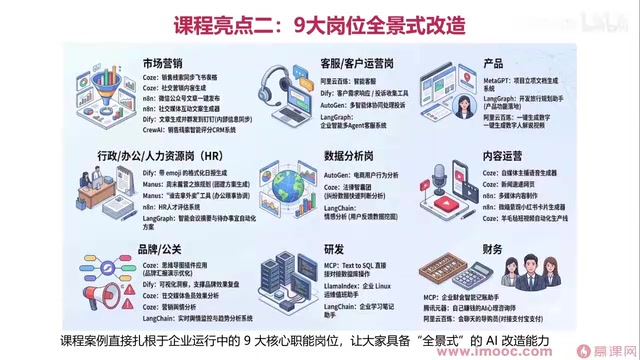
The course repeatedly drives home one point: when you get to a company, you'll find that the hardest part is rarely writing the code — it's not knowing where the business pain points and hidden pitfalls are. So the case design principle is direct: find the pain and target it.
- Marketing: Automate lead syncing and cleansing, eliminating manual lead exports and spreadsheet reconciliation.
- Finance: Build an intelligent bookkeeping assistant that reduces account processing time from hours to minutes.
- R&D: Master Text-to-SQL — ask questions in natural language and let the Agent query the database directly, no complex SQL required.
- PR & Operations: Build real-time public sentiment monitoring that automatically alerts on emerging negative coverage and pushes recommended response strategies.
The course also covers HR resume screening, multi-turn complaint handling in customer service, data analysis for product managers, and automated content production pipelines for content operations. The deeper goal is to cultivate an "AI lens" — the ability to walk into any company and immediately identify which repetitive tasks are worth automating with an Agent.
Four Enterprise-Grade Comprehensive Capstone Projects
The course ties together its scattered technical lessons through four enterprise-grade capstone projects, each delivering a complete, deployable system.
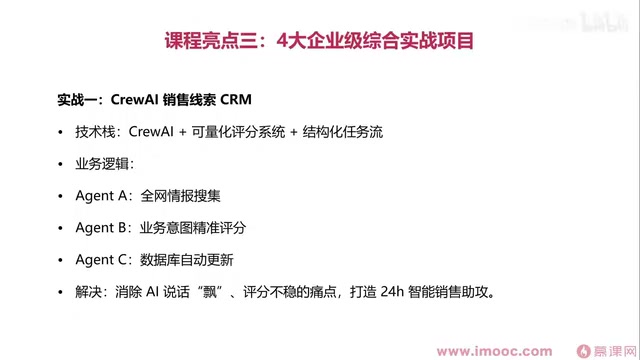
Project 1: Sales Lead Intelligent Scoring System Based on CrewAI
Traditional lead qualification is done manually — slow, inconsistent, and prone to missing high-value prospects. This project simulates a complete sales team: one Agent gathers intelligence from across the web, while another scores leads with precision based on business logic. The highlight is a scientific evaluation framework that converts unstructured lead data into quantifiable scores, ultimately delivering a 24/7 lead scoring system with robust, stable logic.
Project 2: Meeting Summary and Action Item Tracking System Based on LangGraph
This is a hands-on implementation of the increasingly popular LangGraph state machine. The problem it solves isn't just "summarize a conversation" — it's "get something done": starting from a meeting recording, the system automatically identifies responsible parties and dispatches tasks to email and to-do lists, completing the full business loop. The core learning value is mastering Agent memory and state management under complex logic.
LangGraph's core abstraction is the "State Graph": the Agent's entire execution process is modeled as a directed graph, where each node represents a processing step (e.g., calling an LLM, executing a tool, awaiting human review) and edges represent transition conditions. Unlike linear chain-style invocation, LangGraph supports looping nodes — an Agent can retry a step repeatedly until a condition is met, and it supports pausing mid-execution to await human input (Human-in-the-loop). State management is another key feature: intermediate results after each node execution are persisted in a state object, meaning tasks can be resumed from a checkpoint even after interruption — particularly valuable for long-running enterprise process automation. Meeting summary tracking is exactly the kind of scenario that requires these capabilities: identifying speakers, extracting action items, matching responsible parties, triggering notifications — each step can fail or require conditional branching, and LangGraph's state machine model makes such complex workflows controllable and debuggable.
Project 3: Short-Video Automated Production Pipeline Based on Coze
For content operations teams, the biggest fear is missing a posting schedule. This fully automated pipeline takes a single keyword as input and handles the entire workflow — from topic selection and storyboard scripting to automated voiceover and video synthesis. For lean teams, it significantly boosts output volume and is a textbook cost-reduction and efficiency-improvement scenario.
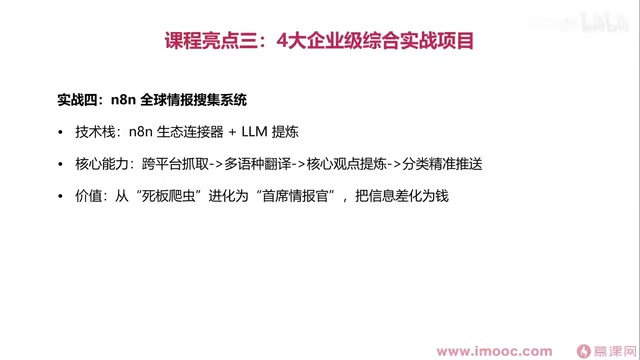
Project 4: Global Industry News Intelligence System Based on n8n
In an era of information overload, intelligence is the most valuable currency. This project leverages n8n's powerful connectivity to build a thinking intelligence system: it automatically traverses global news sources, structures the content, extracts key insights, and distributes them with precision according to logical rules. This isn't a rigid scraper — it's a "Chief Intelligence Officer."
Course Value: From Using AI to Making AI a Productivity Tool
Through deep hands-on work with these four projects, learners walk away not with scattered demos and code snippets, but with four complete digital employee solutions — ready to be added to a résumé or deployed directly within a company.
The course emphasizes a clear progression: from agile development for rapid deployment, to deep customization for complex systems, with the architectural thinking and design logic behind Agent development fully unpacked along the way. As the course puts it: today's workplace isn't short on people who can chat with AI — what's scarce are the people who can turn AI into a genuine productivity tool.
From a content structure standpoint, this course is logically well-organized. It covers the three major technical layers — low-code platforms, the MCP protocol, and mainstream Agent frameworks — and anchors them to real enterprise job functions and comprehensive capstone projects. It's well suited for learners who want to systematically build Agent development capabilities and advance toward enterprise-grade applications.
Related articles

Automate Job Search with AI Agents and Residential Proxies for Precise Matching
Build an AI Agent with MCP and residential proxies to bypass recruitment site anti-scraping and geo-restrictions, scrape thousands of DevOps jobs, then have Claude score and rank each against your resume. Includes proxy comparison experiments, project structure, and cost analysis—filtering only, no auto-submission.

The AI Task Assistant That Knows When to Back Off: A Cure for Activation Struggles
One Small Step is an AI assistant for task initiation struggles, using agentic decisions for guilt-free reminders, timely retreat, and cross-platform task management. The developer shares real test results on 13 tasks and architectural trade-offs.

FastAPI: A High-Performance Python Framework and a Production-Ready API Development Powerhouse
FastAPI is a high-performance web framework based on Python type hints, supporting async and automatic OpenAPI docs. With over 100k GitHub stars, this article analyzes its core strengths, production readiness, and selection advice.