Getting Started with LangChain: From Core Libraries to AI Agent Development
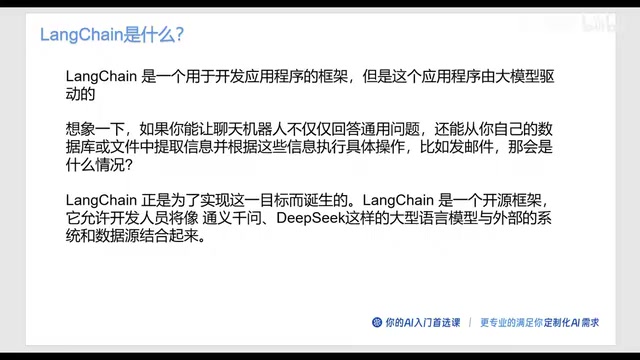
LangChain is a modular framework for connecting large language models to enterprise systems, agents, and deployment pipelines.
LangChain is an open-source framework designed for building large language model-powered applications, serving a role similar to Spring or Django in backend development but tailored for AI use cases. It helps enterprises connect general-purpose models like OpenAI, DeepSeek, and Qwen to internal data sources such as CRMs and document libraries. The ecosystem includes LangChain Core for base abstractions and LCEL syntax, the main package for Chains and Agents, third-party integration libraries, LangGraph for orchestrating complex multi-step AI Agents, LangServe for REST API deployment, and the optional LangSmith platform for online debugging.
What Exactly Is LangChain
If you've built traditional backend applications, you've likely relied on mature development frameworks — Java developers lean on the Spring ecosystem (Spring MVC, Spring Cloud), Python developers use Django, and PHP developers have their own ecosystem counterparts. LangChain plays a similar role, but serves an entirely different purpose: it's a framework specifically designed for developing applications powered by large language models.
In other words, LangChain isn't about building a large model from scratch — it's about integrating existing models (such as Qwen, DeepSeek, OpenAI, etc.) into real-world business scenarios. It's primarily Python-based, which might feel unfamiliar to developers from other language backgrounds. In practice, though, anyone with a background in another language can pick up enough Python basics in a day or two to understand most LangChain application code.
Why Enterprises Need LangChain
The most common way we interact with large models today is through chat. Chat can solve a wide range of general problems, but those capabilities are limited to what the model learned during training — it has no knowledge of your company's internal data.
For enterprises, real value is locked inside proprietary systems — CRM platforms, sales management systems, and mountains of internal documents. What businesses actually want is to harness the power of large models to extract insights from those systems and documents, answer business-specific questions, and even take action — like automatically sending emails.
LangChain was built precisely for this goal. As an open-source framework, it lets developers connect general-purpose large models to external systems and data sources, enabling a wide range of real-world enterprise applications. This is the core value that sets it apart from "just chatting" with an AI.
In enterprise scenarios, the most widely adopted technical approach for connecting large models to internal data is RAG (Retrieval-Augmented Generation). The core idea is: chunk enterprise documents and store them as vectors in a database; when a user asks a question, retrieve the most relevant document chunks from the vector database; then pass those chunks along with the question to the large model, so it answers based on actual source material. This approach mitigates the hallucination problem — where models confidently make things up — without requiring expensive fine-tuning of the model itself. LangChain provides a complete set of ready-to-use components for the RAG pipeline, including document loaders, text splitters, vector stores, and retrievers.
LangChain's Core Libraries
Since LangChain is a framework, it's naturally composed of multiple subsystems and libraries. Understanding how these libraries divide responsibilities is the key first step to getting started.
LangChain Core: The Foundation Layer
As the name suggests, LangChain Core is the foundation of the entire system. It contains abstract definitions for all the fundamental components — large language models, vector stores, parsers, and more — along with the methods for composing these components together. It also provides LCEL (LangChain Expression Language). Think of it as the bedrock that everything else is built on.
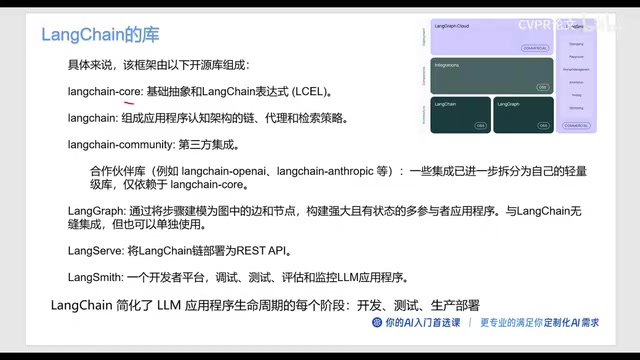
LCEL (LangChain Expression Language) is a declarative, chainable syntax provided by LangChain Core. It uses the pipe operator (|) to connect multiple components in sequence, similar to piping commands in Linux. For example, prompt | llm | output_parser concisely expresses the complete flow of "format the prompt, pass it to the model, then parse the output." LCEL is designed to let developers describe data flow across components with minimal code, while automatically gaining capabilities like streaming output, async calls, and batch processing — no need to implement these features manually.
LangChain Main Package: The Cognitive Framework
Built on top of Core, the main LangChain package provides higher-level constructs such as Chains, Agents, and retrieval strategies. The purpose of these components is to assemble the application's "cognitive framework" — organizing the capabilities of large models into reusable processing pipelines.
Third-Party Integration Libraries
An open-source framework can only go so far on its own; it needs community contributions to cover a wide range of use cases. Accessing OpenAI and accessing Qwen aren't exactly the same — every large model has its own quirks — so the community maintains dedicated third-party integration libraries. When building your application, you import the relevant modules from the appropriate integration package.
One notable trend: what was once bundled together as a single third-party integration package is now being broken out into finer-grained, independent packages, making maintenance and usage more flexible.
LangGraph and AI Agents
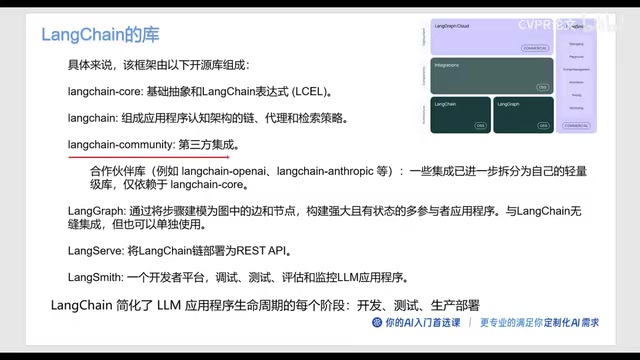
The word "Graph" in LangGraph hints at its purpose. This library is primarily used to implement AI Agents.
The tasks an agent needs to handle are often complex, involving multi-step workflows that may include loops and branches. Modeling and orchestrating these workflows with a graph structure is a natural fit — which is why it's called LangGraph. If you want to build an agent that can autonomously plan, invoke tools, and complete multi-step tasks, LangGraph is a critical piece of the LangChain ecosystem.
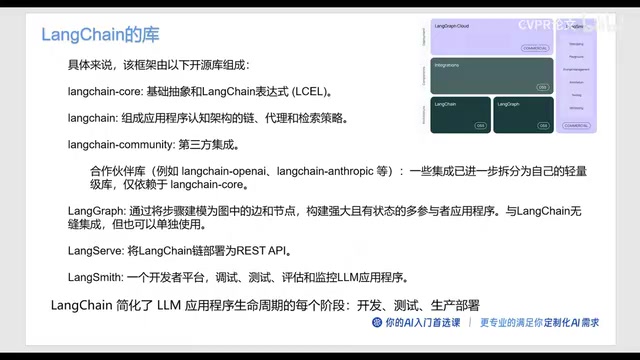
An AI Agent is a program capable of perceiving its environment, autonomously planning, and taking action. Unlike the traditional "one question, one answer" model, an agent independently decides which tools to call (such as a search engine, database query, or code executor), how many steps to take, and dynamically adjusts its next action based on the results of each step. LangGraph models these multi-step tasks as directed graphs: nodes represent individual processing steps (such as calling a large model or executing a tool), and edges represent the transition logic between steps, supporting conditional branching and loops. This modeling approach allows iterative agent behaviors — like "plan → execute → reflect → re-plan" — to be precisely described and debugged, offering far more flexibility than linear chain-style execution.
Deployment and Debugging: LangServe and LangSmith
Once development is complete, applications typically need to be exposed as standalone services. LangServe is the library that solves this problem — it publishes your application via a REST API, making it a composable component within a larger enterprise system.
Debugging and testing are handled by LangSmith. Worth noting: LangSmith is an online debugging platform — you need to log in to the platform to view debug information, which isn't always convenient, and it may incur costs during use.
Whether to use LangSmith is entirely up to the developer. You can still debug without it; it just takes a bit more effort. This "optional, not required" positioning also reflects the modular design philosophy of the LangChain ecosystem.
Summary
LangChain is not a single library — it's a framework ecosystem composed of multiple open-source components: LangChain Core, the main LangChain package, third-party integration libraries, LangGraph, LangServe, and LangSmith. Each plays a distinct role, covering the complete lifecycle of large model application development: from foundational abstractions and workflow orchestration, to agent construction, service deployment, and debugging.
With a clear understanding of how these pieces fit together, tackling hands-on projects like RAG-based retrieval or AI Agent development becomes much more straightforward. The next step is to dive deeper into the core components within LangChain that are worth focusing on.
Related articles

AI Agent Earns $10K in One Week: 3 Key Upgrades Explained
A blogger shares how he earned $10K in a week with an AI Agent — not by adding more skills, but through verification, approval gates, and subagents to raise trust and enable true automation.
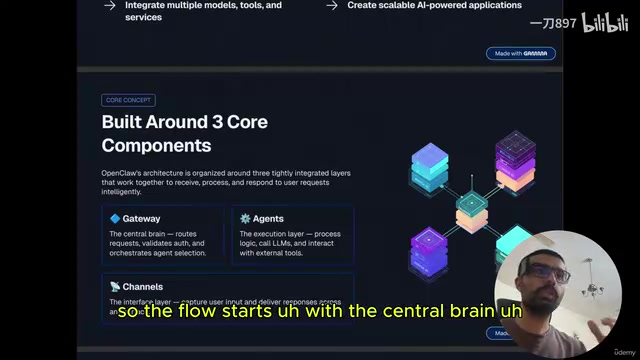
Getting Started with OpenClaw: Multi-Channel AI Agent Gateway and Automated Workflow Guide
OpenClaw is an open-source multi-channel AI agent gateway. This guide covers its three core components — gateway, agents, and channels — plus tool integration and memory mechanisms.
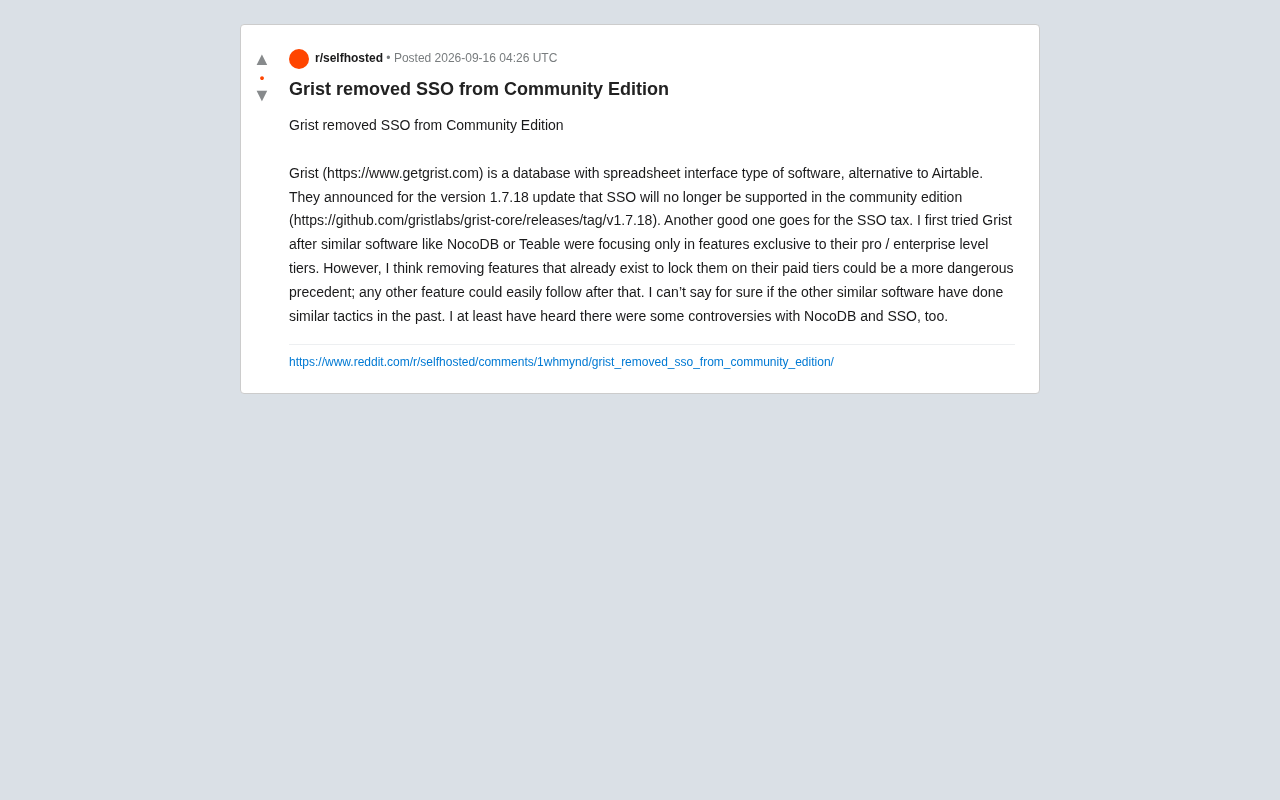
Grist Removes SSO from Community Edition: The 'SSO Tax' Debate Resurfaces
Grist v1.7.18 removed SSO from its Community Edition, locking it behind a paid tier and reigniting the 'SSO Tax' debate. We analyze the incident, open-source monetization tensions, and what it means for self-hosted users.