How DeepAgents Multi-Agent Collaboration Works: How the Primary Agent Orchestrates Sub-Agents

DeepAgents is a higher-level LangChain framework that uses primary-sub-agent orchestration for enterprise-grade complex tasks.
DeepAgents is an agent framework released by the LangChain team in 2025, analogous to Spring Boot in the Java ecosystem. Rather than starting from scratch, it wraps LangChain's foundational capabilities (models, RAG, tools, memory) and LangGraph's state machine runtime into a higher-level framework. The three layers are clear: LangChain is the parts library, LangGraph is the chassis, and DeepAgents is the assembly framework. Its core mechanism is the Sub-Agent system — supporting both synchronous and asynchronous sub-agents orchestrated by a primary agent — enabling task decomposition and parallel execution for long-running, enterprise-grade workloads.
What Is DeepAgents: A New Layer of Abstraction in the LangChain Ecosystem
DeepAgents is an agent framework released by the LangChain team, positioned as infrastructure for building long-running, complex-task agents. Its core goal isn't to reinvent the wheel — it's to make it easier for developers to create agents that run stably over extended periods. That emphasis on stability is precisely what sets DeepAgents apart from earlier approaches.
Many developers who've worked with Python, LangChain, or LangGraph have an immediate reaction: "We already have LangChain and LangGraph — why do we need yet another framework called DeepAgents?" That question is actually the perfect entry point for understanding what DeepAgents is all about. According to technical livestream coverage on Bilibili, DeepAgents launched around November 2025. Rather than being built from scratch, it stands on the shoulders of LangChain and LangGraph — it's a higher-level abstraction built on top of the entire LangChain ecosystem.
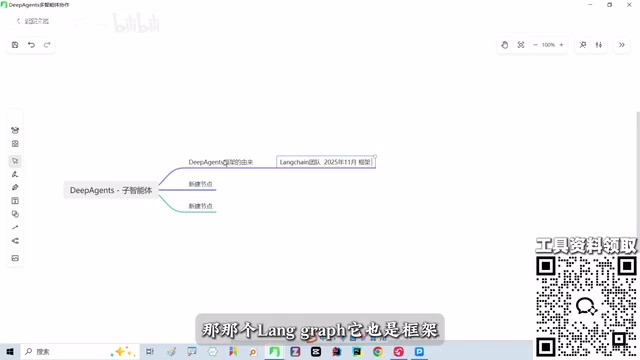
The Three-Layer Relationship in the LangChain Ecosystem
To understand where DeepAgents fits, you first need to see how the key components of the LangChain ecosystem relate to one another. The ecosystem includes LangChain, LangGraph, LangSmith, and frameworks like DeepAgents. LangSmith handles agent monitoring and sits in a relatively independent operations layer, so we can set it aside for now. The three worth untangling are LangChain, LangGraph, and DeepAgents.
A great analogy captures this perfectly: if you've worked with Java, then DeepAgents is to the LangChain ecosystem what Spring Boot is to the Spring family. In day-to-day Java development, you rarely interact directly with Spring or Spring MVC — they're both integrated under the hood by Spring Boot, so developers don't need to worry about the lower-level details. DeepAgents serves exactly the same role: it packages up the underlying capabilities so you can focus on building more powerful agents.
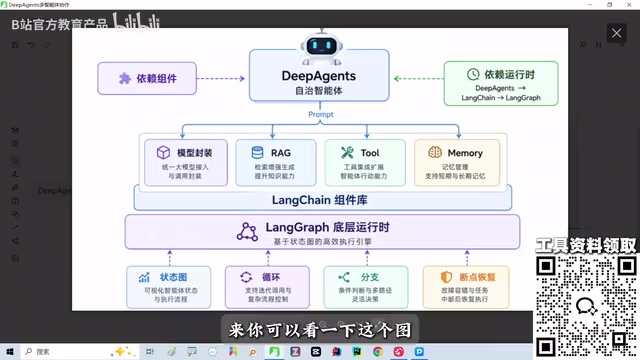
The Role of Each Layer
- LangChain: Provides the building blocks — model wrappers, RAG, tool calling, memory management, context handling, and other foundational capabilities.
- LangGraph: Provides the runtime engine — think of it as the agent's "chassis," responsible for managing state, loops, branches, and checkpoint recovery.
- DeepAgents: Assembles those building blocks and the chassis into a more complete, autonomous, and stable agent.
In other words, LangChain is the parts library, LangGraph is the runtime chassis, and DeepAgents is the assembly framework that puts them together into a finished vehicle.
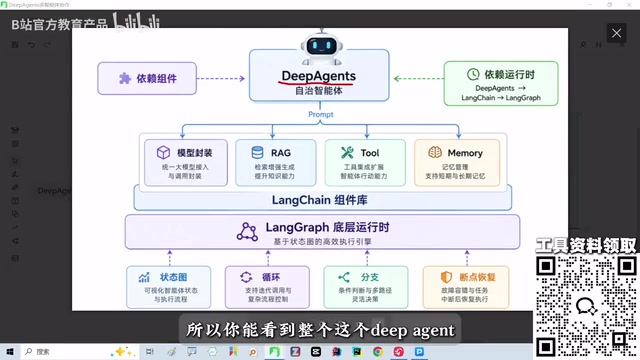
Looking at the technical implementation more closely: LangChain was originally designed around the concept of "chain calls," connecting LLM calls, prompt templates, and output parsers into a Pipeline. LangGraph built on top of that by introducing a directed graph (DAG / cyclic graph) state machine model, allowing agents to jump between nodes, backtrack, or enter loops — naturally supporting the ReAct (Reason + Act) paradigm of "think → act → observe." Each layer solves problems at a different granularity: LangChain handles capability composition within a single call, while LangGraph manages the runtime control flow across multiple steps. DeepAgents adds one more layer of abstraction on top, primarily addressing coordination and lifecycle management across multiple agents — so developers can quickly build multi-agent systems capable of task decomposition, parallel execution, and result aggregation without manually writing graph nodes and edge transitions.
Why Agents Need a "Chassis"
A truly useful agent is far more complex than a simple request-response loop of "user asks, model answers." After a user poses a question, the agent needs to analyze the problem, call tools, assess whether the retrieved information is sufficient, perform additional RAG searches when needed, and maintain memory across interactions. All of this involves complex state transitions and conditional branching — exactly the kind of problem LangGraph as the chassis is designed to solve.
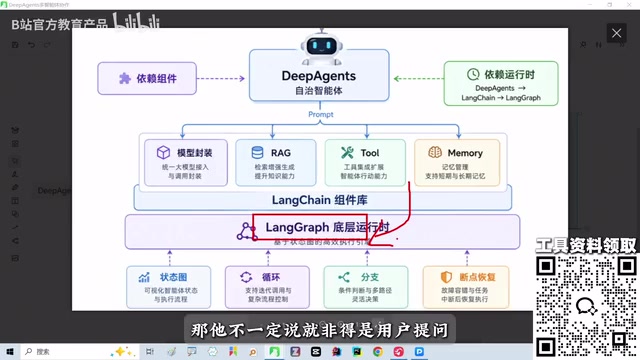
The good news for developers is that you don't need to treat LangGraph as intimidating. Even a passing familiarity with LangChain and LangGraph is enough to understand and use DeepAgents — the higher-level framework has already abstracted away most of the complexity.
Sub-Agents: The Core Mechanism of DeepAgents
The heart of this topic is DeepAgents' Sub-Agent mechanism — the key to the "primary agent orchestrates sub-agents" multi-agent collaboration pattern. DeepAgents supports creating both synchronous sub-agents and asynchronous sub-agents, enabling the primary agent to decompose complex tasks and process them in parallel.
The value of this primary-subordinate architecture is clear: while you could build agents with LangChain and LangGraph alone, delivering more capable, more autonomous, and more stable enterprise-grade agents requires a more mature approach. According to practitioners in the field, most enterprise-level projects are now adopting this multi-agent collaboration architecture for production deployments, and the accompanying real-world projects are built directly on top of this theoretical foundation.
The distinction between synchronous and asynchronous sub-agents is worth unpacking. Synchronous sub-agents block the primary agent's flow when invoked — the primary agent waits for the sub-agent to return a result before continuing. This suits scenarios where results have dependencies, such as "retrieve materials first, then write a report based on those materials." Asynchronous sub-agents, on the other hand, can be triggered concurrently by the primary agent — each sub-task executes independently, and the primary agent collects all results for final integration. This is ideal for parallel, independent tasks like querying multiple data sources simultaneously. This distinction maps closely to the concept of synchronous vs. asynchronous API calls in traditional backend development. In long-running tasks, async mode can significantly reduce total execution time, while sync mode ensures correctness when logic must be strictly sequential. The two modes can be mixed, with the primary agent dynamically selecting an orchestration strategy based on task dependencies.
Summary: An Agent Framework Built on Giants
The core value of DeepAgents can be summed up in one sentence: It leverages LangChain's capabilities (models, RAG, tools, memory, context), runs on LangGraph's chassis, and assembles them into a more complete, more stable agent framework. The sub-agent mechanism is the key design that enables multi-agent collaboration and supports long-running complex tasks.
For developers looking to advance to enterprise-grade agent development, understanding the three-layer relationship in the LangChain ecosystem and grasping how the primary agent orchestrates sub-agents is the essential first step into DeepAgents.
Related articles

Huberman's Rational Supplement Guide: A Five-Layer Health Framework and Scientific Decision-Making
Stanford neurobiology professor Huberman proposes a rational supplement framework: behavior and nutrition are the foundation, basic combination supplements serve as insurance, and sleep/hormonal/cognitive directions should stick to single-ingredient experiments. Omega-3 is the top single-ingredient choice, and melatonin is not recommended.

The Unsung Painter Behind Gilded Age Manhattan Interior Design
HN discussion highlights the painter behind Gilded Age Manhattan interiors: he created murals and decorative paintings but was long overlooked as his work was seen as architectural appendage.

Can AI Agents Be Socially Engineered? Understanding Prompt Injection and Tool Permission Risks
Through Invariant Lab's GitHub Issue injection and Brave's AI browser attack, this article analyzes how Prompt Injection induces AI Agents to perform unauthorized actions, and offers protection advice across three layers: least privilege, tool validation, and operation auditing.