LangChain Beginner's Guide: What Problems Does It Actually Solve for LLMs?

LangChain solves the three core limitations of LLMs: knowledge cutoffs, no external access, and statelessness.
LangChain is an open-source framework for building LLM-powered applications, playing a role in the Python and Agent ecosystem similar to Spring in Java. Its core value lies not in wrapping APIs, but in bridging three structural gaps: LLMs have training knowledge cutoffs, cannot natively connect to databases or third-party APIs, and are inherently stateless with no multi-turn memory. LangChain addresses these through Function Calling, external tool integration, and a Memory module, with LangGraph underpinning complex agent orchestration. Official docs — English first, Chinese as a supplement — are the best learning resource.
As a practitioner in AI application development — or more specifically, large language model (LLM) application development — LangChain is almost impossible to avoid. Whether you're building AI agents or developing products powered by large language models, understanding the role LangChain plays in the overall tech stack is the essential first step. This article is based on a beginner-level LangChain tutorial and covers the framework's positioning, the core problems it solves, and the logic behind its name.
What Exactly Is LangChain
LangChain is an open-source framework for developing applications powered by large language models (LLMs). These LLMs include the models we use daily — DeepSeekAd, Claude, Qwen, and others. Within the Python ecosystem and the mainstream Agent development ecosystem, LangChain is nearly indispensable, which is why most people encounter it first when learning about large models.
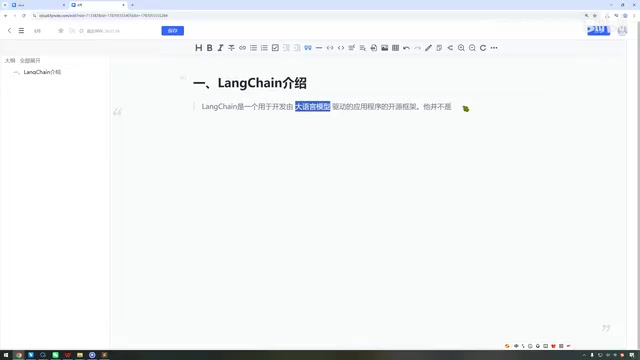
Many people mistakenly think of LangChain as a simple API wrapper. Sure, if you just want to call the API of a model like DeepSeek for a single Q&A, LangChain can do that. But its value goes far beyond that — it's an agent framework with pre-built components and a rich set of tool integrations.
If you come from a Java background, think of LangChain's role in Agent development as analogous to Spring's role in the Java ecosystem. Under the hood, it now runs on LangGraph and also includes DeepAgent-related capabilities. With this framework, developers can build sophisticated LLM applications without having to construct complex integration architectures from scratch.
LangGraph is the underlying framework within the LangChain ecosystem for handling complex agent orchestration. It models an agent's workflow as a directed graph: nodes represent specific processing steps (such as calling a model, executing a tool, or making a conditional branch), while edges represent the transition logic between steps. Compared to LangChain's earlier linear "Chain" approach, LangGraph supports loops, conditional branches, and multi-agent collaboration — enabling more complex reasoning flows like "try → fail → reflect → retry" iterative behaviors. LangChain's team has progressively migrated complex Agent construction capabilities onto LangGraph. The two are not replacements for each other but have distinct focuses: LangChain handles component integration and simple pipelines, while LangGraph handles complex stateful workflow orchestration. Beginners are advised to start with LangChain's basic chains, then gradually move deeper into LangGraph.
The Three Core Problems LangChain Solves
Before learning any technology, you should first understand what problems it solves. From a high-level perspective, LangChain primarily addresses three constrained scenarios inherent to large language models.
Knowledge Cutoff: The Model Doesn't Know What Happened After Training
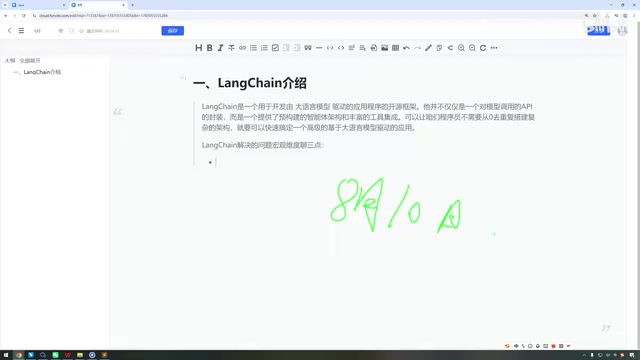
A large language model's knowledge is limited to its training data — it cannot access information beyond its training cutoff date. For example, a model that finished training on August 10th has no way to answer questions about the weather on August 11th or what happened on August 12th.
You might say, "But I ask Doubao and it knows the answer." This requires clarifying a key concept: Doubao itself is already a packaged application built by someone else. You're not interacting directly with the underlying large language model — you're using an application driven by an LLM. LangChain provides a mechanism called Function Calling that lets us invoke the appropriate tools to retrieve data that the model itself cannot access. Similarly, models are not great at complex arithmetic, which can also be addressed by connecting an external tool like a calculator via Function Calling to ensure accuracy.
Function Calling (also known as Tool Calling) is a key capability extension mechanism in the LLM space. The principle works like this: developers pre-define a set of "tools" (essentially functions or API interfaces) and inform the model of each tool's name, purpose, and parameter format. When a user asks a question that requires external data, instead of fabricating an answer, the model outputs a structured instruction — something like "I need to call this tool with these parameters" — which the framework layer actually executes. The result is then returned to the model, which generates a final answer based on real data. LangChain provides a high-level abstraction over Function Calling: developers simply define and register tools into the chain, and the framework automatically handles the call protocol between the model and the tools. This dramatically lowers the implementation barrier and is one of the core advantages LangChain offers over calling raw APIs directly.
No Ability to Interact with External Systems
A large language model has no way to directly interact with external systems on its own. For instance, if you want to call a third-party API to check the weather, or if you've written some utility classes for precise calculations, the model itself cannot reach those resources.
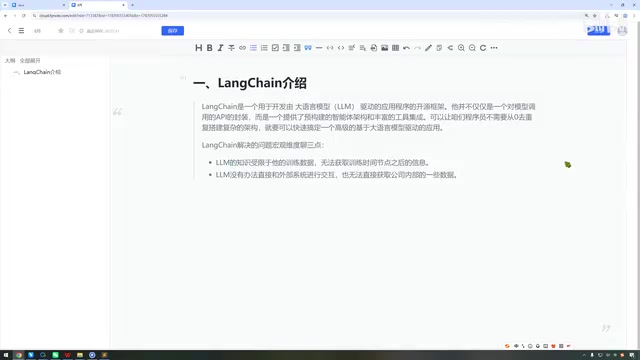
A more common scenario involves enterprise internal data. When building LLM-based applications, you often need company data stored in a database — but the model can't just spin up a JDBC connection to fetch that data on its own. These cross-system data retrieval needs can all be addressed through LangChain.
No State Persistence
When chatting with tools like Doubao or DeepSeek, you'll notice they remember your previous messages and respond with context in mind. But this isn't a native capability of the model itself — large language models are fundamentally single-turn systems. They don't have state persistence, and the second question doesn't automatically relate to the first.
This seamless multi-turn conversation experience is also implemented at the framework level. LangChain can help us manage conversation state and achieve true contextual continuity. Of course, LangChain solves far more than just these three problems — these are simply the most important ones to highlight.
Large language models are stateless by architecture: each API call receives a text input and produces a text output, with no memory retained after the call ends. The "multi-turn conversation" experience we enjoy in products like Doubao or ChatGPT is actually achieved at the application layer — each new request appends the conversation history to the current input (the "prompt") before sending it all to the model. Only by seeing the complete context can the model generate a coherent reply. This technique is called "context window injection." LangChain provides a dedicated Memory module that automatically manages the storage, truncation, and summarization of conversation history — because the context window has a length limit, and when history grows too long, intelligent trimming is needed to avoid exceeding the model's processing capacity. Understanding this mechanism helps developers make informed trade-offs between cost, response speed, and context completeness.
The Logic Behind the Name "LangChain"
The name LangChain has two parts. "Lang" comes from "Language," pointing to large language models; "Chain" refers to the chaining of interactions in combination.
Put simply, the core idea of LangChain is to connect large language models with other resources inside (and outside) the computer in a chain-like manner, enabling them to interact with one another to build more powerful AI applications or agents. This concept of "chain-linking" is the essence behind the framework's name.
How to Learn: Make the Most of Official Documentation
LangChain is rapidly and continuously evolving, so the most reliable reference throughout your learning journey will always be the official documentation.
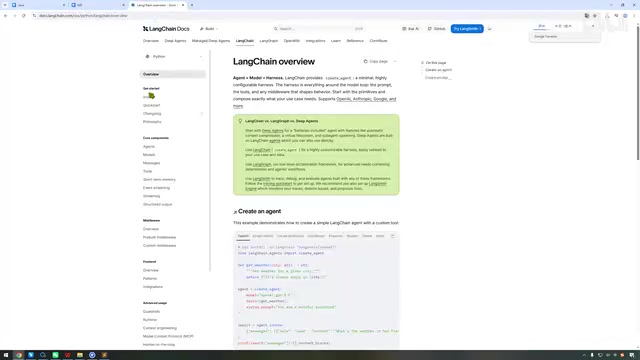
The official docs primarily cover several core components — LangChain, LangGraph, DeepAgent, and LangSmith — and explain the relationships and differences between them. The overall architecture can be summarized as "model plus orchestration framework": the LLM provides the intelligence, while LangChain serves as the framework that handles orchestration. The official docs also introduce a feature called createAgent, an extremely simple and highly configurable wrapper that lets you connect to a wide variety of models.
For readers comfortable with English, reading the English documentation directly is the most recommended approach, since the latest updates always appear there first. If your English isn't strong, the Chinese documentation is a viable alternative — both versions stay largely in sync and the code content is identical. Worth noting: the Chinese docs read more like an AI translation, so occasional phrasing may be imprecise, but the vast majority of the content is reliable.
Summary
The value of LangChain lies fundamentally in bridging three structural gaps in large language models: knowledge cutoffs, the inability to interact with external systems, and the lack of state memory. Once you understand these three points, you'll see clearly why LangChain is the foundational building block of LLM application development. As you continue learning, it's recommended to stay close to the official documentation, start with Function Calling and chain-based orchestration, and gradually work your way toward building your first agent application.
Related articles

Penguin Moves Up Publication of 'Smarter Than Us': An AI Risk Guide for General Readers
Penguin moves up publication of 'Smarter Than Us,' an AI guide co-written with Patchen Barss that explains how AI works and lays out its many risks for non-technical readers.

From Photons to Production: An Open-Source Computer Vision Engineering Reading Path
Reddit user open-sources a computer vision engineering reading path with 16 chapters from image formation to production deployment, emphasizing primary sources, dependency order, and reproducible benchmarks to help engineers understand why models fail and build reliable vision systems.

Prompt Failures? The Truth About Why AI Agents Struggle in Production—and How to Fix It
A Reddit developer built Agents with Copilot and Gemini but faced unstable behavior. This article analyzes three gaps in prompt engineering for Agent scenarios and offers three practical paths to reliable Agent deployment, including structured prompts, workflow-first approaches, and building an evaluation loop.