LangGraph Multi-Agent Routing: Production-Grade Orchestrator-Worker Architecture Design

Production-grade LangGraph multi-agent routing using Orchestrator-Worker pattern with dynamic task DAGs.
This article analyzes the limitations of static Supervisor routing in LangGraph multi-agent systems and presents the Orchestrator-Worker pattern as a production-grade alternative. It covers dynamic per-turn task DAG construction, checkpoint_ns-based state isolation, explicit interrupt context management, structured data contracts between agents, and practical guidance on when to avoid over-engineering with distributed protocols like A2A.
The Problem: Limitations of Single-Route Design
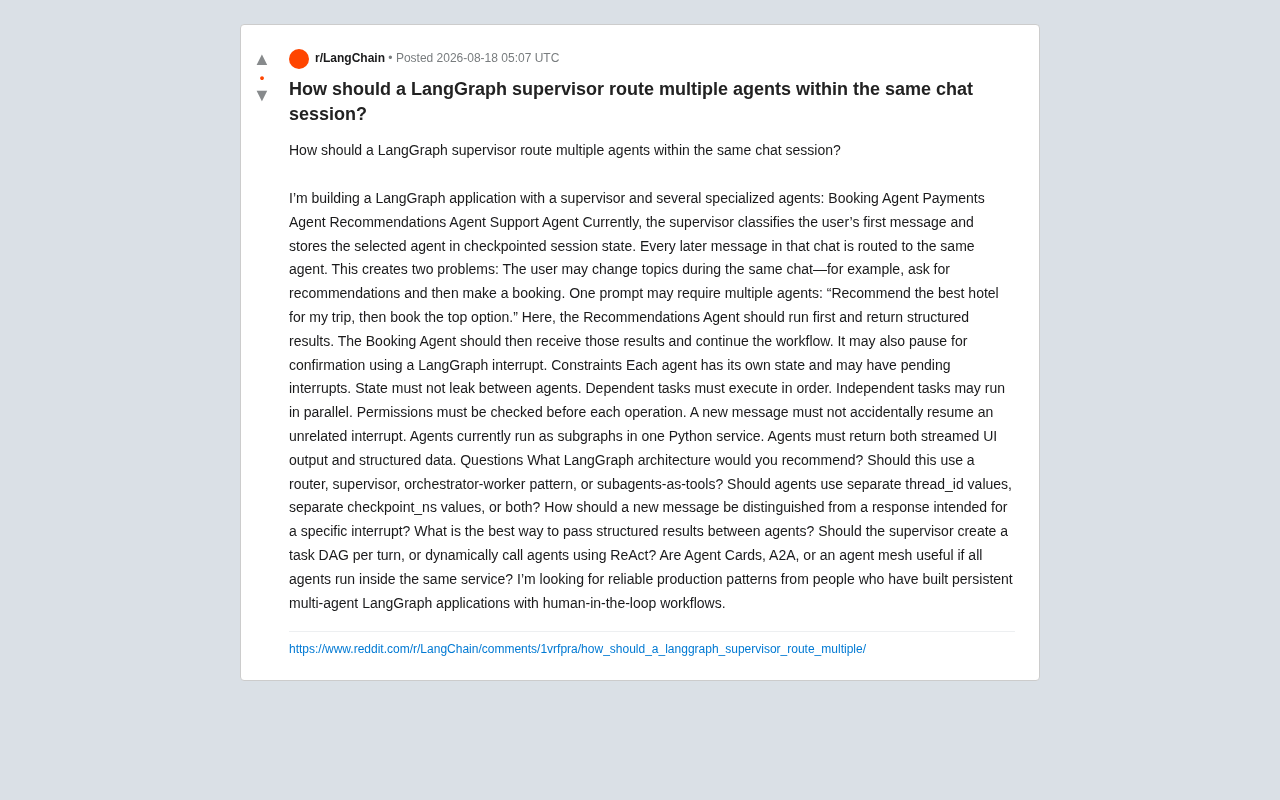
When building complex conversational AI applications, multi-agent collaboration has become a mainstream architecture. Recently, a developer shared a real-world case on Reddit: a system built with LangGraph featuring a Supervisor and multiple specialized Agents covering four functional modules — Booking, Payments, Recommendations, and Support.
LangGraph is an orchestration framework in the LangChain ecosystem designed specifically for building stateful, multi-step AI applications. Its core idea is to model AI workflows as graph structures — nodes represent computation steps (such as calling an LLM or executing tools), while edges represent control flow (such as conditional branches or loops). Unlike traditional chain-based invocations, LangGraph natively supports loops, conditional routing, and persistent state management, making it particularly well-suited for scenarios requiring multi-turn interactions and complex decision-making. Its checkpointing mechanism allows execution to be paused and resumed at any node, providing the infrastructure for human-in-the-loop approval workflows. The Supervisor pattern is a common multi-agent orchestration approach in LangGraph, where a centralized supervisor node is responsible for dispatching tasks to specialized Agents — similar to a project manager role within a team.
The developer's current implementation has a typical pain point: the Supervisor only performs intent classification on the first message in a session, then stores the selected Agent in checkpointed session state, and all subsequent messages are permanently routed to that same Agent.
This "classify once, bind forever" design quickly exposes two critical problems in real-world scenarios:
- Topic switching fails: A user might ask about recommendations first, then want to make a booking within the same session, but the system continues sending messages to the Recommendations Agent.
- Multi-Agent collaboration is missing: A single prompt might require multiple Agents working in sequence — for example, "Recommend the best hotel for me, then book the top-ranked option."
Breaking Down the Core Challenges
Sequential Execution of Dependent Tasks
In a compound request like "recommend + book," the Recommendations Agent must run first and return structured results, then the Booking Agent receives those results to continue the workflow — potentially pausing midway through LangGraph's interrupt mechanism to await user confirmation. This requires the system to identify dependencies between tasks and construct the correct execution order.
LangGraph's interrupt mechanism allows graph execution to pause at any node, waiting for external input (typically human approval or confirmation) before resuming. This mechanism is critical for high-risk operations — for example, requiring user confirmation of the amount before payment, or user selection of specific options before booking. Technically, when an Agent calls the interrupt() function, the current graph state is persisted to checkpoint storage (such as a database), and the execution thread is released. When the user response arrives, the system restores state from the checkpoint and continues execution. The challenge lies in interrupt management across multi-Agent scenarios: if the Booking Agent and Support Agent both have pending interrupts simultaneously, the system must precisely route the user's response to the correct interrupt point — otherwise it could lead to accidental order confirmations or incorrect ticket closures.
State Isolation and Interrupt Management
The constraints the developer listed are highly valuable for production reference:
- Each Agent has independent state and may have pending interrupts
- State must never leak between Agents
- Dependent tasks must execute sequentially; independent tasks can run in parallel
- Permissions must be checked before each operation
- New messages must not accidentally resume an unrelated interrupt
- Agents need to return both streaming UI output and structured data
The core tension behind these constraints is: how to maintain clear state boundaries for each Agent and prevent interrupt cross-contamination while sharing a single session context.
Recommended Architecture: Orchestrator-Worker Pattern
For these types of requirements, the more reliable production pattern is the Orchestrator-Worker pattern, rather than simple static routing.
Why Not Use a Static Router
A simple Router is suitable for stateless, one-time classification scenarios. But this use case requires re-evaluating intent on every conversation turn and supporting multi-Agent relay — a static Router clearly falls short.
Dynamically Building a Task DAG Per Turn
A more robust approach is to have the Supervisor dynamically build a task DAG (Directed Acyclic Graph) on every conversation turn, rather than binding to an Agent once.
DAG (Directed Acyclic Graph) is a fundamental data structure in computer science, widely used in task scheduling, compiler optimization, and data flow management. In the multi-agent orchestration context, each node in the DAG represents an Agent task, directed edges represent dependencies between tasks, and the "acyclic" constraint ensures no circular dependencies that could cause deadlocks. The key advantage of DAGs is topological sorting — it can automatically derive a valid execution order, ensuring all prerequisites are completed before downstream tasks begin. Meanwhile, nodes without dependencies can safely execute in parallel, maximizing throughput. In production-grade workflow engines like Apache Airflow and Prefect, DAGs have been proven as a reliable orchestration paradigm, and bringing them into multi-agent systems is a natural extension of engineering best practices.
Compared to pure ReAct dynamic invocation, the DAG approach offers these advantages:
- Explicitly expresses task dependencies, naturally supporting both sequential and parallel execution
- Facilitates permission validation before execution
- Produces predictable results, benefiting observability and debugging in production environments
ReAct (Reasoning + Acting) is an LLM Agent paradigm proposed by Yao et al. in 2022. Its core idea is to have the model alternate between reasoning (Reason) and acting (Act): the model first generates a thought process to analyze the current state, then decides which tool to call or what action to take, then continues reasoning based on the tool's returned observations — looping until the task is complete. ReAct's flexibility makes it ideal for exploratory tasks and open-ended problem solving, but this flexibility also means non-determinism — the same input may produce different tool call sequences and step counts. In scenarios involving financial transactions, booking confirmations, and other processes requiring strict procedural guarantees, ReAct's non-determinism could cause critical steps to be skipped or execution order to become scrambled, which is why it needs to be paired with more structured orchestration mechanisms.
The recommendation is to use DAG as the backbone, with ReAct used locally within individual Agents when tool calls are needed. This hybrid architecture balances determinism at the macro workflow level with flexibility at the micro task level.
State and Interrupt Isolation Strategies
Choosing Between thread_id and checkpoint_ns
Regarding whether to use independent thread_ids or independent checkpoint_ns values — this is the most technically nuanced part of the problem:
- thread_id: Represents a complete conversation thread. User-level conversations should maintain the same
thread_idto preserve overall context continuity. - checkpoint_ns (namespace): Used to isolate checkpoint state for different subgraphs within the same thread.
In LangGraph's persistence mechanism, a checkpoint records a complete state snapshot of graph execution at a given moment, including node outputs, accumulated message history, and custom state variables. checkpoint_ns (namespace) is an isolation identifier automatically assigned by LangGraph for subgraphs, creating logically independent state spaces under the same thread_id. Specifically, when an Agent runs as a subgraph embedded in the main graph, its internal state read/write operations are scoped to its own namespace — other subgraphs cannot directly access or modify them. This design draws from the namespace isolation concept in operating systems — similar to how Linux's namespace mechanism isolates process resources. In practice, this means the Booking Agent's intermediate state (such as pending order details) won't pollute the Recommendations Agent's state (such as filter criteria and sorting results), even though they share the same user session thread.
For architectures where "Agents run as subgraphs within the same Python service," the recommendation is to share a thread_id and assign each Agent an independent checkpoint_ns. This preserves session-level continuity while achieving physical isolation of Agent state, preventing state leakage and ensuring each Agent's pending interrupts don't interfere with one another.
Distinguishing New Messages from Interrupt Responses
One of the developer's key concerns is: how to prevent new messages from accidentally resuming an unrelated interrupt?
The production-grade approach is to maintain an explicit interrupt context at the Supervisor layer:
- When an Agent produces an interrupt, record the Agent that owns the interrupt, its namespace, and the expected response type.
- When a new message arrives, the Supervisor first determines whether there is an active interrupt "awaiting response" and whether the message semantically constitutes a response to that interrupt.
- Only when there's a clear match does it resume the corresponding interrupt; otherwise, the message is treated as a new intent and enters the DAG planning workflow.
This "pre-routing judgment" is the core defense against interrupt cross-contamination. Implementation can leverage LLM semantic understanding — for example, if the Booking Agent is waiting for the user to confirm "Book a standard room at ¥580/night?", and the user replies "OK, confirmed," the Supervisor should recognize this as a response to the interrupt. But if the user replies "I'd like to check the refund policy," it should be classified as a new intent and routed to the Support Agent.
Structured Data Passing and Collaboration Granularity
How Agents Pass Results to Each Other
When the Recommendations Agent passes results to the Booking Agent, explicitly defined structured data contracts (such as Pydantic models) should be used rather than relying on natural language text parsing.
Pydantic is the most popular data validation library in the Python ecosystem. It leverages Python's type annotations (Type Hints) to automatically perform data validation, type conversion, and serialization at runtime. In multi-Agent systems, defining data contracts between Agents using Pydantic models means: the Recommendations Agent's output (such as a hotel list containing fields like name, rating, and price) is defined as a strict Pydantic model, and the Booking Agent's input also declares acceptance of that model. When data passes from one Agent to another, Pydantic automatically validates field types, required fields, and value constraints. Any data that doesn't conform to the contract immediately raises a clear validation error at the point of transfer, rather than producing hard-to-trace runtime exceptions deep within the downstream Agent's processing logic. This "contract-first" design philosophy has been widely validated in microservices architecture, and applying it to inter-Agent communication is a key practice for ensuring system reliability.
Structured contracts guarantee type safety, facilitate validation, and make downstream Agent behavior predictable.
Are A2A and Agent Cards Necessary?
The developer also asked: if all Agents run within the same service, do Agent Cards, A2A protocol, or agent mesh provide value?
The answer is typically no. A2A (Agent-to-Agent) protocol is an open standard launched by Google in 2025, designed to solve interoperability problems between AI Agents built with different frameworks and by different vendors. Its core component, the Agent Card, is a JSON metadata description file — similar to an OpenAPI specification in web services — that declares an Agent's capabilities, input/output formats, authentication requirements, and communication endpoints. Agent Cards enable one Agent to discover and understand another Agent's functionality at runtime without pre-hardcoded integration logic. A2A also defines standardized message formats and task lifecycle management, supporting cross-network Agent collaboration.
However, these mechanisms are primarily designed for distributed, cross-organization scenarios — for example, a travel agency Agent interacting with an airline Agent across services. When all Agents are subgraphs within the same process, introducing these protocols only adds unnecessary serialization overhead and complexity. In this case, direct Python function calls combined with structured state passing is the cleaner and more efficient approach. A2A and similar standards are only worth considering when you need to split some Agents into independent services in the future.
Production Best Practices Summary
Overall, to build reliable, persistent multi-agent LangGraph applications, the following principles are recommended:
- Re-plan every turn: Abandon one-time binding. Have the Supervisor build a task DAG based on the current message each turn.
- DAG as backbone, ReAct as supplement: Use DAG to guarantee sequencing, parallelism, and permission gating. Use ReAct flexibly within individual Agents.
- Share thread_id, isolate checkpoint_ns: Balance session continuity with state isolation.
- Explicit interrupt context management: Determine whether a message is a new intent or an interrupt response before routing.
- Structured data contracts: Pass results between Agents using strongly-typed models.
- Avoid over-engineering within a single process: Don't introduce distributed protocols like A2A for single-service architectures.
The complexity of multi-agent systems often lies not in getting Agents to "run" but in the engineering details of state isolation, interrupt management, and dependency orchestration. Building these constraints into the architecture design upfront is what enables truly production-ready human-in-the-loop workflows. This also reflects a broader trend in AI engineering: as LLM capabilities improve, the system bottleneck is shifting from model capability to engineering architecture — how to reliably orchestrate, isolate, and monitor the collaboration of multiple AI components is becoming the key dividing line between prototypes and production systems.
Related articles

Uber Deploys ChatGPT Work Company-Wide: AI in the Workplace Enters the Scaled Implementation Phase
Uber deploys ChatGPT Work to 30,000+ employees, extending it from engineering to all roles. We analyze its expert-engineer pairing, end-to-end automation, and questions of AI control and power concentration—insights for scaling AI in the workplace.

Shift at Midnight Hands-On: When "ID Verification" Becomes Alien Hunting
Shift at Midnight blends ID verification with horror survival in a four-player co-op game. We break down its inspection mechanics and chaotic humor.

Zelensky Recounts the Outbreak of War: I Need Ammunition, Not a Ride
Zelensky recalls the first day of war in a YouTube interview: farewell to family, rejecting Biden's evacuation offer with "I need ammunition, not a ride," and how Bucha shaped his stance on compromise and peace talks.