LLM Application Development 101: Prompt Engineering, RAG, and Agent Concepts Explained
A beginner's guide to core LLM app development concepts: RAG, Agents, and prompt engineering explained.
This article systematically covers the foundational concepts and core methodologies of LLM application development. LLMs are probabilistic pattern-matchers, not precise retrieval systems, and their intelligence emerges from large-scale training. Application development is about equipping an existing general-purpose model with tools, memory, and workflows — turning it into a deployable "digital employee." RAG, Agents, and prompt engineering are the three primary strategies for managing inherent uncertainty. LangChain and LlamaIndex serve different use cases, and a hybrid model selection approach balances capability with cost.
What Is a Large Language Model? Building the Right Mental Model
Before diving into LLM application development, we need to answer a more fundamental question: what exactly is a large language model? At its core, an LLM is a deep neural network trained on massive amounts of text data with an enormous number of parameters. That definition contains three key ideas.
First, massive text data. GPT-scale models are trained on datasets that can reach tens of petabytes — essentially a sweep of nearly all publicly available content on the internet. That's why these models seem so "knowledgeable." Second, enormous parameter counts. If an LLM is like a brain, parameters are like neurons. More parameters theoretically means a smarter model — leading frontier models now operate at the trillion-parameter scale. Third, deep neural networks — LLMs aren't a brand-new technology; they still fall squarely within the neural network paradigm.
One important mental model to establish: LLMs learn statistical patterns and semantic relationships in language — they don't acquire objective scientific knowledge. Think of them more like compression software: they compress vast amounts of information into core representations plus a reconstruction algorithm, storing the logic and patterns behind knowledge in a much smaller "footprint." Understanding this explains why models make mistakes — they're fundamentally finding patterns, not performing precise retrieval.
Where Does Intelligence Come From: Emergence and Two-Phase Training
Capabilities like reasoning and in-context learning exhibited by LLMs are known as emergent phenomena: once parameter count and training data volume cross a certain threshold, abilities appear that smaller models simply don't possess. That said, this remains something of a "black box" — why it happens isn't fully understood, and whether intelligence will keep scaling linearly with more parameters is still an open question in the research community.
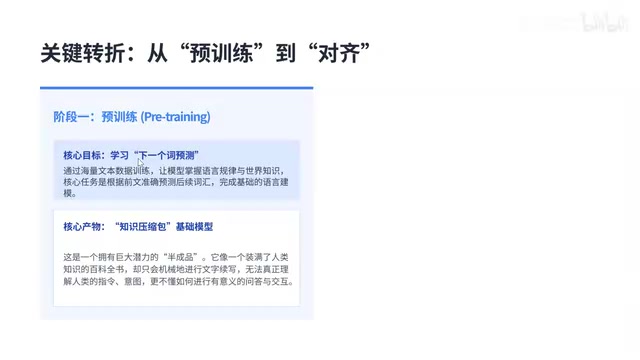
The training process has two main phases. Pre-training aims to teach the model to "predict the next word," using massive text corpora to develop language understanding and world knowledge — essentially building that "compressed archive." But internet data is noisy and contains biased or harmful content, which is why a second phase is needed: instruction fine-tuning and human alignment, which shapes the model to follow human intent and produce controllable, reliable outputs.
The most common technical approach for alignment is RLHF (Reinforcement Learning from Human Feedback). The process works like this: human annotators rank multiple model outputs from best to worst; those preference signals train a "reward model"; then a reinforcement learning algorithm (typically PPO) adjusts the LLM's parameters toward higher-reward outputs. This transforms a model that can "speak" into one that "speaks well" — producing responses that are more helpful, harmless, and honest. A more recent approach, DPO (Direct Preference Optimization), bypasses training a separate reward model entirely by fine-tuning directly on preference-labeled data. It's simpler and has been widely adopted by many open-source models. Understanding this mechanism helps explain why models sometimes seem overly polite or refuse to answer ambiguous questions — these are behavioral imprints left by the alignment phase.
What Is LLM Application Development: From Brain to Digital Employee
This is the central question of the whole article. The answer is clear: LLM application development is not about training a new brain from scratch. It's about taking a brain that already has powerful general capabilities and equipping it with eyes (inputs), hands and feet (tools), memory (databases), and workflows — transforming general-purpose AI into a "digital employee" that understands specific business contexts and executes concrete tasks.
It helps to distinguish two roles. ML/AI engineers are responsible for "building the brain" — designing model architectures, running large-scale training, and tuning parameters to improve general intelligence. This typically requires advanced degrees and elite research teams. Application developers, by contrast, are "building the employee" — no need to master the underlying algorithms. Instead, they work with mature model foundations and use prompt engineering, toolchain integration, and business workflow orchestration to turn general intelligence into usable, valuable products.
Consider this example: GPT is the brain (the model), and ChatGPT is an application. That same underlying model can also power coding tools like Codex, knowledge bases, intelligent customer service systems, and countless other applications. One brain, many models and applications.
Four Key Concepts You Must Understand
Token: The Atomic Unit of Model Understanding
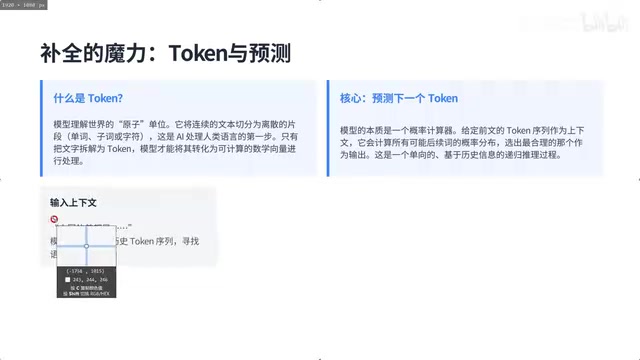
A token is the smallest indivisible unit a model uses to process text — it could be a word, a character, or even a fragment of a word, depending on the tokenization algorithm. API pricing is typically calculated per token. Unlike physical units, token lengths aren't fixed. The model must first break text into tokens, which are then converted into numerical vectors it can compute with.
The Model's Nature: A Probability Calculator
At its core, a model is a probability calculator: given a sequence of tokens as context, it computes a probability distribution over all possible next words and selects the highest-probability one as output, then appends that result to the context and repeats. For example, given "The capital of China is," the model calculates that "Bei" (北) has the highest probability, outputs it, then predicts "jing" (京) — generating "Beijing" through this simple prediction loop. This seemingly straightforward cycle is the underlying logic behind AI's generative capabilities.
Context Window: The Model's Working Memory
The context window is the total number of tokens a model can reference at once during generation — essentially its "working memory." It directly determines how much conversation history the model can retain and how large a document it can process in a single pass. If a model can only handle 2,000 tokens and you give it a 5,000-token document, the output may be incomplete or inconsistent.
There's also a phenomenon called "lost in the middle": models tend to pay more attention to — and better remember — information at the beginning and end of their input, while details buried in the middle of long texts are more easily overlooked. This is a key issue to address when building reliable long-text applications.
Hallucination: Confident, Coherent Nonsense
Hallucination refers to when a model generates content that sounds logically consistent but is actually fabricated. The root cause is that LLMs are probability machines, not information retrieval systems — they predict the next token based on probabilities, and fabrication is a natural byproduct. Hallucinations aren't entirely bad: in creative contexts like fiction writing or image generation, they can be a source of novel ideas.
The Core Challenge in Application Development: Taming Uncertainty
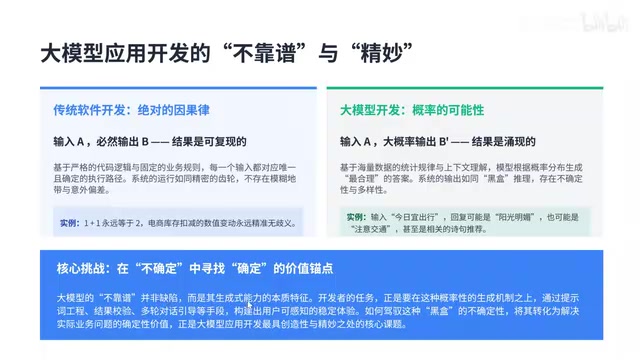
Traditional software follows "absolute causality": input A always produces output B, and results are reproducible. LLMs are probabilistic: input A will probably produce output B, but the same question asked multiple times may yield different answers. This uncertainty is fundamental to the model's generative nature, and the developer's core job is to transform probabilistic outputs into stable, reliable user experiences. There are three main strategies for reducing hallucination and improving consistency.
RAG: Giving the Model an External Knowledge Base
RAG (Retrieval-Augmented Generation) works on the principle of "letting the LLM take an open-book exam with its own reference materials." Instead of sending the user's question directly to the model, the system first retrieves relevant knowledge snippets from a database, then combines those results with the original question before passing everything to the model for generation. This effectively combines the LLM's generative capabilities with the factual accuracy of external data, enabling real-time injection of private knowledge. It's currently the most practical and cost-effective path for enterprise AI deployment, and the primary defense against hallucination.
RAG's technical implementation relies on vector databases and semantic embeddings. Documents are split into chunks, and each chunk is converted into a high-dimensional numerical vector via an embedding model, then stored in a vector database (such as Pinecone, Chroma, or Milvus). When a user asks a question, the question is also converted to a vector, and the database quickly finds the most semantically similar chunks by computing cosine similarity — returning them to the model as context. This differs fundamentally from keyword search: it understands meaning rather than matching literal strings, so even if the question uses different words than the document, semantically similar content can still be retrieved. In practice, chunking strategy (chunk size), embedding model selection, and retrieval result reranking all significantly impact RAG system quality — these are the key areas to tune when deploying in production.
Agent: Giving the Model the Ability to Act
Agents can proactively perceive their environment, autonomously plan task sequences, call tools to take action, and maintain memory with continuous reactivity. They use an LLM as their core cognitive engine: upon receiving a task, the agent first creates a plan (step one, step two, etc.), stores intermediate results, and calls external tools like search, weather APIs, or other services. Tools like Cursor and Codex fall within the agent paradigm, and agents for booking flights, handling finance, generating presentations, and more are proliferating rapidly — this is one of the most important directions in application development.
Prompt Engineering: The Lowest-Barrier Technique
Prompt engineering is the systematic process of designing and optimizing input content — using precise language to clearly communicate intent, constraints, and goals to the model, significantly improving output quality without touching any parameters. Common techniques include setting a role, providing few-shot examples, decomposing tasks, constraining output format, and providing chain-of-thought guidance.
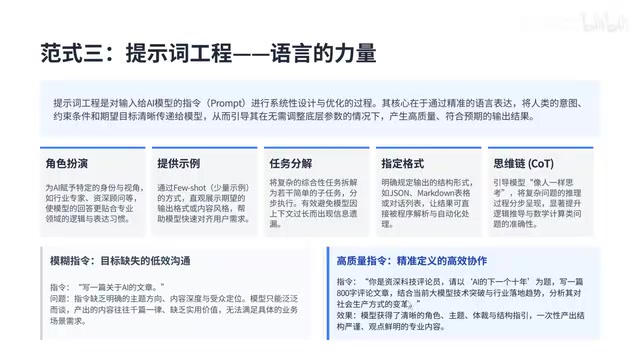
Compare these two approaches: asking "write an article about AI" gets mediocre results. But asking "You are a senior technology commentator. Write an 800-word opinion piece titled 'The Next Decade of AI,' exploring current LLM breakthroughs and industry trends and analyzing their impact on how society produces value" — with a role, task, length, and context — produces noticeably better output.
Development Tools and Model Selection
LLM application development primarily relies on frameworks. LangChain breaks application logic into standard components that developers can freely combine like building blocks, covering the basics of conversation, agents, and tools — well-suited for both RAG and Agent development. LlamaIndex focuses specifically on connecting private data with LLMs, functioning as a semantics-aware, context-aware advanced index — particularly strong in RAG scenarios.
For model selection, the top international tier consists of GPT, Claude, and Gemini (all closed-source) — strongest in capability but expensive. Domestic Chinese models tend to be open-source and more affordable, though generally slightly behind on overall capability. A practical recommendation: use international models for planning and design tasks, and domestic models for execution-heavy workloads, balancing quality and cost.
Beyond LangChain and LlamaIndex, LangGraph and AutoGen are two emerging frameworks worth watching. LangGraph is an extension within the LangChain ecosystem designed specifically for building multi-step, stateful agent workflows — it uses directed graphs to describe task nodes and conditional branches, making it well-suited for complex scenarios requiring cyclical reasoning or multi-turn tool calls. Microsoft's open-source AutoGen focuses on multi-agent collaboration, allowing multiple agents to take on different roles (e.g., programmer, reviewer, project manager) and converse with each other to complete tasks cooperatively — it excels at code generation and complex problem-solving. On the deployment side, Ollama lets developers run open-source models (like Llama, Mistral, Qwen, etc.) locally with a single command, making it extremely useful for scenarios with data privacy requirements or for zero-cost local debugging — a common choice for local development environments.
Application Areas and Evaluation Criteria
LLMs can be applied across a wide range of areas: intelligent customer service, knowledge management (knowledge bases), content generation (short video scripts, fiction), software development (tools like Codex), data analysis, personalized education and learning, and more.
Evaluating the quality of an application comes down to two categories of metrics. Technical metrics: answer accuracy, content relevance, and response latency. Business metrics: user satisfaction, task completion rate, and cost optimization rate. These are critical benchmarks for real-world application work.
A final note on role positioning — application developers are "intelligent orchestrators" who connect models, technology, and user value. The key skills are prompt design, model selection and evaluation, workflow orchestration, and product thinking. In the LLM era, the boundary between product manager and engineer is blurring — they're often the same person. As the saying goes: the best way to predict the future is to build it. The wave of LLM application development is only just beginning.
Related articles
vLLM v0.30.0rc1 Released: Isolates FlashInfer BF16 Autotuning Logic
vLLM v0.30.0rc1 release candidate fixes FlashInfer BF16 autotuning isolation (PR #57285). Learn the technical background and its impact on inference deployment.
Comp AI Raises $34M Series A, Bets on Agentic Security Compliance
Comp AI raises $34M Series A led by Roo Capital and Grand Ventures, betting on "continuously agentic" AI to transform compliance from periodic audits into real-time monitoring.
MIT Technology Review's 35 Innovators Under 35: A Climate Tech Edition Explained
MIT Technology Review's latest 35 Innovators Under 35 list focuses on climate tech, spotlighting nine young global innovators. Here's what the list means and why it matters.