LLM Development Learning Path: From Zero to Enterprise-Level Projects

A structured 5-stage learning path from LLM basics to enterprise-level AI application development.
This article outlines a complete, five-stage learning path for LLM application development — covering LLM fundamentals, RAG knowledge bases, AI Agents, model fine-tuning, and hands-on projects. It explains core concepts like Transformer architecture, RLHF, LoRA, and MCP, and provides practical guidance on tools like LangChain, LlamaIndex, and LangGraph for building real-world enterprise AI applications.
From prompt engineering to RAG knowledge bases, from AI Agents to model fine-tuning, large language model (LLM) application development has evolved into a relatively mature technology stack. This article, based on a systematic introductory LLM course, maps out a complete technical learning path — from understanding the fundamentals of LLMs to delivering enterprise-grade projects — helping beginners build a clear knowledge framework.
Five Stages of LLM Development Learning
A complete LLM development learning journey can be broken down into five progressive stages: LLM Fundamentals, RAG Knowledge Base Development, AI Agent Development, Model Fine-Tuning, and Hands-on Projects. This structure follows a clear logic — first understand the underlying principles, then master application techniques that require no training cost (RAG, prompt engineering), then move into agent development that demands more engineering skills, and finally tackle the more resource-intensive domain of model fine-tuning.
For beginners, this order matters greatly. RAG and prompt engineering are "low-cost, high-return" techniques that require no GPU to get started, while fine-tuning requires a GPU and a compute platform. Starting with easier, application-focused topics before moving to model training is simply a more practical learning curve. One often-overlooked detail: your environment only needs Python 3.10 or higher — earlier versions will prevent certain LLM libraries from working.
Understanding LLMs: From AI 1.0 to AI 2.0
To truly master LLM development, you first need to understand what LLMs are and why they're so powerful. Framing artificial intelligence as two distinct eras is a useful perspective.
The Era of Perceptual Intelligence (AI 1.0)
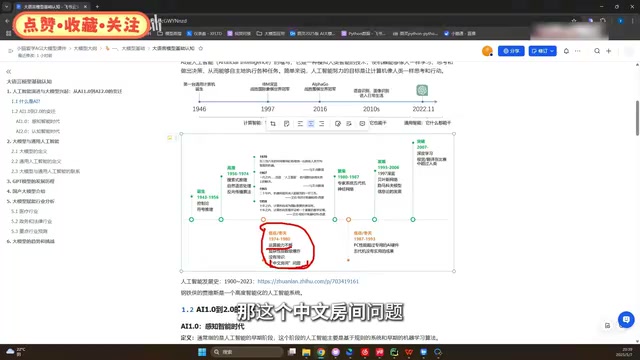
AI 1.0, known as the "perceptual intelligence era," focused on giving machines human-like sensory capabilities: computer vision, image recognition, OCR, speech recognition and synthesis. Everyday applications like facial payment, access control, Siri, and smart speakers all belong to this era.
But AI 1.0 had three major limitations: heavy reliance on manually labeled data, narrow single-task capabilities lacking generalization, and a lack of true comprehension. For example, when you told an early AI system "I'm tired," it could only respond with a scripted reply like "Then get some rest" — it couldn't ask why you were tired or express genuine concern.
The Era of Cognitive Intelligence (AI 2.0)
AI 2.0 is the era we're in today. Its defining characteristic is that machines don't just "perceive" data — they "understand" its meaning and make intelligent decisions. This era brings reasoning and comprehension, cross-domain applicability, adaptive learning, and multimodal fusion. Complex applications like medical diagnosis assistance, legal consulting, and personalized education are now becoming possible.
GPT's Evolution and the Essence of LLMs
At their core, LLMs (Large Language Models) are machine learning and natural language processing systems trained on massive text datasets to learn how to understand and generate human language. The driving force behind this wave is the continuous iteration of the GPT series.
From GPT-1 in 2018 (Transformer-based, 117M parameters) to GPT-2 (1.5B), GPT-3 (175B), and the multimodal GPT-4, both parameter scale and capabilities have grown exponentially. GPT-4 supports both text and image input, and through Reinforcement Learning from Human Feedback (RLHF), it has achieved significant gains in safety and controllability.
Deep Dive: Transformer Architecture and the Significance of Scale
The Transformer architecture is the foundation of modern large language models. Introduced by Google in the 2017 paper Attention Is All You Need, it replaced the previously dominant RNN/LSTM approach with a "self-attention mechanism," enabling parallel processing of sequential data and capturing long-range dependencies. The exponential growth in parameter count gave rise to "emergent abilities" — capabilities like reasoning and few-shot learning that appear suddenly once a model crosses a certain scale threshold, something smaller models simply cannot do. This is the core driver of the LLM revolution.
The RLHF pipeline has three steps: first, fine-tune the base model with supervised learning; second, train a "reward model" to simulate human preference scoring; third, use a reinforcement learning algorithm like PPO to optimize the language model so it generates outputs aligned with the HHH principles (Helpful, Harmless, Honest). The leap in safety and usefulness from early GPT-3 to ChatGPT is largely RLHF's doing. More recently, DPO (Direct Preference Optimization) has gained popularity as a simpler alternative.
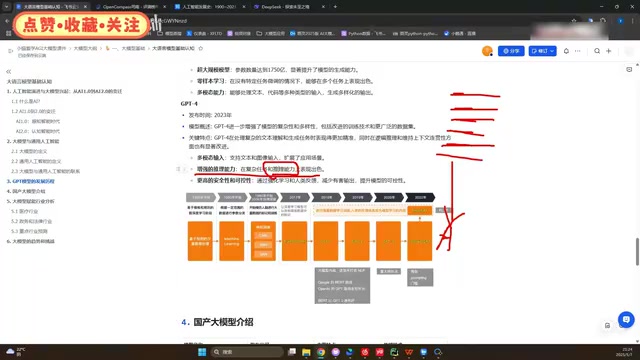
Here's a critical distinction that often confuses beginners: conversational products and base LLMs are two different things. DeepSeek R1 and GPT's o1/o3-mini are base LLMs, while the DeepSeek chat interface and ChatGPT are conversational products built on top of those base models. Enterprise development is always based on the base LLM, typically accessed via API.
On the domestic model front, Alibaba's Qwen, Zhipu GLM, Baidu's ERNIE, and DeepSeek are all strong options. For learning purposes, Qwen is recommended — registering on the Alibaba Cloud Bailian platform gives you 1 million tokens for free, with fast response times that are more than sufficient to complete a full course.
RAG and Agents: The Two Pillars of LLM Application Development
RAG Knowledge Bases: Solving Hallucination and Timeliness Issues
LLMs have a training data cutoff date, which creates timeliness issues, and they're prone to "hallucinations." Two solutions exist: RAG (Retrieval-Augmented Generation) and fine-tuning. A helpful analogy: RAG is like "copying from the answer sheet" during an exam, while fine-tuning is "studying the material from scratch." RAG is lower cost and faster to implement, making it the most widely adopted approach in enterprise applications today.
Deep Dive: How RAG Works
The RAG pipeline breaks down into three phases: Indexing, Retrieval, and Generation. In the indexing phase, enterprise documents are split into text chunks, converted into high-dimensional vectors by an embedding model (e.g., text-embedding-ada-002), and stored in a vector database (e.g., Faiss, Milvus, Chroma). In the retrieval phase, the user's query is also vectorized and used for similarity search (cosine similarity or ANN approximate nearest neighbor) to fetch the top-K most relevant document chunks. In the generation phase, the retrieved context and original question are assembled into a prompt for the LLM to synthesize an answer. Advanced RAG builds on this with query rewriting, hybrid retrieval (semantic + keyword), and reranking, which significantly improve recall precision and address the core problem of naive RAG: too much retrieval noise.
That said, basic (naive) RAG has a notable shortcoming — it may retrieve documents that are completely unrelated to the question. This is why Advanced RAG is needed, with pre- and post-retrieval optimizations and an evaluation mechanism to "grade the homework" and verify system quality. On the framework side, LangChain handles end-to-end application building, while LlamaIndex specializes in document loading and retrieval — they're often used together. Open-source RAG application platforms like Dify and FastGPT are also popular choices.
AI Agents: Giving LLMs "Arms"
If an LLM is "the brain," then an AI Agent is "the arms" — it enables the model to actually execute tasks. The core capability of an Agent is task decomposition and tool invocation — when a question can't be answered directly (like querying real-time weather), the Agent calls an external tool to retrieve the result.
This capability ties closely to the recently popular concept of MCP (Model Context Protocol). MCP is an open standard proposed by Anthropic in late 2024 that defines a unified communication specification for AI Agents to call external tools: tool providers publish an MCP Server, and Agents act as MCP Clients to call it via the protocol — enabling a "build once, connect everywhere" model. Claude, Cursor, and other mainstream AI products already support MCP, with an ecosystem covering hundreds of use cases including file systems, databases, web browsing, and code execution. It's often called the "USB standard" for AI Agent tool integration, significantly lowering the integration cost of Agent systems.
Taking it further, multi-Agent systems simulate the collaborative dynamics of a software development team: product manager, project manager, frontend developer, and backend developer each play their role, with each Agent focused on a specific stage before handing off to the next. The LangGraph framework (from the same family as LangChain) makes it fast to build these multi-agent systems, using a directed graph to define state transitions and collaboration logic between Agents.
Model Fine-Tuning and Quantization: Advanced-Stage Core Techniques
When RAG isn't sufficient for specialized domain needs, fine-tuning becomes necessary. Open-source models on the market (DeepSeek, GLM, Qwen, Llama) are all pretrained models — they have broad general knowledge but lack depth in specialized areas and have no access to proprietary enterprise data. Fine-tuning means retraining with a specialized dataset so the model excels in a specific domain.
Fine-tuning comes in two forms: full fine-tuning (resource-intensive) and parameter-efficient fine-tuning. The most mainstream efficient approach is LoRA (Low-Rank Adaptation): rather than modifying the model's original weight matrices directly, LoRA injects two small low-rank matrices A and B as a side branch (with very few parameters), updating only those matrices during training and then merging them back into the original weights at inference. For a model with hundreds of billions of parameters, LoRA achieves results close to full fine-tuning by training less than 1% of the parameters, bringing VRAM requirements down from hundreds of GBs to what a single consumer-grade GPU can handle. QLoRA goes further by combining 4-bit quantization, making it possible to fine-tune a 33B model on a single 24GB GPU — the current industry-standard choice.
Model quantization is another important compression technique, essentially a precision reduction: model weights are converted from float16 (16-bit) to int8 (8-bit integer) or even int4 (4-bit), cutting model size in half or to a quarter. Take the full DeepSeek 671B model as an example — FP16 precision requires roughly 1,340GB of VRAM, while the 4-bit quantized version requires only around 400GB, making deployment on a consumer-grade GPU cluster feasible. Common quantization methods include GPTQ (post-training quantization with low accuracy loss), AWQ (activation-aware weight quantization), and GGUF format (used by llama.cpp, suitable for CPU inference). Combined with distillation and pruning, quantization dramatically lowers the barrier to private deployment. As a rough guide for local deployment VRAM requirements: 24GB VRAM can run a 32B model, while 8GB VRAM can only run a 1.5B small model.
From Learning to Deployment: Projects and Industry Applications
The complete learning path ultimately culminates in four real-world enterprise projects: a knowledge base platform for a large manufacturing enterprise, a customer service Agent for a retail company, an AI-powered intelligent monitoring and prediction system for a video platform, and an AI family doctor for healthcare.
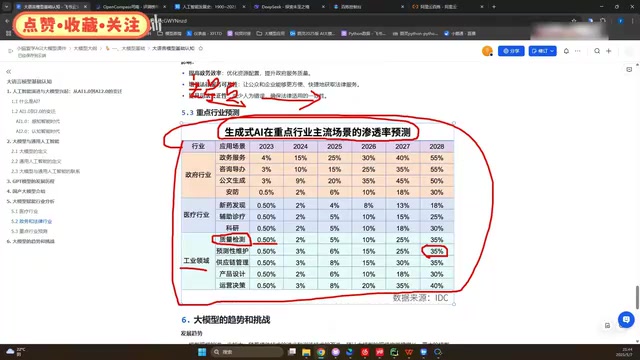
From an industry perspective, LLMs are deeply penetrating sectors including healthcare (assisted diagnosis, drug development), government and legal services (intelligent customer service, policy analysis, legal document generation), and manufacturing (quality inspection penetration rates are expected to grow substantially). Today's job market values hands-on project experience most. RAG has become the mainstream enterprise application approach due to its low cost and strong results, while Agents are the area that major tech companies are currently investing heavily in.
It's worth being clear-eyed about the real challenges: LLMs also face issues around ethical safety, data privacy, and resource consumption. Many companies explicitly prohibit employees from using the public cloud versions of DeepSeek or ChatGPT due to concerns about proprietary data leakage — which, in turn, illustrates the real-world value of local deployment and private fine-tuning. For learners, mastering this complete technology stack — from fundamentals to production — is the critical step to breaking into the LLM development field.
Related articles

Kimi K3 Deep Dive: 2.8 Trillion Parameter Open-Source Model Closes the Gap with Closed-Source Frontier for the First Time
Moonshot AI releases Kimi K3 open-weight model with 2.8T parameters and 1M token context. Our deep dive covers coding, 3D dev, agent capabilities, and safety concerns.

How to Choose an AI Agent Platform for Your Team: 5 Evaluation Dimensions and a Decision Framework
Choose the right AI Agent platform by evaluating model flexibility, observability, tool integration, security compliance, and total cost. A complete decision framework to help technical leaders avoid vendor lock-in.

Legora's Legal AI Practice: How Vertical AI Empowers Law Firms and Corporate Legal Transformation
Explore Legora's legal vertical AI practice, covering AI model selection strategies, enterprise legal transformation challenges, and the path to deploying vertical AI in the legal industry.