redu.cloud: A High-Speed Cloud Platform Built for AI Agents

redu.cloud launches a cloud platform for AI agents, focused on ultra-fast provisioning of stateful resources.
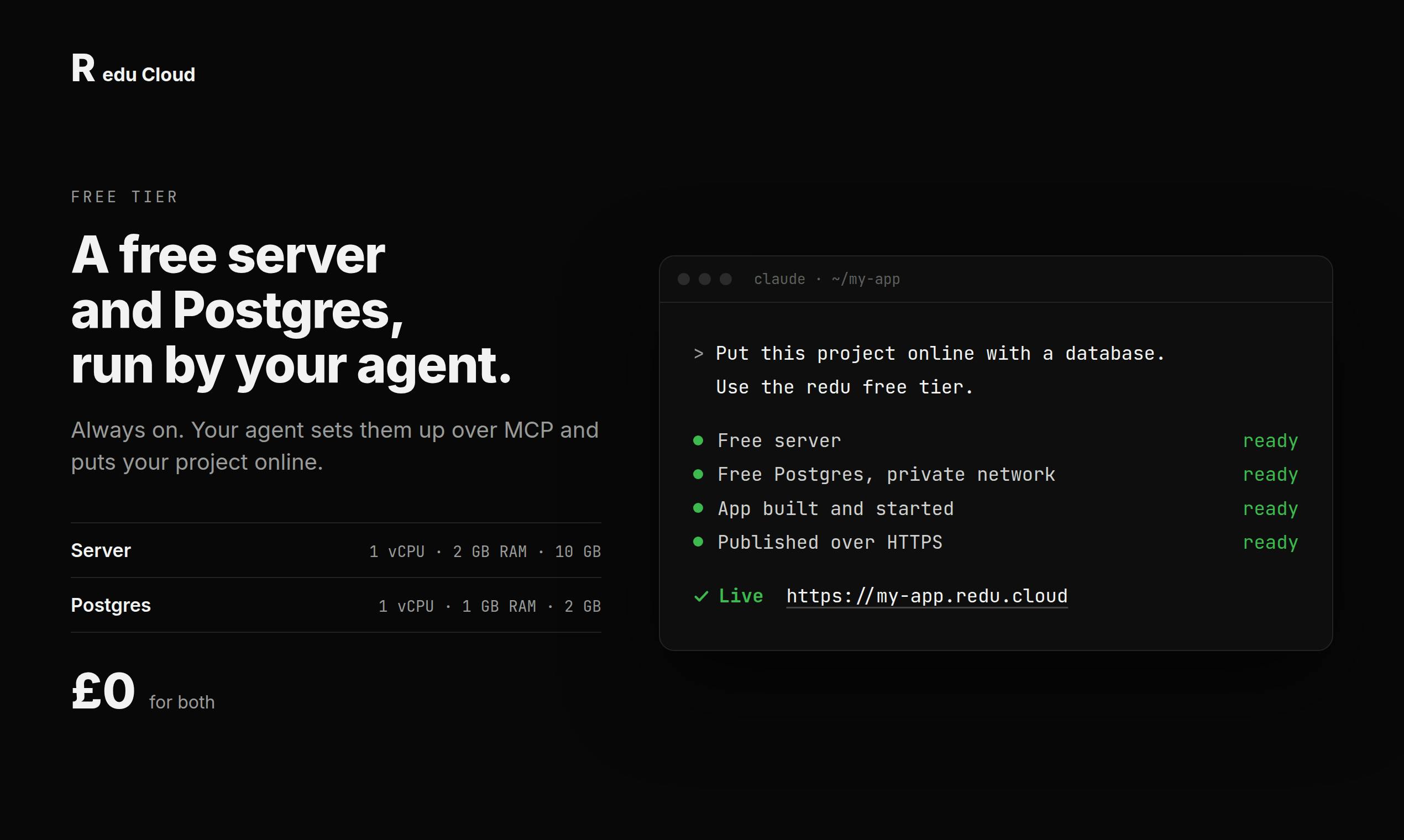
redu.cloud has launched a platform on Product Hunt positioned as an "AI agent-exclusive cloud," aiming to let agents obtain cloud resources at their own speed rather than human speed. Traditional cloud services rely on manual approval and minute-level provisioning, which cannot match the continuous, concurrent, automated rhythm of agents. redu.cloud focuses on fast provisioning of stateful resources (databases, storage volumes, running instances), covering four time-sensitive scenarios: application deployment, DevOps, stateful model training, and production outage remediation. It offers a generous free tier. The product received 68 votes on Product Hunt, ranking 14th for the day—a moderate response, but with clear niche positioning. As agents move from demos to production, demand for such infrastructure will grow, though actual performance and differentiation still need real-world verification.
redu.cloud: A High-Speed Cloud Platform Built for AI Agents
When AI agents need to deploy applications, train models, or fix production outages, traditional cloud infrastructure often becomes a bottleneck—human-speed resource provisioning simply can't keep up with an agent's automated pace. redu.cloud has proposed a solution on Product Hunt that tackles this pain point head-on: a cloud platform built for AI agents, with a tagline that captures the core philosophy precisely: "Run machines at agent speed, not human speed."
Why Do Agents Need a Dedicated Cloud?
Traditional cloud services are designed around human workflows: manually requesting resources, waiting for approval, configuring environments—the whole process is measured in minutes or even hours. But AI agents operate continuously, concurrently, and automatically. They need instant access to stateful resources to efficiently handle deployment, DevOps, stateful model training, and similar tasks. According to the Product Hunt page, redu.cloud lets agents obtain the resources they need at extreme speed, while emphasizing "safely"—security is not compromised for speed.
This positioning fills a market gap. Most current agent tools focus on logic orchestration or API calls, but few platforms specifically optimize the latency of underlying resource provisioning. redu.cloud turns its attention to the even more foundational infrastructure layer.
The distinction between stateful resources and stateless resources is key to understanding this need. Stateless resources (such as serverless functions and ephemeral containers) do not retain any session data; each invocation is independent. Stateful resources (such as databases, persistent storage volumes, long-running service instances, and model checkpoints) preserve data and context across their runtime. When AI agents execute multi-step tasks, they often need to pass and accumulate state across steps—for example, maintaining a database connection during application deployment or saving checkpoints during model training. Traditional cloud platforms typically take minutes to provision and initialize stateful resources, whereas an agent's concurrent workflows may need to create or destroy such resources every second, creating a significant latency bottleneck. redu.cloud's claimed "instant access" targets exactly this pain point, attempting to compress stateful resource provisioning latency down to a level that matches the agent's decision loop.
Core Capabilities and Use Cases
According to the official description, redu.cloud's core value is reflected in several aspects:
1. Fast Provisioning of Stateful Resources
When completing tasks, agents frequently depend on stateful resources such as databases, storage volumes, and running service instances. redu.cloud claims it can provide these resources "extremely fast," so agents don't idle while waiting. This is especially critical for scenarios that require frequently creating temporary environments.
The scenario of "stateful model training" deserves separate mention. Conventional model training is usually treated as a stateless batch task: read the dataset, train, output weights. But in agent-driven training, the model may need to continuously update its state based on environmental feedback (such as online learning or environment interaction in reinforcement learning), or the training process may need to retain intermediate checkpoints for fault recovery. Such training tasks depend more heavily on persistent storage and running instances, and are sensitive to resource launch speed—agents need to iterate and roll back quickly. By listing "training stateful AI models" as a core scenario, redu.cloud implies that its resource provisioning mechanism must support fast mounting of persistent volumes and rapid rebuilding of instances, which is a higher technical bar than simply providing stateless compute instances.
2. Coverage of Typical Agent Workflows
The product explicitly lists four categories of scenarios:
- Application deployment: Agents automatically complete the release process
- DevOps tasks: Continuous integration, environment management, and similar operations
- Training stateful AI models: Training tasks that require persistent state support
- Fixing production outages: Quickly spinning up diagnostic environments when incidents occur
What these scenarios share is time sensitivity—human-speed responses often miss the optimal window.
3. A Generous Free Tier
redu.cloud offers a "generous free tier," lowering the barrier for developers and agent builders to try it out. Although the specific quota is not disclosed in the source material, this strategy helps attract early users to validate use cases.
Market Reception and Positioning Analysis
On Product Hunt, redu.cloud received 68 votes and 2 comments, ranking 14th for the day. That result isn't particularly outstanding in the highly competitive developer tools category, but considering the product targets the relatively niche "agent infrastructure" market, its precise positioning is worth noting.
From an industry trend perspective, AI agents are moving from demos to production environments, and the demand for underlying resource scheduling speed will only grow. If redu.cloud can deliver on its promises of stability and security, it has the potential to become one of the infrastructure options for the agent era. However, public information is currently limited, and actual performance, the range of resource types covered, and differentiation from other cloud providers still require more real-world data to verify.
Product Hunt's ranking and voting mechanism helps clarify what the data in this article means. Product Hunt ranks each day's launched products by user votes; 14th place means a mid-to-upper position among all products launched that day. 68 votes is a moderate level for developer tools—popular products typically receive hundreds of votes. It's worth noting that Product Hunt votes reflect more the exposure and community engagement on launch day than long-term product quality. For B2B developer tools targeting a niche market (agent infrastructure), a low vote count does not directly equate to low value, but it does indicate limited mainstream awareness. The "2 comments" mentioned in the article also suggest relatively little early user interaction, meaning the product is still in the validation stage.
Conclusion
redu.cloud puts forward a clear proposition: cloud platforms need to be redesigned for the pace of agents. It targets the specific need for fast provisioning of stateful resources and offers a free tier as an entry point. For teams building automated agent workflows, this is a new option worth keeping an eye on.
One-line Summary
redu.cloud launches a cloud platform designed for AI agents, focused on ultra-fast provisioning of stateful resources.
Paragraph Summary
redu.cloud has launched a platform on Product Hunt positioned as an "AI agent-exclusive cloud," with the core idea of letting agents obtain cloud resources at their own speed rather than human speed. The article notes that traditional cloud services are designed around manual approval and minute-level provisioning, which cannot match the continuous, concurrent, automated work rhythm of agents. redu.cloud focuses on fast provisioning of stateful resources (databases, storage volumes, running instances), covering four time-sensitive scenarios—application deployment, DevOps, stateful model training, and production outage remediation—and offers a generous free tier to lower the barrier to entry. The product received 68 votes on Product Hunt, ranking 14th for the day, indicating a moderate market response, but its niche positioning is clear. The article argues that as agents move from demos to production, demand for this kind of infrastructure will grow, but actual performance and differentiation still need to be verified through real-world testing.
Related articles

Full AI Comic Drama Workflow with WorkBuddy: 8 Steps from Zero to Final Cut
A complete eight-step WorkBuddy workflow for making AI comic dramas: topic planning, script and storyboard, image assets, video generation, voiceover, editing, and publishing, plus WorkBuddy's expert-skill mechanism and tips for summoning experts one by one. Suitable for beginners.

Codex Practical Tutorial: From Installation to Multi-Agent Collaboration
Based on a Bilibili Codex practical tutorial, this article systematically covers installation and configuration, CLI interaction, slash commands, AGENTS.md architecture, the MCP protocol, multi-agent collaboration, and enterprise plugin development, helping developers understand engineering usage of AI Agents.

AI Agent Practical Guide: Building an Enterprise-Grade Agent from Scratch
A beginner-friendly guide to AI Agents: the difference from traditional programs, the perception-decision-action loop, technical evolution, the enterprise tech stack (LLM, tool calling, memory, RAG), and use cases.